
Developmental Disabilities and Eugenics
Phrenology, IQ testing, forced sterilization, and the institutions built for children labelled feebleminded, through to aversive behaviorism.

New York Public Library, Public domain, via Wikimedia Commons
1500 to 1799 #
- 1730s–1790s – Early Taxonomies of Human Difference
- Carl Linnaeus and Johann Blumenbach classified humans into racial and biological types. Later foundational for eugenics.
- 1762 – Jean-Jacques Rousseau Publishes Émile, or On Education
- Proposes that childhood unfolds in natural stages, each with its own needs and characteristics.
- Argues that children are fundamentally different from adults, and that rushing their development causes harm.
- Emphasizes observation, patience, and individualized instruction—especially in early childhood.
- Legacy: Establishes the idea of age-based developmental norms, against which later deviations could be measured and pathologized.
- 1796 – Theory of Craniometry Introduced
- Franz Joseph Gall began presenting his theory that the brain consists of distinct organs controlling specific traits, and that these can be measured via skull shape.
- Gall’s early work focused on children and criminals, claiming he could identify “natural” dispositions through cranial anatomy.
1800s #
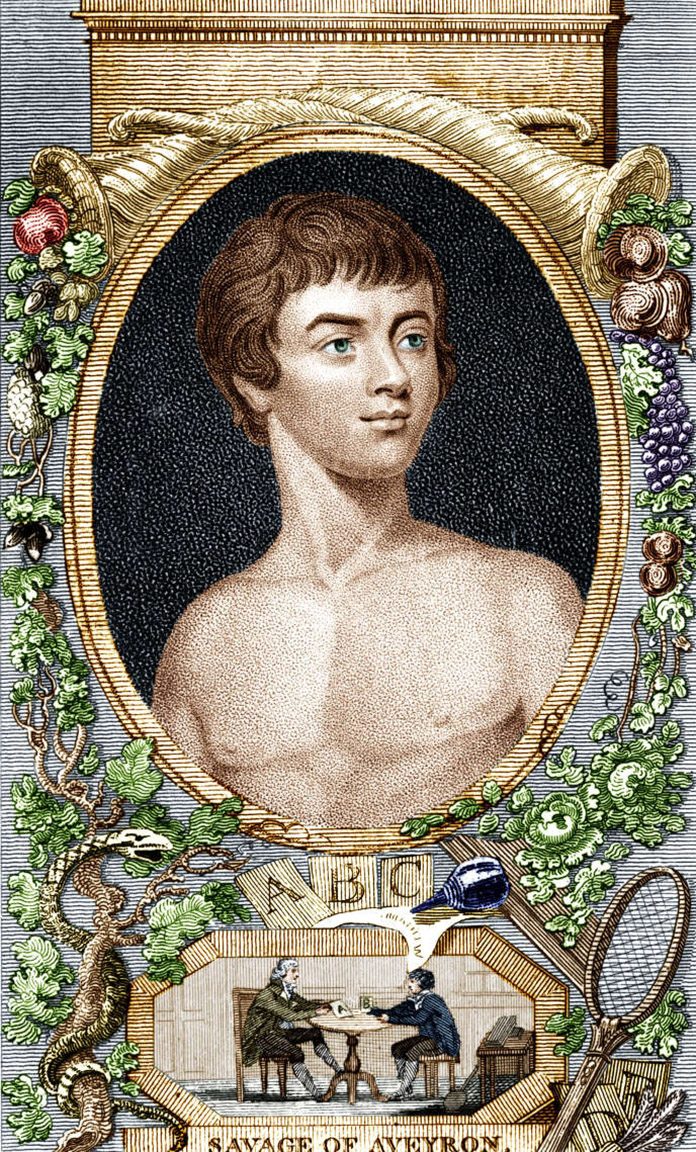
- 1801–1807 – Jean Marc Gaspard Itard Documents Work with Victor of Aveyron
- Attempted to “civilize” a so-called “feral child” using sensorimotor training and structured routine. His failure to bring Victor to full speech or social engagement leads to speculation that some children may be biologically incapable of normal development.
- 1809–1819 – Development of the Organ Map
- Gall refines his list of cerebral “organs” and their corresponding locations on the skull.
- His unpublished manuscripts circulate widely among European intellectuals.
- 1815–1832 – Popularization of Phrenology by Johann Spurzheim
- Spurzheim breaks with Gall and coins the term phrenology.
- Promotes phrenology as a tool for education, moral reform, and child development.
- Key publications:
- 1815 – The Physiognomical System
- 1825 – Philosophical Principles of Phrenology
- 1821 – A View of the Elementary Principles of Education
- 1835 – American Adoption of Phrenology
- Orson and Lorenzo Fowler began publishing and lecturing in the U.S.
- Established the American Phrenological Journal in 1838.
- Phrenology was adopted in schools, prisons, and asylums.
- Children are a central focus: phrenologists claim early skull readings can predict criminality, genius, or moral failure.
- Orson and Lorenzo Fowler began publishing and lecturing in the U.S.
- 1838 – Ex parte Crouse Decided
- A landmark Pennsylvania Supreme Court case upheld the state’s right to institutionalize minors without due process if it was deemed to be for their “moral well-being.” This decision cemented the doctrine of parens patriae, granting the state broad authority over children in need of “reform.”
- 1842 – First School for “Idiotic” Children in Paris
- Édouard Séguin established a Bicêtre under the mentorship of Jean Itard (who had worked with Victor of Aveyron).
- This school emphasized moral treatment, sensory education, and physical training.
- It was the first systematic effort to educate intellectually disabled children using structured pedagogy.
- He published Traitement moral, hygiène, et éducation des idiots in 1846, outlining his methods.
- The school was shut down in 1848 during political unrest in France, and Séguin emigrated to the U.S.
- 1845 – Lunacy Act (England and Wales)
- Established the Lunacy Commission: A new central body with the power to inspect, regulate, and standardize all asylums, both public and private.
- Mandated Record-Keeping: Institutions were now required to keep registers of inmates, including detailed reports.
- Redefined Legal Insanity: Codified definitions and procedures for classifying people as “lunatics” or “idiots.”
- Extended Custodial Reach: Gave magistrates and Poor Law authorities more power to remove individuals from families and place them in asylums, including children with intellectual disabilities or behavioral issues.
- 1847 – Randall’s Island Asylum for Idiots Opens (New York)
- One of the earliest custodial institutions for “idiotic” children in the United States. Reflected growing belief that children with cognitive and behavioral differences should be removed from public life.
- 1848 – The Experimental School for Teaching and Training Idiotic Children Founded.
- Later renamed The Fernald Center, this was one of the first U.S. institutions specifically for children with developmental disabilities.
- School administrators included known eugenicists who promoted the segregation of mentally disabled children.
- 1860s – John Langdon Down Classifies ‘Ethnic Types’ of Idiocy
- As superintendent at Royal Earlswood Asylum in England, Down publishes racialized taxonomies of children with disabilities. His 1866 paper Observations on an Ethnic Classification of Idiots introduces the term “Mongoloid” to describe what is now known as Down syndrome. Children are the primary subjects of his theories.
- 1876 – Association of Medical Officers of American Institutions for Idiotic and Feebleminded Persons Founded
- Édouard Séguin serves as first president. The organization formalizes medicalized approaches to child disability, promoting life-long institutional care and early identification of children with perceived defects.
- 1876 – Cesare Lombroso publishes The Criminal Man: Introduces the theory of the “born criminal,” claiming certain individuals are biologically predisposed to crime. Though later discredited, Lombroso’s framework of classification based on physical and psychological traits influenced U.S. child-saving institutions, contributing to the rise of diagnostic sorting, eugenic labeling, and indefinite confinement of children deemed “defective.”
- 1883 – “Eugenics” Popularized by Sir Francis Galton
- The eugenics movement influenced psychiatric discourse on hereditary mental illness and reinforced the belief that children with mental disorders might pose a societal risk. The growing acceptance of eugenics contributed to increased institutionalization and the belief that “undesirable” traits should be managed through segregation and control.
- 1888 – Vineland Training School Founded
- Originally The New Jersey Home for the Education and Care of Feebleminded Children
- Psychological Research Laboratory founded in 1906.
- 1890 – The New York Child Study Association Founded
- This group promoted psychological research on childhood behavior and mental illness, marking an early attempt to apply scientific methods to child psychology—though much of the research still framed bad behavior as a moral failing.
- 1892 – American Medico-Psychological Association Recognizes ‘Insanity in Children’
- The precursor to the APA formally identified childhood insanity as a medical category. This pathologized non-normative child behavior and legitimized asylum expansion for children.
- 1896 – Plessy v. Ferguson Decided
- The Supreme Court’s ruling on segregation reinforced racial disparities in institutional care, with Black children often placed in inferior facilities with harsher conditions.
- 1896 – The First U.S. Child Psychiatric Clinic Opens at the University of Pennsylvania
- Psychologist Lightner Witmer established this clinic to begin formally studying mental illnesses in children. However, early child psychology still focused more on correction than support.
1900 to 1949 #
- 1902 – Amos Johnson opens Harper Cottage for “fallen women” at the Indiana School.
- Designed as a sanctuary for women and to prevent “the next generation of mental defectives.”
- A. W. Wilmarth notes that female “imbeciles” are given less freedom than males.
- 1905 – Binet-Simon Test Developed
- Alfred Binet and Théodore Simon created the first modern IQ test to identify schoolchildren needing help in Paris. It is later exported to the U.S. and reframed as a tool for measuring innate intelligence.
- 1907 – Indiana Sterilization Law
- First forced sterilization law in the U.S. aimed at “defectives.”
- 1908 – Henry Goddard Brings IQ Testing to the U.S.
- At Vineland Training School, Goddard translated and adapted the Binet test into English. He coined the term “moron” in 1910 and uses the test to argue for hereditary feeblemindedness.
- 1909–1917 – State Sterilization Laws Expand Rapidly
- Following Indiana, over 15 states pass laws allowing sterilization of the “feebleminded,” often targeting institutionalized youth. These include California (1909), Washington (1909), Connecticut (1909), and Virginia (1916). California becomes the most aggressive, sterilizing more than 20,000 people, many of them adolescents in state care.
- 1912 – Helena Devereux Opens Private School for Disabled Children
- Beginning as a small school for children with developmental and behavioral challenges in Pennsylvania, this initiative evolved into the Devereux Foundation—one of the largest nonprofit behavioral health providers in the U.S.
- 1915 – Sonia Shankman Orthogenic School Founded
- Established in Chicago as a day school to observe children with behavioral challenges. Later expanded to include residential services and became a pioneer in therapeutic milieu therapy.
- 1917 – National Committee for Mental Hygiene Expands to Schools
- Launches programs promoting mental health education and psychological screening for children, integrating mental hygiene ideology into public institutions.
- 1920s – Charles Bernstein at the Rome State School pioneered a system of “colonies” and parole, allowing inmates to work in rural or urban settings, often for private farmers or factories.
- By 1928, he had opened “fifteen colonies for women” and eventually sixty-two for all groups. He was able to “parol[e] inmates after a time of useful work and good behavior in the colony to work on privately owned farms.” This challenged the prevailing view of permanent segregation.
- 1926 – Southard School Established
- Founded as the children’s division of the Menninger Clinic in Topeka, Kansas. Originally intended for children with intellectual disabilities, it gradually became a prototype for psychoanalytically oriented RTCs.
- 1927 – Buck v. Bell
- U.S. Supreme Court upholds Virginia’s Eugenical Sterilization Act.
- Carrie Buck, a teen institutionalized at the Virginia Colony for Epileptics and Feeble-Minded, was deemed “unfit to reproduce.”
- Legalized forced sterilization of institutionalized youth.
- Oliver Wendell Holmes writes: “Three generations of imbeciles are enough.”
- 1933 – Nazi Germany: Law for the Prevention of Hereditarily Diseased Offspring
- Enabled forced sterilization of people with disabilities, including thousands of institutionalized children labeled as “feebleminded,” epileptic, schizophrenic, or “asocial.”
- 1935 – Devereux Foundation Formally Incorporated
- Initially served “mental defectives,” later rebranded as therapeutic I/DD care.
- 1939 – Nazi Germany: Child Euthanasia Program Begins
- In July 1939, Hitler authorized a secret program (via oral directive) to murder disabled infants and children deemed “unfit to live.”
- Known later as “Kindereuthanasie” (“child euthanasia”), it specifically targeted:
- Children with intellectual disabilities
- Those with physical deformities or chronic illness
- Often institutionalized or reported by doctors, midwives, and social workers
- 1943 – Leo Kanner publishes “Autistic Disturbances of Affective Contact”
- Describes 11 children with early-onset social withdrawal, resistance to change, rote memory, and lack of “affective contact”
- Coins the term “infantile autism” and introduces it as a formal diagnosis in U.S. psychiatry
- Popularizes the “refrigerator mother” theory
- Attributes autism to cold, unloving parenting
- Describes parents as “just happening to defrost enough to produce a child”
- Leads to decades of mother-blame, family separation, and institutionalization
- Advocates for institutional placement
- Promotes “protective environments” outside the home
- Reinforces the idea that autistic children are unfit for family life
1950 to 1979 #

- 1961 – JFK’s Panel on Mental Retardation
- Calls for deinstitutionalization but leads to growth in private RTCs.
- 1963 – Community Mental Health Act
- Signed by JFK, this act funds the construction of community-based mental health centers. Intended to replace large institutions, but underfunding and lack of follow-through lead to gaps filled by private facilities.
- 1965 – Medicaid/Medicare Funding
- Enables new funding streams for private I/DD residential services.
- 1965 – “Building Social Behavior in Autistic Children by Use of Electric Shock”
- Published by Ivar Lovaas, Benson Schaeffer and James Q. Simmons in the Journal of Experimental Research in Personality, vol. 1
- At UCLA, Lovaas began conducting behavioral modification experiments on autistic children using electric shocks, slaps, shouting, and physical punishment to suppress behaviors like hand-flapping, head-banging, or not responding to commands.
- Developed a regimen of contingent aversives including electric shocks and hitting, often administered for minor infractions such as noncompliance or stimming.
- 1968 – Applied Behavior Analysis (ABA) Named and Defined
- Baer, Wolf, and Risley publish the seminal article “Some Current Dimensions of Applied Behavior Analysis,” formalizing ABA as a discrete field. Initially used with developmentally disabled and autistic children to enforce compliance and extinguish behaviors.
- 1971 – Judge Rotenberg Center (JRC) Founded
- Originally Behavior Research Institute, founded by Matthew Israel. Known for aversive conditioning and shock therapy.
- 1975 – Education for All Handicapped Children Act (EHA)
- Guarantees education in least restrictive environments—while districts still outsource difficult cases.
1980s and 1990s #
- 1980 – DSM-III Introduces “Infantile Autism”
- Listed under “Pervasive Developmental Disorders” (PDD).
- Criteria were strict and narrow, based largely on Leo Kanner’s model:
- Onset before 30 months
- Gross deficits in language
- Marked social impairments
- Restricted/repetitive behaviors
- 1983 – Devereux Expansion
- Grows into a national chain using Medicaid/public school funds to house I/DD youth.
- 1987 – DSM-III-R Updates to “Autistic Disorder”
- Loosened the criteria.
- Removes the age-30-month requirement.
- Introduces the term “Autistic Disorder,” laying groundwork for broader recognition.
- 1990 – IDEA (Individuals with Disabilities Education Act)
- Reinforces rights to public education but increases RTC outsourcing for behavioral cases.
Sources #
- Down, J. L. (1866). Observations on an ethnic classification of idiots. Clinical Lectures and Reports by the Medical and Surgical Staff of the London Hospital, 3, 259–262. Langdon Down 1866 (romolocapuano.com, PDF)
- Gall, F. J. (1835). On the Functions of the Brain and of Each of Its Parts (trans. Winslow Lewis Jr.). Boston: Marsh, Capen & Lyon.
- Goddard, H. H. (1910). Four hundred feeble-minded children classified by the Binet method. Journal of Psycho-Asthenics, 15(1), 17–30.
- Hall, G. S. (1904). Adolescence: Its psychology and its relations to physiology, anthropology, sociology, sex, crime, religion and education (Vols. 1–2). D. Appleton. Mode (archive.org)
- Itard, J. M. G. (1801). Mémoire sur les premiers développemens de Victor de l’Aveyron. Paris: Goujon fils.
- Rousseau, J.-J. (1762). Émile, ou De l’éducation. Paris: Jean Néaulme.
- Trent, J. W., Jr. (1994). Inventing the feeble mind: A history of mental retardation in the United States. University of California Press.
- University of Pennsylvania School of Nursing. (n.d.). History of psychiatric hospitals. Nursing, History and Health Care.History of psychiatric hospitals (nursing.upenn.edu)