History
How the troubled teen industry grew out of centuries of institutions for controlling children, and how survivors and families have fought back.

Speer, engraver, Public domain, via Wikimedia Commons
The Troubled Teen Industry did not appear out of nowhere. Every one of its methods, from peer-enforced discipline to selling parents a cure, has a longer history. The pages in this section trace those roots and follow the industry from its first programs to the survivors now taking it apart.
Timelines
Child control before the modern TTI
From the agoge of ancient Sparta to medieval oblation to industrial-era orphan trains, authorities have spent thousands of years convincing and coercing families to send their children away. No matter how cruel the treatment, “experts” always seemed to agree that it was best for kids and best for society.
Juvenile justice and the birth of the TTI
At the turn of the 20th century, social reformers took special interest in poor and delinquent youth. Emerging theories in psychology and human development led to experimental efforts at child reform. Meanwhile, various religious groups continued their battle for children’s souls.
Corporatization and political leverage
As Johnson’s War on Crime and Nixon’s War on Drugs took shape in US policy and culture, middle-class parents grew increasingly concerned about the rebellious behavior of teens. Opportunistic entrepreneurs created chains of boarding schools, rehabs, ranches, and other programs to exploit those fears while lining their own wallets.
Survivors and families fight back
Thanks to the tireless effort of survivors and activists, the industry has begun to crumble. A timeline of survivors and their loved ones speaking out and making a difference, from the first Rebekah Home testimony in 1973 to today.
The story in prose
Prefer a narrative to a timeline? How the modern TTI took shape, 1919 to 1969 follows the thread from fundamentalist revivals and Alcoholics Anonymous through military “guided group interaction” to Synanon, Lester Roloff, and the first programs built for teenagers.
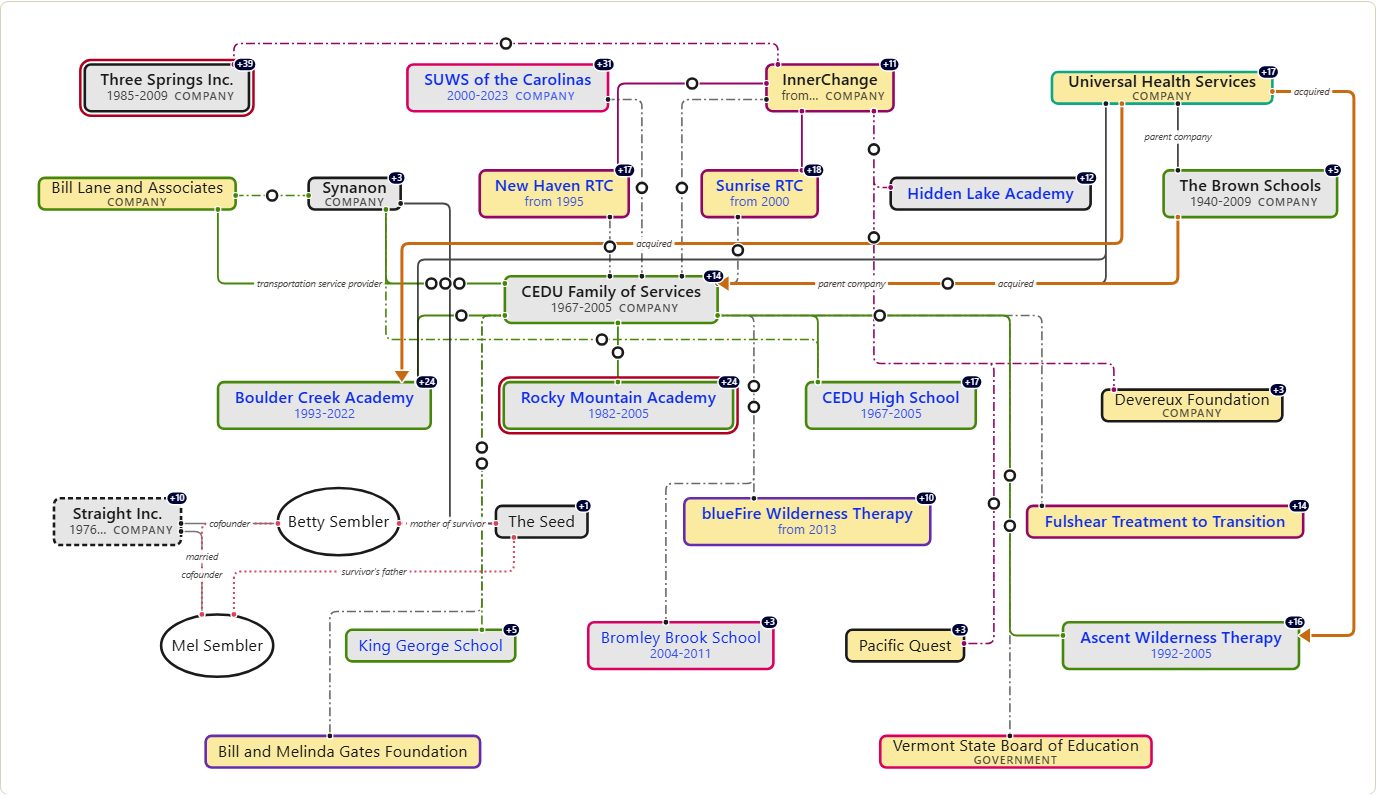
Who is connected to whom
Staff, founders, investors, and public figures move between programs constantly. Our network map shows the tangled web of connections between TTI programs, their operators, and the organizations around them.
Grieving the kids we have lost
In Loving Memory is our list of young people who have died in residential treatment. Every name there is a reason this history matters.
Not the troubled teen industry
Institutional abuse outside the troubled teen industry
These are not troubled teen industry programs. They are listed here because their history is sometimes set beside the troubled teen industry's, or because the same companies and practices turn up in both; each page says where the two meet and where they do not.
-
Indian boarding schools and residential schools
Government and church schools in the United States and Canada that took Indigenous children from their families. Not part of the troubled teen industry; the page is mostly directions to Indigenous-led organizations.