
Orphan Care Through the Ages
From Roman alimenta to the last orphan train: how poverty became a reason to institutionalize children, and how orphanages gave way to residential treatment.

Unknown engraver, Public domain, via Wikimedia Commons
Contents
Timeline: Poverty & Orphans #
Antiquity #
- c. 200 BCE – Roman Republic established alimenta programs
- Charitable grain and financial assistance programs supported poor children of Roman citizens, especially in Italy. These were elite-sponsored and intended to reinforce social hierarchy.
Late Antiquity #
- c. 380 CE – Edict of Thessalonica
- Christianity became the state religion; almsgiving reframed as a religious duty. Church became a central provider for the poor, including orphans.
- c. 400 CE – Augustine of Hippo promotes Christian charity
- Writes extensively on caritas (charitable love). Argues that the poor exist to test the compassion of the rich.
Early Middle Ages #
- 529 CE – Rule of St. Benedict
- Monasteries obligated to provide for orphans and travelers. This shapes the cloister as a refuge for the ‘deserving poor,’ especially children.
- 7th–9th c. – Merovingian & Carolingian poor relief
- Royal decrees encourage nobles and bishops to care for orphans. Orphan care is ad hoc, often handled by monasteries and noble patronage.
High Middle Ages #
- 1179 CE – Third Lateran Council
- Formal condemnation of simony and corruption; indirectly affects church-funded orphan care. Parish institutions slowly become more structured.
- 13th c. – Rise of foundling hospitals in Italy
- First known: Ospedale degli Innocenti (Florence, founded 1419 but planned earlier). Response to infant abandonment and illegitimacy.
Late Middle Ages #
- 1348–1351 CE – Black Death
- Massive orphan crisis. Surge in child vagrancy. Cities begin experimenting with institutional responses—early hospitals in France and Italy become more child-focused.
- 1351 CE – Statute of Labourers (England)
- Attempts to force able-bodied poor (including adolescents) into labor after the plague. Early legal distinction between ‘deserving’ and ‘undeserving’ poor.
Early Modern Period #
- 1536 CE – Henry VIII’s Dissolution of the Monasteries
- Destroys many traditional systems of monastic charity. Created a massive void in poor and orphan care in England.
- 1547 CE – Vagabonds and Beggars Act (England)
- Passed under Edward VI, this act criminalized vagrancy and expanded the punishment of poverty.
- Orphaned or abandoned children found begging or without employment could be classified as vagrants and subjected to state intervention.
- Children as young as seven could be:
- Taken from the streets
- Imprisoned or whipped
- Placed into forced apprenticeships for up to ten years
- Marked a turning point in treating poverty—especially child poverty—as a threat to social order.
- 1572 CE – First Elizabethan Poor Relief Act passed
- Marked the beginning of a legislative framework for organized poor relief in England.
- Authorized local justices to:
- Register the poor
- Assess taxation (the poor rate) on property owners
- Children of the poor could be removed from their families and placed into apprenticeships
- Able-bodied adults could be forced to work.
- 1601 – Elizabethan Poor Law enacted
- Sometimes called the “Old Poor Law,” this statute consolidated earlier Elizabethan legislation and became the foundation for England’s welfare system for over two centuries.
- It distinguished between:
- The ‘impotent poor’ (elderly, sick, or disabled) who were to be cared for through outdoor relief.
- The ‘able-bodied poor’ who were expected to work and were often placed in workhouses.
- Poor children, who could be apprenticed and removed from parental care for training.
- Relief was locally administered by parish overseers and funded through a mandatory poor rate (local tax).
- The system institutionalized a surveillance-based, moralizing approach to poverty, and laid the groundwork for later punitive welfare models.
- 1627 – English ships transport between 1400 and 1500 children to the American colonies for child labor apprenticeships, demonstrating the early practice of “putting out” or “placing out” children.
- Children have no legal say in their placement; authority rests with parents or local officials like overseers of the poor.
- Colonial governments enact laws to control indentured servitude and apprenticeships, often requiring indentured children to be taught to “read, write and cipher.”
18th Century #

- 1723 – The Workhouse Test Act:
- Passed as part of the Act of Settlement reforms.
- Allowed parishes to deny outdoor relief to any able-bodied person who refused to enter a workhouse.
- Workhouses were intentionally designed to be austere and dehumanizing to discourage dependency.
- 1739 – Thomas Coram establishes Foundling Hospital (London)
- First official institution in England dedicated to abandoned children, especially those born outside of marriage.
- Mothers could leave infants anonymously at the gate, helping them avoid infanticide charges.
- Framed children as innocents needing rescue—not criminals or laborers.
- Promised Christian upbringing and moral education
- Prepared children for labor:
- Boys for naval or military service
- Girls for domestic work
- 1740 – First British-American Orphanage Founded:
- Bethesda Orphanage was established by Great Awakening leader George Whitefield, who cited German Pietist August Hermann Francke as a major influence. Francke believed it was important to break children’s will to enforce obedience.
Late 18th – 19th Century: Industrial Revolution & Urban Poverty #

- c. 1760–1840 – Industrial Revolution begins in Britain
- Rapid industrialization transformed rural economies and drew millions into cities like Manchester, Birmingham, and London.
- Rural families migrated in search of factory jobs, creating:
- Overcrowded urban slums
- Poor sanitation and dangerous housing conditions
- Resulted in:
- Widespread disease (cholera, tuberculosis)
- Alcoholism and malnutrition
- High mortality and injury rates
- Orphans and poor children were especially vulnerable:
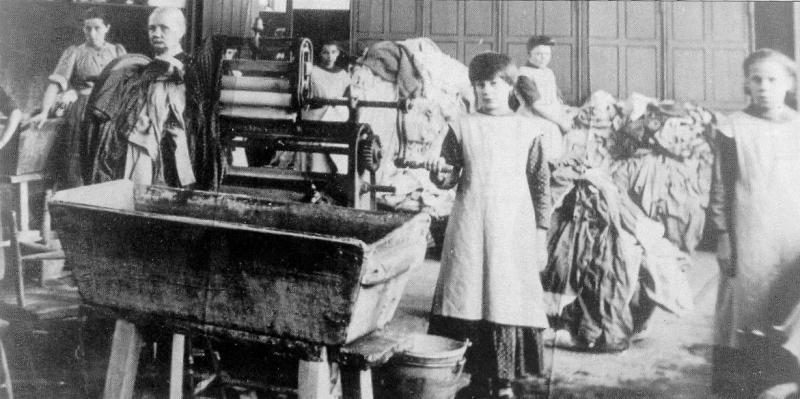
- Many worked long hours in factories, mines, and textile mills under brutal conditions
- Others were confined in workhouses with minimal rations and harsh discipline
- Sparked both philanthropic and moralistic reform movements aimed at:
- ‘Saving’ children through religious and vocational instruction
- Disciplining them through institutionalization and labor training
- 1800–1850 – At least 62 private charities are created in the US, mostly aiming to place children in apprenticeships or indentured servitude.
- 1806 – First Private Orphanage Founded in US:
- The Orphan Asylum Society was established in New York City by elite philanthropists including Eliza Hamilton, Alexander Hamilton’s widow.
- Children received food and shelter alongside strict Protestant religious instruction.
- Despite the involvement of wealthy benefactors, children in private orphanages were still exploited for their labor.
- 1825 – The New York House of Refuge, founded by the Society for the Prevention of Pauperism, was the first major institution to house and “reform” delinquent youth.
- Its founding was supported by wealthy merchants, judges, and ministers, including Cadwallader D. Colden and Thomas Eddy.
- The Refuge was designed to rescue children from corrupting environments—especially immigrant neighborhoods—via discipline, labor, and Christian instruction.
- Children were segregated by gender and race, subjected to strict routines, corporal punishment, and industrial or agricultural labor.
- Boys learned blacksmithing, shoemaking, or farm work; girls did sewing and domestic labor.
- Sentences were indeterminate, with release based on obedience and perceived moral reform.
- 1826 – Houses of Refuge emerged in Boston (1826) and Philadelphia (1828), creating a triad of early northern Houses of Refuge.
- These became the standard model for youth incarceration by mid-century, influencing legislation and moral norms nationwide.
- Black children were either excluded or segregated into inferior facilities or state-run adult penitentiaries.
- Their misbehavior was more often framed as criminal rather than moral, denying them the “reform” rationale extended to white children.
- Though framed as humanitarian, these institutions often resembled prisons in both structure and atmosphere.
- Critics noted the overreliance on confinement, silence, and labor rather than genuine education or freedom.
- 1834 – Poor Law Amendment Act (UK)
- Replaced the decentralized Elizabethan Poor Law system with a national framework.
- Centralized poor relief into large, punitive workhouses.
- Conditions were deliberately harsh to deter all but the most desperate from seeking aid.
- For families, this often meant:
- Separation of men, women, and children into different institutional areas
- Loss of familial contact and cohesion
- For children:
- Removal from their parents and institutional confinement
- Regimens of labor, religious instruction, and surveillance
- Minimal education focused on obedience, not development
- Strict disciplinary practices
- Reframed poverty as a moral failing to be punished
- Cemented a view of poor children as future laborers rather than dependents needing protection or nurture
- 1841–1880s – Dorothea Dix exposes almshouse conditions
- Conducted nationwide investigations across the U.S. into the treatment of vulnerable populations.
- Documented horrific conditions in almshouses and jails where children, the elderly, and mentally ill people were confined together.
- Found that children in almshouses were often:
- Neglected and unschooled
- Exposed to physical and sexual abuse
- Living in disease-ridden, unsanitary conditions
- Lobbied state legislatures to:
- Remove children from adult almshouses and jails
- Establish separate institutions for dependent children
- Advocated for facilities that emphasized:
- Moral development
- Structured care and education
- 1849 – George W. Matsell, New York City’s first Chief of Police, reports on the growing problem of “vagrant and delinquent children.”
- 1849 – The board of governors of the New York Almshouse favors placing children in families and seeks legislation for out-of-state indentures.
- 1850 – The Boston Children’s Mission sends 150 children to out-of-state placements.
- 1852 – Massachusetts enacts first U.S. compulsory school attendance law
- Truancy becomes a legal issue. Poor and immigrant children were increasingly monitored through education systems. Truancy laws become a pathway to institutionalization.
- 1854 – The phrase “orphan train” is first used to describe the transportation of children outside their home localities on railways.
- Charles Loring Brace’s Children’s Aid Society of New York sends 46 children to Dowagiac, Michigan, marking the beginning of the official “orphan train movement.”
- 1854 – The Children’s Aid Society’s First Annual Report identifies 10,000 “vagrant children” in New York City.
- 1855 – New York State authorizes “trustees, directors or managers of any incorporated orphan asylum, or institute or home for indigent children” to “bind out” male children under 21 and female children under 18 without geographic restrictions.
- 1857–1858 (February to February) – Statistics from one charity indicate that 65% of all placed children had at least one living parent.
- 1862 – The Homestead Act is passed, encouraging westward migration and creating demand for labor.
- 1866 – Orphanages are established to remove children from almshouses.
- 1860s–80s – Almshouse Reform Movement (U.S.)
- National campaigns seek to remove children from adult almshouses and place them in separate orphanages or industrial schools.
- 1869 – Charity Organisation Society founded (UK)
- Founded in London to systematize charitable efforts in a more ‘scientific’ and moralizing way.
- Aimed to distinguish between the ‘deserving’ and ‘undeserving’ poor.
- Promoted heavily surveilled aid:
- Volunteers (often middle-class women) visited poor families’ homes.
- Evaluated cleanliness, behavior, and moral character.
- Aid was conditional on moral improvement and proper domestic conduct.
- Families deemed unfit were denied help and their children could be institutionalized
- 1875 – New York State Children’s Law passes
- Passed as Chapter 173 of the Laws of 1875.
- Prohibited placement of children aged 3 to 16 in county poorhouses (almshouses), except in cases where they were:
- Deemed insane
- Labeled idiotic
- Otherwise unfit for family care
- Required that such children be transferred to orphan asylums or placed with families approved by the State Board of Charities
- 1904 – The Arizona Territory Orphan Train Placement case
- New York Foundling Hospital sends 40 Caucasian children to be indentured to “Mexican Indian” Catholic families. A white mob forcibly takes children.
- 1905 – The Arizona Supreme Court rules that the “best interests of the children” require them to remain with Anglo families.
- 1909 – U.S. White House Conference on Dependent Children
- Declares home care preferable to orphanages. Begins shift toward foster care.
- 1923 – New York statute allows institutions to place children for adoption without further parental consent if the parent placed the child with them.
- 1927 – 12 states still allow indenture of institutional charges and children from county poor farms.
- May 31, 1929 – The last orphan train leaves New York City for Sulphur Springs, Texas, marking the end of the orphan train movement.
- Ended due to factors like railroad expansion completion, declining labor demand in the West, backlash from Western states, and new in-home family support programs.
- 1948 – UN Declaration of Human Rights
- Recognized the right to care and protection for all children. Spurred an international push against orphan institutionalization.
- 1960s–80s – Deinstitutionalization & rise of residential treatment
- Poor children moved from orphanages to psychiatric or behavioral facilities.
Sources #
- Barr, B. (1992). Spare children, 1900–1945: Inmates of orphanages as subjects of research in medicine and in the social sciences in America (Doctoral dissertation, Stanford University).
- Barr, B. (n.d.). Estimates of numbers of children in institutions, foster family care, and adoptive homes, 1910–1960. Adoption History Project, University of Oregon.Barrstats (pages.uoregon.edu)
- Rauschenbusch, W. (1917). A Theology for the Social Gospel. New York: Macmillan. Theologyforsoc00raus (dn790006.ca.archive.org, PDF)
- Trammell, R. S. (2009). Orphan Train myths and legal reality. The Modern American, 5(2), Article 3. Iss2 (digitalcommons.wcl.american.edu)