Investigatory Spotlight: John Santa & Montana Academy
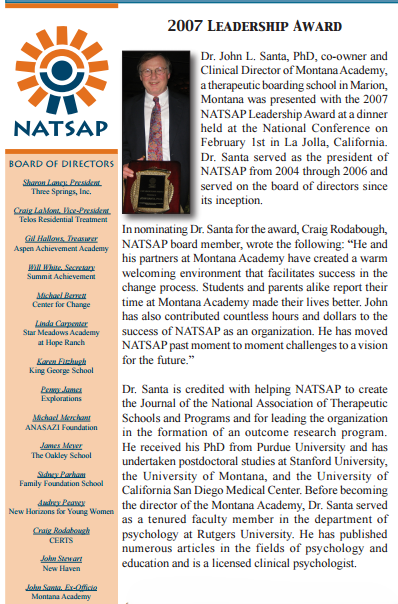
Shortly after co-founding Montana Academy in 1997, John Santa played a pivotal role in shaping NATSAP during its early years. Santa was among the first to contribute to NATSAP financially, supplying thousands of dollars in seed money for the organization. He was a participant in NATSAP’s first organizational meeting and was elected to its inaugural Board of Directors. Santa was appointed Chair of NATSAP’s first Ethics and Standards Committee, where he led development of the ethical guidelines that NATSAP claims to rely on today. Between 1999 and 2007, Santa occupied a variety of leadership roles within NATSAP, including President and Research Committee Chair.
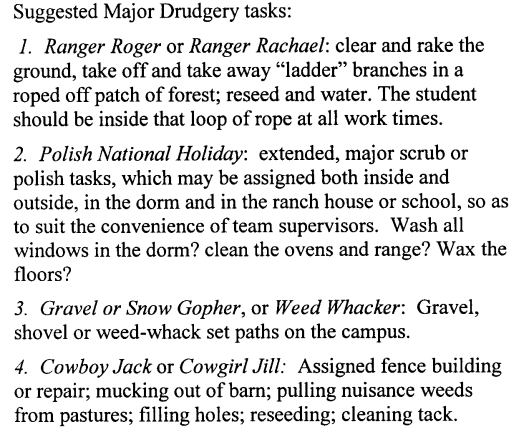
Montana Academy, where Santa served as co-director for over 20 years, is now known among the TTI survivor community for reportedly abusive practices. Staff relied on coercive, punishment-based methods disguised as therapy, resulting in lasting trauma for many survivors. Montana Academy employed a level system called “clans,” where students progressed by exhibiting compliant behavior. Punishments, referred to as “drudgery,” frequently involved forced manual labor. In 2017, despite charging over $8000 per month in tuition and fees, staff failed to adequately supervise a 16-year-old student named Benjamin Jackson. He died by suicide. Rather than performing an internal audit and making corrections to prevent future tragedies, Santa’s business partner, John McKinnon, wrote a letter to families saying that it was impossible to keep kids from dying by suicide unless they were kept in psychiatric ward-like conditions. The lack of compassion and professionalism in this response is astonishing. Montana Academy was purchased by Embark Behavioral Health in 2021 and the facility reopened as Embark at Flathead Valley in 2022. David Chiarito, a longtime employee of Montana Academy, is the current executive director.
As Chair of the NATSAP Research Committee, Santa led the creation of the Research Designated Program (RDP) distinction to encourage directors of member programs to study their own students and contribute to research. There are obvious issues with this approach to research, ranging from bias that undermines credibility to ethical issues in obtaining truly informed and voluntary consent. Past versions of the NATSAP website reveal that the organization actively promoted the RDP designation as a marketing tool, offering programs a special page in its directory and a logo to include in promotional materials. The potential for harm to students is only mentioned vaguely, in passing. Transparent, concrete solutions for minimizing harm to participants are not explicitly required.
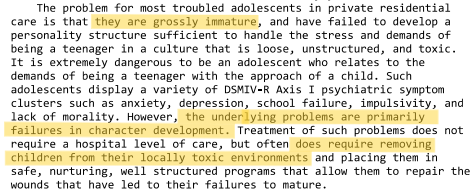
As a clinician and researcher, Santa showed exceptional disregard for the thoughts, feelings, beliefs, and values of the kids he worked with. In his work, including his development of the MAMA-t, he exhibits a paternalistic, dismissive tone towards teenagers. The MAMA-t in particular relies on the perceptions and assessments of adults without any input from the teens being evaluated. Using the scale, behaviors that are rated highly for “maturity” actually reflect conformity and willingness to submit to adult control. Santa’s body of work gives no serious consideration to the fact that undesirable behavior could be caused by a host of factors outside a teenager’s control, including trauma, medical conditions, and learning disabilities. All disobedience is pathologized, even when it is generally age-appropriate.
Santa’s dismissive approach to survivor testimonies and reports of abuse was given deeply unsettling context at the 2007 hearing mentioned previously. During the hearing, Dr. Katherine Pinto criticized NATSAP specifically for its dishonest and unaccountable practices. As an example, she recounted a recent incident when she, with a group of colleagues, gave a presentation at an American Psychological Association (APA) conference. Dr. Pinto and her colleagues presented on hundreds of cases of mistreatment in facilities for troubled youth, including those represented by NATSAP. According to Dr. Pinto, NATSAP’s representatives feigned concern and earnestly promised to address these issues with their board.
What happened next was shocking but not surprising. Instead of treating Dr. Pinto’s concerns with respect as promised, NATSAP published an open letter dismissing all criticism as “the noisy complaints of a few individuals.” While she did not name him during her testimony, it is publicly known that the open letter was authored by John Santa, then President. In his letter, he casts NATSAP as an unfairly persecuted innocent party. His stance is haughty, confrontational, and filled with misleading information. For example, Santa claims that “critics [of NATSAP], including a number of educated professionals, make sweeping conclusions without legitimate data and without examining any of our programs or available outcome data.” In truth, Santa was obviously already well aware that there were many credible reports of abuse and death at NATSAP member programs. His manipulative response reflects his true priorities: protecting himself, his reputation, and his colleagues, no matter the cost to vulnerable kids.
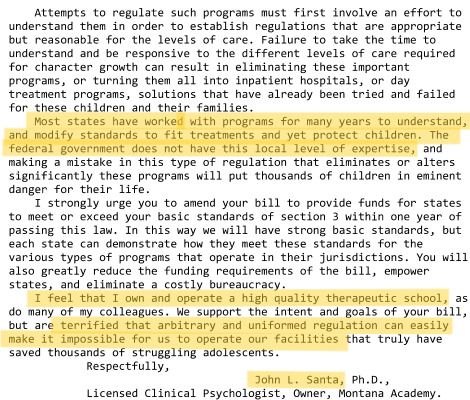
Throughout his career, Santa argued passionately against federal regulation of the TTI. Instead, he was a firm advocate for self-regulation, in addition to state regulation when necessary. His vision for effective state regulation must be questioned in light of his involvement with Private Alternative Adolescent Residential or Outdoor Programs (PAARP), a regulatory body in his home state of Montana. Santa chaired PAARP from its inception in 2007 until it dissolved in 2019. During PAARP’s 12-year existence, the board received at least 58 complaints involving member programs. Under Santa’s leadership, PAARP declined to take meaningful action regarding even a single one of them. No penalties were issued whatsoever, not even fines or warnings.
As a co-director of Montana Academy, Santa’s role as Chair of the PAARP board raised serious concerns about potential conflicts of interest. The Missoulian published a series of investigatory articles in 2019 that highlighted the prevalence of overlapping ownership and regulatory roles within Montana’s troubled teen industry. Santa’s leadership at PAARP mirrored his leadership at NATSAP: he helped build a tight-knit network of insiders that prioritized public relations over holding the industry to a higher standard. In the face of mounting public scrutiny, John Santa ultimately recommended that oversight for therapeutic programs should be taken over by the Montana Department of Public Health and Human Services. His newfound embrace of regulation becomes less significant when considered in light of the fact that he retired from his professional capacity at Montana Academy shortly thereafter.
John Santa had countless opportunities to do the right thing, but he chose not to. From Montana Academy to NATSAP and PAARP, he focused on protecting the industry instead of addressing its problems. When faced with evidence of neglect and abuse, he prioritized public relations over accountability. Despite obvious issues with his moral compass, Santa was permitted to become an authority on industry ethics. This fact either speaks to the poor judgment of those who appointed him or suggests their morals were as flawed as his. His foundational role in NATSAP calls the integrity of the entire organization into question. NATSAP has never denounced Santa or acknowledged the harm he caused during his time in the organization. It’s tempting to hope he was an outlier, but his harmful attitudes toward teens were widespread among his peers.
Future installments in this series will continue to examine the underreported histories of NATSAP’s founding members.
Click here to read or download files from the Montana Academy Document Library.
Resources & Further Reading
Bolton, A. (2019, September 12). New regulations for youth treatment programs receive mixed feedback. Montana Public Radio. Retrieved from https://www.mtpr.org/montana-news/2019-09-12/new-regulations-for-youth-treatment-programs-receive-mixed-feedback
Evans, C., Larson, S., & Florio, G. (2019, January 26). Tangled web of owners, administrators, at Montana residential programs. Missoulian. Retrieved from https://missoulian.com/news/state-and-regional/tangled-web-of-owners-administrators-at-montana-residential-programs/article_3fa1742f-80ce-5a4c-8c63-9c50e6a80d82.html
Tompkins, L., & Larson, S. (2019, January 23). 12 years, 58 complaints, no sanctions at Montana residential programs. Missoulian. Retrieved from https://missoulian.com/news/state-and-regional/12-years-58-complaints-no-sanctions-at-montana-residential-programs/article_7c8a1677-8e10-522c-bb28-c8b6d258be50.html
Larson, S., & Tompkins, L. (2019, January 21). Fox guards henhouse in Montana programs for troubled teens. Missoulian. Retrieved from https://missoulian.com/news/state-and-regional/fox-guards-henhouse-in-montana-programs-for-troubled-teens/article_86736f9b-eb6e-59f9-b312-3a9388361075.html
Larson, S. (2019, January 21). Reflections Academy school for girls sued 3 times in 3 months; claims of grooming, abuse. Missoulian. Retrieved from https://missoulian.com/news/state-and-regional/reflections-academy-school-for-girls-sued-3-times-in-3-months-claims-of-grooming-abuse/article_1fd62a4b-861e-510b-89c3-c67dbc082850.html
Larson, S. (2019, February 9). Head of MT board regulating programs for troubled teens open to increased transparency. Missoulian. Retrieved from https://missoulian.com/head-of-mt-board-regulating-programs-for-troubled-teens-open-to-increased-transparency/article_9555d38a-a559-5e84-90ef-8c219160c48c.html
McKinnon, J. A., Santa, J. L., & Solomon, L. (2019). The MAMA-t: A measure of relative maturity in adolescence. Journal of Therapeutic Schools and Programs, 11(1), 62–78. https://doi.org/10.19157/JTSP.issue.11.01.04
Missoulian Editorial Board. (2020, January 31). About this series: Troubled kids, troubled system. Missoulian. Retrieved from https://missoulian.com/news/state-and-regional/about-this-series/article_91fa0ea9-502e-541b-bd0e-d3b0e7567308.html
Montana Board of Private Alternative Adolescent Residential or Outdoor Programs. (2006, September 12). Report of findings to the Montana Legislative Economic Affairs Interim Committee. Retrieved from https://leg.mt.gov/content/Committees/Interim/2005-2006/Economic-Affairs/Meetings/September-12-2006/02-PAARP-Report-of-Findings-EAIC-09-12-06.pdf
Montana Department of Health and Human Services. (2022). Oversight and Regulation of Private Adolescent Residential Programs (PAARP). Helena, MT.
Montana State Legislature. (2019). House Bill 628: An act revising laws related to private alternative adolescent residential or outdoor programs. Helena, MT: Montana State Legislature.
National Association of Therapeutic Schools and Programs. (2006). Open letter to critics of private residential treatment programs [Letter from John Santa, President of NATSAP]. NATSAP News: 4th Quarter 2006.
Santa, J. L. (2019, February 25). SB267 Support [Letter to David Howard, Chair, Senate Public Health, Welfare and Safety, Montana State Senate]. Montana Department of Labor & Industry.
Santa, J. L., & Moss, J. (2019). A brief history of the National Association of Therapeutic Schools and Programs, reprinted and updated. Journal of Therapeutic Schools and Programs, 11(1), 18–29. URL: https://doi.org/10.19157/JTSP.issue.11.01.10
Tompkins, L., Evans, C., & Larson, S. (2019, January 25). Former students describe isolation, physical punishments, ‘cuddle puddles’. Missoulian. Retrieved from https://missoulian.com/news/state-and-regional/former-students-describe-isolation-physical-punishments-cuddle-puddles/article_8a4c6430-c7f4-54c3-8c21-f44ab406e7d7.html
Tompkins, L., & Evans, C. (2019, January 22). Life and death at Montana Academy. Missoulian. https://web.archive.org/web/20190123225836/https://missoulian.com/news/state-and-regional/life-and-death-at-montana-academy/article_5a3bb210-d808-5281-a6c5-3c4224109e46.html
U.S. House Committee on Education and Labor. (2007, October 10). Cases of child neglect and abuse at private residential treatment facilities [Hearing]. Government Printing Office. Retrieved from https://www.govinfo.gov/content/pkg/CHRG-110hhrg41839/pdf/CHRG-110hhrg41839.pdf
U.S. House Committee on Education and Labor. (2008, April 24). Child abuse and deceptive marketing by residential programs for teens [Hearing]. Government Printing Office. https://www.govinfo.gov/content/pkg/CHRG-110hhrg41839/pdf/CHRG-110hhrg41839.pdf