Spiritual Abuse & Religious Trauma
What is Spiritual Abuse?
Spiritual abuse is a significant form of mistreatment that occurs when religious or spiritual beliefs and authority are misused or exploited to harm individuals. This phenomenon is increasingly recognized for its lasting damage to victims’ sense of identity, well-being, and mental health.:
Defining Characteristics of Spiritual Abuse
Spiritual abuse is characterized by a systematic pattern of coercive and controlling behavior within a religious or spiritual context. Key elements include:
- Misuse of Power and Authority
- Leaders use their spiritual position to control or dominate others, or to bolster their own needs. This can involve demanding unquestioning obedience.
- The abuser, often a leader, may attain a “cult-like” or “guru” status, their word becoming infallible and their authority unquestioned because they are seen as “chosen and anointed by God” or a divine representative.
- This power differential is amplified by the perception that the abuse comes directly from a divine or holy source.
- Manipulation and Coercion
- Using spiritual or religious beliefs, including scripture and the pulpit, to manipulate, pressure, or control behavior and enforce agendas. This can include “proof-texting,” where scripture is taken out of context to justify actions.
- Employing scare tactics, such as threatening that “God will withdraw his love” or punish individuals for perceived “sin” or disobedience.
- Promoting a relationship with the divine or the community that is based on performance and dependence (Conditionality). Members believe they must meet certain spiritual standards to earn approval or avoid negative consequences.
- Shame and Guilt
- Frequently used as tools for manipulation and control. Victims may receive messages that their spirituality is “defective” or that something is inherently “wrong with them”.
- Perfectionist-retributionist doctrines can lead to intense self-denigration and guilt for failing to live up to perceived spiritual standards or live without “sin”.
- Suppression of Expression and Isolation
- Creating an environment where open disagreement or questioning is discouraged, often leading to individuals being shunned or asked to leave.
- Enforcing secrecy and silence around injustices experienced within the group.
- Individuals may be actively isolated from external support systems or views outside the group’s worldview.
- Systemic Nature
- Abuse can be perpetrated by an individual leader (Individual Leader Model) or by a group or entire church community (Group Model), which can be subtler and even unconscious.
- Theological and institutional structures may actively protect abusive leaders, contributing to a culture of impunity.
Impacts of Spiritual Abuse
The consequences of spiritual abuse are profound and far-reaching, affecting individuals across psychological, emotional, spiritual, physical, and social domains.
- Spiritual and Existential Impacts
- Weakening or undermining spiritual empowerment, leading to a loss of meaning and purpose.
- Damage at a transcendental level, which can shatter a victim’s connection with the divine or sacred. This can result in a crisis of faith. and a distorted perception of God.
- Profound spiritual insecurity, grief, and existential disorientation. Many survivors report feeling that something sacred, like their “soul,” has been stolen.
- Psychological and Emotional Impacts
- Intense feelings of fear, shame, guilt, and self-blame. This self-blame is often exacerbated by cultural views that may imply victims are at fault.
- Experience of despair, hopelessness, anger, cynicism, loneliness, and misunderstanding.
- Development of PTSD-like symptoms, including anxiety, panic attacks, depression, self-harm tendencies, and suicidal ideation.
- Loss of a sense of self, identity confusion, or a fragmented identity.
- Difficulty with critical thinking, decision-making, trusting oneself or one’s emotions, and setting boundaries.
- Repression of feelings and desires, which can lead to emotional breakdown.
- For LGBTQIA+ individuals, this can manifest as intense guilt and self-hatred, leading to internalized homophobia.
- Physical and Physiological Manifestations
- Physical symptoms stemming from psychological distress, such as tension headaches, gastrointestinal disturbances, and chronic pains.
- Disregulated nervous system, impaired cognitive functioning.
- Nightmares, flashbacks, and exaggerated startle responses.
- Sleep and eating disorders, sexual dysfunction, and substance abuse.
- Social and Relational Impacts
- Disruption of intimate relationships, social isolation, and withdrawal.
- Loss of supportive community, as victims may be deserted by church friends.
- Disclosure of abuse is often met with victim-blaming, denial, disbelief, or outright hostility from the religious community, leading to re-victimization and abandonment.
Contexts of Spiritual Abuse
Spiritual abuse is a broad concept that can occur in various settings, from highly organized religious institutions to intimate interpersonal relationships.
- Cults and Extreme Religious Groups
- Characterized by strong authoritarianism, where members often lose their sense of self and face extreme difficulty leaving.
- Cult involvement is conceptualized as creating traumatic memories with symptoms similar to PTSD.
- Christian Communities
- Much of the existing literature on spiritual abuse focuses on experiences within Protestant denominations, particularly evangelical and fundamentalist groups.
- This includes the historical context of the “shepherding” or “discipling” movement, which emphasized submission to spiritual authorities.
- Specific forms include purity culture and the misuse of scripture to enforce rigid gender roles or control sexuality.
- Clergy Sexual Abuse
- Involves an extreme abuse of power, where the divine status of the religious leader is projected onto the abuser, making the violation feel as if it were perpetrated by the divine itself.
- This can lead to stymied spiritual development in victims and a “dual traumatization” – from the abuse itself and the institution’s often unsupportive or denying response.
- Indigenous Communities (Historical Trauma)
- While unique to Native American experiences, historical trauma fits many spiritual abuse criteria. This includes colonial and cultural genocide efforts, such as the banning of traditional religious ceremonies, the prevention of access to sacred sites, and the forced assimilation in boarding schools.
- Abusive clergy were often intentionally relocated to Native American areas, exacerbating existing colonial violence.
- Desacralization and contamination of sacred objects and practices (e.g., psilocybin mushrooms, peyote) by Westerners for recreational or individual healing purposes can constitute spiritual abuse for Indigenous communities, stripping these items of their original sacred meaning and contributing to their criminalization.
- Attempts to subsume Indigenous spiritual abuse into broader categories without recognizing its specific cultural and historical context are seen as a perpetuation of colonization.
- Secular and Quasi-Spiritual Contexts
- Spiritual abuse can extend beyond traditional religious institutions to secular spaces like psychotherapy, where a “wounding healer” might misuse their power. It can also occur in “New Age” or “neoliberal spirituality” contexts.
Recognizing that abuse has occurred, having the opportunity to share one’s story, and redefining one’s spirituality are crucial steps for survivors to reclaim agency and begin their healing journey.
Growth After Spiritual Abuse
- Recognizing Abuse: Naming the Abuse
- Individuals who have experienced religious/spiritual (R/S) abuse can begin healing and experience posttraumatic growth (PTG) when they recognize their experiences as abuse.
- Survivors frequently face disbelief, stigma, isolation, and even hostility from both their spiritual communities and broader society.
- These reactions often compound trauma, leading to self-blame, mental health challenges, and difficulty integrating the experience.
- Acknowledgment of abuse offers psychological validation, reduces symptoms, and supports healing.
- Recognizing that others share similar experiences helps survivors realize they are not alone or uniquely damaged.
- Relaying One’s Story: Exploring the Trauma Narrative
- Survivors benefit greatly from the opportunity to articulate their trauma narratives.
- Sharing stories—through speaking, writing, art, or music—is vital for integrating trauma into one’s life story.
- Narrative expression restores agency, helps resolve confusion, rebuilds emotional trust, and diminishes the trauma’s psychological grip.
- Strong emotions like anger, grief, and fear often surface and must be validated as appropriate responses.
- Redefining Spirituality: Transformation of Spirituality
- Survivors frequently reevaluate their beliefs, redefining their spirituality and relationships with the Divine, self, clergy, and others.
- This transformation often moves from rigid doctrine toward a more relational, nuanced, and flexible spirituality.
- The process includes deconstructing old beliefs and intentionally reconstructing new ones aligned with personal growth.
- Survivors may adopt curiosity and humility, embracing complexity and space for questioning.
- While some may distance themselves from organized religion or avoid religious language, others may reclaim spiritual rituals with new meaning.
Works Cited:
Bisantz, L. (2023). Betrayed by the Divine and Overlooked by Scholarship: An Inquiry into Spiritual Abuse and Religious Trauma. University of Colorado Honors Journal, 161–164. https://doi.org/10.33011/cuhj20231887
Giovino, R. (2024, December 11). Trauma and spiritual abuse. Insight Digital Magazine.
Keller, K. H. (2016). Development of a spiritual abuse questionnaire [Doctoral dissertation, Texas Woman’s University]. https://twu-ir.tdl.org/server/api/core/bitstreams/f591874a-dd01-4883-8363-3f76499cde98/content
Oakley, L., & Humphreys, J. (2018). Understanding spiritual abuse in Christian communities. CCPAS; The National Centre for Post Qualifying Social Work at Bournemouth University. https://thirtyoneeight.org/media/gbsj1haw/spiritualabusesummarydocument.pdf
Ozanne, J. (2017). Spiritual abuse – the next great scandal for the Church. Royal College of Psychiatrists. https://www.rcpsych.ac.uk/docs/default-source/members/sigs/spirituality-spsig/resources/spsig-archive-ozanne-spiritual-abuse-the-next-great-scandal-for-the-church.pdf?sfvrsn=3697843c_2
Perry, S. (2024). Religious/spiritual abuse, meaning-making, and posttraumatic growth. Religions, 15(7), Article 824. https://doi.org/10.3390/rel15070824

Legislative Loopholes
Florida


Medical Neglect
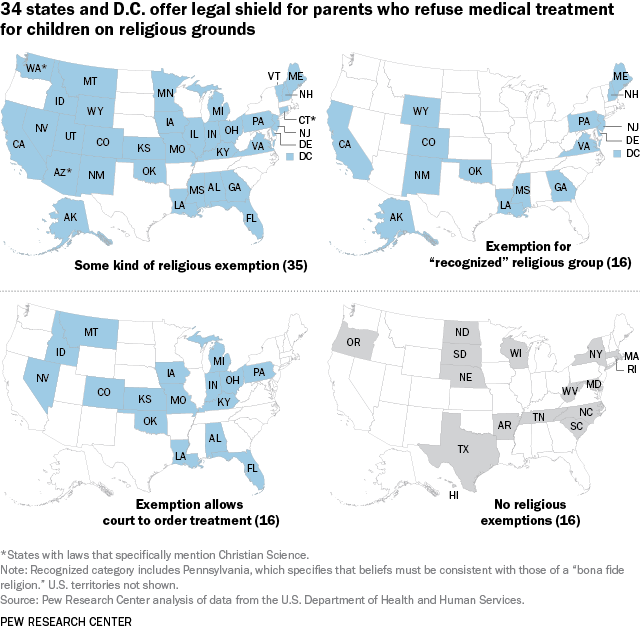
Texas


Missouri