
Facility profile Florida
Alachua Academy
Alachua Academy is a juvenile justice RTC in Gainesville, Florida, operated by Rite of Passage, Inc. It has operated since 2009.
About Alachua Academy
Florida DJJ listed Sequel TSI of Florida as the provider of Alachua Academy from 2016 through June 2022, Wayne Halfway House from at least May 2023 to July 2025, and Rite of Passage, Inc. in 2026.source 1, source 2, source 3 Florida DJJ lists Rite of Passage, Inc. as the provider of Alachua Academy (October 2026); Sequel TSI of Florida ran it from 2016 to 2022 and Wayne Halfway House, a separate Tennessee company not part of Sequel or Vivant, from about 2023.source 1, source 2
Timeline
From the records: who ran it and the deals that moved it, its names, and the deaths, incidents, inspection findings, lawsuits and news stories on file. Point at an event, or tap "More about this", for the details.
2009
Opened in Gainesville, Florida
2016
Sequel Youth and Family Services began running it
It ran the program until 2022.
2017
Sequel TSI: Sold a majority stake to Altamont Capital Partners
Sequel Youth and Family Services ran Alachua Academy at the time.
Sequel TSI: Sold a majority stake to Altamont Capital Partners September 1, 2017
Altamont Capital Partners announced a majority equity investment in Sequel through a holding company, SYFS Parent; terms were not disclosed. At the time Sequel ran 44 programs in 19 states, and APM Reports counted 35 residential treatment centers in 16 states. CEO John Stupak stayed on and co-founder Jay Ripley remained board chairman. Altamont's portfolio page lists the investment as active and says SYFS Parent later acquired Rebecca & Aaron Schools (2017) and Pine Cone Therapies (2020).
2021
Vivant Behavioral Health: Founded by Sequel co-founder Jay Ripley and bought most of Sequel's remaining centers
Sequel Youth and Family Services ran Alachua Academy at the time.
Vivant Behavioral Health: Founded by Sequel co-founder Jay Ripley and bought most of Sequel's remaining centers
Jay Ripley, one of Sequel's three founders, founded Vivant Behavioral Healthcare in 2021. Sequel sold most of its centers that had not closed to Vivant, which now controls most former Sequel treatment centers still open.
2023
Wayne Halfway House took it over from Sequel Youth and Family Services
It ran the program until 2025.
2025
Wayne Halfway House stopped running it
Staff
Administration
-
Montea Ellis
Current:
-
Jason Katz
Elsewhere in the industry
- Sequel Youth and Family Services Executive Director
-
Kellie Rodgers
Licensing and inspections
- Program
- DJJ-alachua-academy
- License category
- Moderate-risk Residential
- Executive director
- Tony Watts
- Licensed capacity
- 28
- Licensing action
- Active
- Phone on file
- (352) 565-2006
- Licensed address
- 3430 NE 39th Avenue, Gainesville, FL 32609
42 inspection reports on file. Search all Florida reports
The newest 25 reports, by date: 67 findings in 10 reports
-
Jun 30, 2026
QI Residential - FY25-26 - 3 findings
3 findings
-
Failed compliance, DJJ review : Indicator 1.04 Education Staff Training (Education Contract Provider)
The Educational Provider staff shall complete staff training as outlined within the contract. Fourteen teachers were reviewed for training as contractually required. The four on-site teachers completed ten of the seventeen required trainings, with one missing seven trainings, one missing six trainings, one missing five trainings, and one teacher missing only one training. None of the ten flex teachers completed any of the required four trainings as contractually required.
-
Limited compliance, DJJ review : Indicator 1.05 Exit Portfolio (Education Contract Provider)
The Educational Provider shall develop and upload an Exit portfolio at least three school days prior to the youth’s exit from a residential commitment program. The contracted educational provider is required to develop and upload an Exit Portfolio for each youth. The program’s education services are provided by Florida Virtual School (FLVS), which began their contract on July 1, 2024. Three closed youth records were reviewed, and none had all the required exit portfolio documentation. One youth was missing a transcript, one youth was missing an Education Transition Plan, and all three were missing the Progress Monitoring Plans. All three Exit Portfolio’s contained all other required documentation, including results of assessments, course process with grades, Individual Education Plan, if applicable, and high school diploma, if applicable. None of the youth were applicable for Section 504, English Language Learner, behavior intervention plan (BIP), or earned industry certifications. Each Exit plan was uploaded into the Department’s Juvenile Justice Education System within three school days prior to the youth’s release.
-
Failed compliance, DJJ review : Indicator 1.06 Career Education (Education Contract Provider)
Education staff shall develop and implement a career education competency development program. Florida Scholars Academy, the contracted education provider, is currently in the process of developing the Career Education curriculum. At the time of review, no documentation of Career Education was available. Currently, youth at all programs are working with Career Power Workplace Skills workbooks. A review of program activities confirmed no career exploration services are being provided beyond soft skills instruction, which does not meet the requirements of the Florida Administration Code for the program is not incorporating and Type 1 career education nor any addition Type 2 career preparations. Additionally, there has been no lead response from Florida Virtual School (FLVS) regarding supplemental career exploration or coursework options. The absence of structured career exploration programming, beyond soft skills, demonstrates noncompliance with the minimum standard. The interviewed lead teacher states youth do receive the Multi-Tiered Systems of Support (MTSS) and exceptional student education (ESE) services.
-
- Jun 30, 2026 SPEP - FY25-26
- Jun 30, 2026 SPEP - FY25-26
-
Jun 30, 2026
QI Residential - FY25-26 - 3 findings
3 findings
-
Failed compliance, DJJ review : Indicator 1.04 Education Staff Training (Education Contract Provider)
The Educational Provider staff shall complete staff training as outlined within the contract. Fourteen teachers were reviewed for training as contractually required. The four on-site teachers completed ten of the seventeen required trainings, with one missing seven trainings, one missing six trainings, one missing five trainings, and one teacher missing only one training. None of the ten flex teachers completed any of the required four trainings as contractually required.
-
Limited compliance, DJJ review : Indicator 1.05 Exit Portfolio (Education Contract Provider)
The Educational Provider shall develop and upload an Exit portfolio at least three school days prior to the youth’s exit from a residential commitment program. The contracted educational provider is required to develop and upload an Exit Portfolio for each youth. The program’s education services are provided by Florida Virtual School (FLVS), which began their contract on July 1, 2024. Three closed youth records were reviewed, and none had all the required exit portfolio documentation. One youth was missing a transcript, one youth was missing an Education Transition Plan, and all three were missing the Progress Monitoring Plans. All three Exit Portfolio’s contained all other required documentation, including results of assessments, course process with grades, Individual Education Plan, if applicable, and high school diploma, if applicable. None of the youth were applicable for Section 504, English Language Learner, behavior intervention plan (BIP), or earned industry certifications. Each Exit plan was uploaded into the Department’s Juvenile Justice Education System within three school days prior to the youth’s release.
-
Failed compliance, DJJ review : Indicator 1.06 Career Education (Education Contract Provider)
Education staff shall develop and implement a career education competency development program. Florida Scholars Academy, the contracted education provider, is currently in the process of developing the Career Education curriculum. At the time of review, no documentation of Career Education was available. Currently, youth at all programs are working with Career Power Workplace Skills workbooks. A review of program activities confirmed no career exploration services are being provided beyond soft skills instruction, which does not meet the requirements of the Florida Administration Code for the program is not incorporating and Type 1 career education nor any addition Type 2 career preparations. Additionally, there has been no lead response from Florida Virtual School (FLVS) regarding supplemental career exploration or coursework options. The absence of structured career exploration programming, beyond soft skills, demonstrates noncompliance with the minimum standard. The interviewed lead teacher states youth do receive the Multi-Tiered Systems of Support (MTSS) and exceptional student education (ESE) services.
-
-
Jun 30, 2026
QI Residential - FY25-26 - 15 findings
15 findings
-
Limited compliance, DJJ review : Indicator 1.14 Advisory Board
The program has a community support group or advisory board meeting at least every ninety to 120 days. The program director solicits active involvement of interested community partners. The program has facility operating procedures for an advisory meeting with stakeholders. The program had an advisory board meeting on April 16, 2025, and the next scheduled meeting was in September, making the program out of compliance of having a meeting every ninety to 120 days. No other meeting was completed during the annual compliance review period. A meeting was not rescheduled within the quarter due to the program focusing on getting Protection Active Responses and the Department’s Central Community Center’s numbers lower. The advisory board stakeholders include law enforcement, judiciary, community partners, business community, Florida Scholar’s Academy, and the faith community. There is a victim advocate who attends the meetings, and the program is still looking for a parent/guardian whose child was previously involved in the juvenile justice system. The program has had virtual meetings in the past. There were agendas and minutes from previous meetings. The interviewed FA confirmed the community advisory board is held quarterly, but there had not been one since April of this year. The Sheriff of Alachua County was interviewed concerning the advisory board and indicated they are not always able to participate; however, they will send a representative if they cannot be there. It was ...
-
Limited compliance, DJJ review : Indicator 2.08 Youth Needs Assessment Summary (YNAS)
The program shall ensure a Youth Needs Assessment Summary (YNAS) of each youth is conducted within thirty days of admission. The program shall maintain all documentation of the initial assessment process in the Department’s Juvenile Justice Information System (JJIS) on the YNAS. The program has a facility operating procedure to complete a Youth Needs Assessment Summary (YNAS) for each youth within thirty days of admission. Five youth case management records were reviewed. Two youth case management records indicated each youth was assessed within thirty days of admission to the program. Three records contained documentation the YNAS was completed eight, twenty-one, and twenty-seven days late. All five of the records had documentation of the process maintained in the Department’s Juvenile Justice Information System (JJIS). All five records indicated the youth’s top three criminogenic needs were identified and documentation was maintained in each youth’s case management record.
-
Limited compliance, DJJ review : Indicator 2.09 Performance Plan Development, Goals, and Transmittal
(Critical) The intervention and treatment team, including the youth, shall meet and develop the performance plan, based on the findings of the youth’s initial assessment, within thirty days of admission. For each goal, the performance plan shall specify the target date for completion, the youth’s responsibilities to accomplish the goal, and the program’s responsibilities to enable the youth to complete the goal. Within ten working days of completion of the performance plan, the program shall send a transmittal letter and a copy of the plan to the youth’s committing court, the assigned juvenile probation officer (JPO), the parent/guardian, and the Department of Children and Families (DCF) case manager, if applicable. Five youth case management records were reviewed for performance plan development, goals, and transmittal. Two of five case management records indicated the Individualized Performance Plans (IPPs) were developed within thirty days of the youth’s admission. The remaining three records showed the IPPs were developed ten, twenty, and twenty-nine days late. Four of five case management records showed the IPPs were developed after the initial Residential Assessment for Youth (RAY) and Youth Needs Assessment Summary (YNAS) and one which was not. Three of five performance plans were developed with the intervention and treatment leader, youth, administration representative, living unit representative, treatment staff, and education staff. ‘One of five records contained ...
-
Limited compliance, DJJ review : Indicator 2.11 Performance Summaries and Transmittals
The intervention and treatment team shall prepare a Performance Summary at ninety day intervals, beginning ninety-days from the signing of the youth’s performance plan, or at shorter intervals when requested by the youth’s committing court. Additionally, the intervention and treatment team shall prepare a performance summary prior to the youth’s release, discharge, or transfer from the program. The program shall distribute the Performance Summary, as required, within ten working days of signing. Five of the five youth records reviewed, and each were applicable for a performance summary. One of the five youth records included documentation a performance summary was completed ninety days following the signing of the performance plan. Four summaries were completed fourteen, twenty, sixty, , and seventy-eight days late. None of the reviewed records were applicable for a performance summary prior to the youth’s release, discharge, or transfer from the program. Each reviewed performance summary included the youth’s status on each performance plan goal, youth’s overall treatment progress, youth’s academic status, youth’s behavior, interaction with peers and staff, overall behavior adjustment to the program, and significant positive and negative events. All performance summaries documented the youth’s level of motivation/ readiness to change. Each record included documentation on the youth performance summaries indicating the youth were allowed to read and add comments prior to ...
-
Limited compliance, DJJ review : Indicator 2.19 Contract Specific Career and Technical Education
Services (Residential Contract Provider) The program shall implement all career and technical education services (formerly referred to as pre-vocational and vocational services) negotiated or outlined in the contract which are considered Contract Specific Conditions or listed within the Scope of Services Attachment. These may be referenced as the Memorandum of Negotiation (MON), Summary of Negotiated Points, Summary of Supplemental Response Request (SSRR), Best and Final Offer (BAFO), or Special Conditions. Older contracts may not have them clearly identified as a special condition. Career and technical education service instruction shall be provided so the interests, aptitudes, and skills of the youth are developed, while building upon their existing strengths, in a manner supportive of their employability goals which provide an occupational advantage and workforce readiness in their community. These items may exceed the minimum requirements outlined in Florida Statutes and Florida Administrative Code. The program has facility operating procedures to implement career and technical education (CTE) services. The provider agreed to serve as collaborative partners who provide CTE services which lead to career pathways with student outcomes which must include Industry Certifications earned from the Master Credentials List and may include articulation agreements which provide enrollment opportunities into in-demand CTE programs at a local technical college. Should the program ...
-
Limited compliance, DJJ review : Indicator 3.04 Mental Health and Substance Abuse Admission Screening
The mental health and substance abuse needs of youth are identified through a comprehensive screening process ensuring referrals are made when youth have identified mental health and/or substance abuse needs or are identified as a possible suicide risk. The program has a facility operating procedure (FOP) to ensure mental health and substance abuse needs of youth are identified through a comprehensive screening process ensuring referrals are made when youth have identified mental health and/or substance abuse needs or are identified as a possible suicide risk. The program’s FOP includes staff training in mental health and substance abuse issues and administration of all screening tools. The program screens all youth utilizing the Massachusetts Youth Screening Instrument-Second Version (MAYSI-2). Five youth mental health and substance abuse records were reviewed, and two of the five records reflected a MAYSI-2 was completed in full and entered into the Department’s Juvenile Justice Information System (JJIS) on the day of admission. Two of the records had a MAYSI-2 completed in full but entered in JJIS forty-three days late and one day late respectively. One record did not have a MAYSI-2 completed. Of the four applicable records, each MAYSI-2 was completed by a staff member qualified to complete the screening. Documentation confirmed staff reviewed all available information for each youth to include commitment packet, and reports and/or records for existing documentation of ...
-
Failed compliance, DJJ review : Indicator 3.05 Mental Health and Substance Abuse
Assessment/Evaluation Youth identified by screenings, staff observations, or behaviors post-admission as in need of further evaluation must be referred for a Comprehensive Mental Health Evaluation and/or Comprehensive Substance Abuse Evaluation or Updated Evaluation. The program maintains a facility operating procedure to address the provision of mental health and substance abuse assessments/evaluations. Five youth mental health and substance abuse records were reviewed for mental health and substance abuse assessments and evaluations and two included documentation the program completed a new combined mental health and substance abuse evaluation which were completed within thirty calendar days of admission. Three records did not have a new or updated combined mental health and substance abuse evaluation completed. The week of the annual compliance review was the same week the new clinical director was hired. The program was unable to say why the evaluations were not completed but did say this oversight should not happen again going forward. All five-youth mental health and substance abuse records included a consent form obtained for substance abuse services. In the two applicable records, the evaluations included demographics, reason for assessment, relevant background information, behavioral observations, mental status examinations, an interview or procedures administered, discussion of findings, methods of assessment, patterns, impact of alcohol and drug abuse, risk ...
-
Failed compliance, DJJ review : Indicator 3.06 Mental Health and Substance Abuse Treatment (Critical)
Youth determined to have a serious mental disorder or substance abuse impairment and are receiving mental health or substance abuse treatment in a program, shall have an Initial or Individualized Mental Health or Substance Abuse Treatment Plan. When mental health or substance abuse treatment is initiated, an Initial or Individualized Mental Health or Substance Abuse Treatment Plan is completed. The program has a facility operating procedure in place outlining the program’s mental health and substance abuse services. Five youth records were reviewed for Initial Mental Health or Substance Abuse Treatment Plans. Three records reflect an initial treatment plan was developed within seven days of the initiation of treatment. One record had the initial treatment plan completed twenty-three days late, completed by a non-licensed mental health clinical staff, and was not signed by the licensed clinical supervisor as required. One initial plan had the youth’s name written on the form along with the mental health clinical staff’s signature, however, there were no dates or signatures by any other members, and the form was completely blank. This same plan was also completed by a non-licensed mental health staff and was not signed by the licensed clinical supervisor as required. Three records contained all required signatures on the initial plan. Two records were missing the youth’s signature, documentation of reaching out to the parent/guardian, and the treatment team leader’s signature. ...
-
Limited compliance, DJJ review : Indicator 3.07 Treatment and Discharge Planning (Critical)
Mental health and substance abuse treatment planning in programs focus on providing mental health and/or substance abuse interventions and treatment to reduce or alleviate the youth's symptoms of mental disorder and/or substance abuse impairment and enable youth to function adequately in the juvenile justice setting. The treatment team is responsible for assisting in developing, reviewing, and updating the youth's Individualized and Initial Mental Health/Substance Abuse Treatment Plans. All youth who receive mental health and/or substance abuse treatment while in a program shall have a discharge summary completed documenting the focus and course of the youth's treatment and recommendations for mental health and/or substance abuse services upon youth's release from the program. The program has a facility operating procedure addressing mental health and substance abuse treatment and discharge planning. Five youth mental health and substance abuse records were reviewed, and each youth was assigned to a multidisciplinary treatment team upon admission to the program. Reviewed documentation revealed each treatment team was comprised of the youth, program administration, education, medical staff, mental health staff, substance abuse staff, and the parent/guardian. All five youth who received mental health treatment had a properly executed Authority for Evaluation and Treatment (AET) form. Each of the five youth were receiving substance abuse treatment, and all five provided consent ...
-
Limited compliance, DJJ review : Indicator 3.08 Specialized Treatment Services (Critical)
Specialized treatment services shall be provided in programs designated as “Specialized Treatment Services Programs” or are designated to provide “Specialized Treatment Overlay Services.” A major deficiency was assigned to the program July 23, 2025, for services not being provided in accordance with Department policy and failure to meet contractual requirements. Contractual treatment services to include individual therapy bi-weekly, group therapy four days a week, and family therapy at least once a month. Dailey services were not being documented in a timely manner. The Office of Health Services will complete the verification monitoring.
-
Limited compliance, DJJ review : Indicator 3.10 Suicide Prevention Services (Critical)
Suicide precautions are the methods utilized for supervising, observing, monitoring, and housing youth identified through screenings, available information, or staff observations as having suicide risk factors. Any youth exhibiting suicide risk behaviors shall be placed on suicide precautions (precautionary observation or secure observation), and a minimum of constant supervision. All youth identified as having suicide risk factors by screening, information obtained regarding the youth, or staff observations shall be placed on suicide precautions and receive an Assessment of Suicide Risk. The program has a facility operating procedure for suicide prevention services. The program’s process is to complete an Assessment of Suicide Risk (ASR) for each youth during the admission process. Three records were reviewed for suicide prevention services. Two youth were determined to be at risk during admission and one youth was a self-report of suicide risk. The precautionary observation placement start date and ASR referral date were the same date for all three youth. All three records contained an ASR completed on the Department’s Assessment of Suicide Risk form. Each of the three youth records documented the youth was placed on constant supervision. Each ASR documented the parent/guardian and juvenile probation officer (JPO) for each youth was notified. The mental health staff provided supportive services for all three youth. Two of the three ASRs were completed by the licensed ...
-
Limited compliance, DJJ review : Indicator 3.12 Suicide Precaution Observation Logs (Critical)
Youth placed on suicide precautions shall be maintained on one-to-one or constant supervision. The staff assigned to observe the youth shall provide the appropriate level of supervision and record observations of the youth's behavior at intervals of thirty minutes, at a minimum. A major deficiency was assigned July 23, 2025, as a result of missing Precautionary Observation Logs and missing Close Supervision Logs from youth’s records. The deficiency was assigned by the Office of Health Services staff. At the time of the annual compliance review week the deficiency remains open.
-
Failed compliance, DJJ review : Indicator 3.18 Safety Planning Process for Youth
A program shall conduct an on-going safety planning process for each youth. The safety plan shall be designed to identify stimuli which have both positive and negative effects on the youth. The program maintains a facility operating procedure to address the safety planning process for each youth. The safety plan shall be designed to identify stimuli which has both positive and negative effects on youth. Five youth mental health and substance abuse records were reviewed for the safety planning process for each youth. Two records did not have the initial safety plan completed. Three records had the initial safety plan completed within fourteen days of admission. Two of the three applicable records found the plan was jointly prepared by the youth, parent(s)/guardian(s), and the program’s clinical staff. One record did not have documentation of parent involvement. In all three applicable records, the initial safety plans incorporated recommendations from previous and current clinical assessments and screening instruments, and incorporated trauma responsive practices. In all three applicable records, the plan was not reviewed and updated as necessary at least every thirty days. In the three applicable records, twenty-five reviews should have been completed. Twelve reviews were not completed. Of the thirteen completed, five were sixty-six, forty-two, forty, twelve, and ten days late. All three applicable safety plans documented warning signs, youth’s baseline behaviors and crisis ...
-
Limited compliance, DJJ review : Indicator 5.07 Key Control (CRITCAL)
The program has a system in place to govern the control and use of keys including the following: • Key assignment and usage including restrictions on usage; • Inventory and tracking of keys; • Secure storage of keys not in use; • Procedures addressing missing or lost keys; and • Reporting and replacement of damaged keys. Facility operating procedures addressed key assignment and usage including restrictions on usage, inventory and tracking of keys, secure storage of keys not in use, missing or lost keys, and reporting and replacement of damaged keys. A review of the inventory matched the key rings in use. Observations during the annual compliance review week found the staff personal keys are kept in a secure lock box within master control which is not accessible to youth. Each set of keys has an assigned key hook. Keys are assigned to staff according to their department. A tamper proof box was observed in master control where restricted keys are stored. The program’s process for reporting and replacement of damaged keys states damaged keys are reported to the shift supervisor who will complete a maintenance request form. There were no incidents reported to the Department’s Central Communications Center (CCC) or Program Monitoring and Management (PMM) deficiencies related to key control concerns during the annual compliance review period. An informal interview with the facility administrator about the process for restricting usage of keys such as medical and youth and staff ...
-
Limited compliance, DJJ review : Indicator 5.17 Disaster and Continuity of Operations Planning
The program shall have a coordinated disaster plan and Continuity of Operations Plan (COOP) or one comprehensive plan incorporating both. The plan(s) shall provide for the basic care and custody of youth in the event of an emergency or disaster and continuity of the aforementioned, while ensuring the safety of staff, youth, and the public. The plan shall be submitted to the regional director, or designee, for approval and signature. The program shall establish and maintain critical identifying information, as well as a current photograph of each youth, which are easily accessible to verify a youth’s identity, as needed, during his or her stay in the program. The program maintains a facility operating procedure (FOP) addressing the Continuity of Operations Plan (COOP). The program maintains a combined COOP and Emergency Disaster Preparedness Plan. The FOP states the COOP is in the administrative hallway and master control and observations during the annual compliance review week confirmed this practice as well as confirming it is readily available to staff. The COOP was submitted to the Department for approval on March 11, 2025, and last reviewed and updated on March 13, 2025.The plan addresses alternative housing plans approved by the applicable Department regional director/designee. The program has food and necessary supplies readily available in case of emergency evacuation, which are maintained on-site in the kitchen storeroom and in master control. Emergency equipment ...
-
-
Jun 30, 2026
QI Detention - FY25-26 - 11 findings
11 findings
-
Limited compliance, DJJ review : Indicator 1.05 Right Interactions (RI)
Right Interactions (RI) is the department approved Protective Action Response (PAR) curriculum. The center uses physical intervention techniques in accordance with Florida Administrative Code. Any time staff uses a physical intervention technique, such as countermoves, control techniques, takedowns, or application of mechanical restraints (other than for regular transports), a RI Report is to be completed and filed in accordance with the Florida Administrative Code. The center has a facility operating procedure to ensure staff use physical intervention techniques in accordance with the Florida Administrative Code (FAC) requirements. The center had thirty-four Protective Action Response Right Interactions model (PAR/RI) incidents since the last annual compliance review. A review of nine PAR/RI Reports was completed, and six of the nine were not completed on the same day as the PAR/RI incident, with three being completed as required. One report did not contain statements from all the staff involved. Five reports were not reviewed by a supervisor or a (PAR/RI) instructor. Five reports did not have a post-RI interview conducted within thirty minutes after the incident. Six of the PAR/RI incidents were not reviewed by the superintendent within seventy-two hours. A review of the internal incidents and logbooks did not indicate there were additional PAR/RI incidents which did not have a report. None of the reviewed PAR/RI incidents were applicable for mechanical restraints or ...
-
Failed compliance, DJJ review : Indicator 2.08 Review of Youth in Secure Detention
Detention reviews are conducted by the center on a weekly basis to ensure proper management of youth placed in secure detention and the appropriate sharing of information. The superintendent appoints an appropriate staff to coordinate detention reviews. An observation of the weekly detention review for the youth in secure detention was conducted. All required staff were present for the review including medical, mental health, juvenile probation officer, education and center staff coordinating the review, and included a discussion of the necessary elements for proper management of youth placed in secure detention. A review of documentation showed detention reviews were being uploaded as required in July 2024 and three were missing in August, and the center was closed during September, October and November, reopening in December. Two detention reviews were missing in December 2024, one was missing in both February and March of 2025, and no other reviews were recorded beginning in April 2025 through July 2025. A review of documentation showed several detention review sign-in sheets were not signed by staff, and required participants were missing in the majority of the detention review sign-in sheets reviewed. Medical and mental health staff were not shown as being participants in any capacity in several of the review sign-in sheets.
-
Limited compliance, DJJ review : Indicator 4.12 Episodic/First-Aid/Emergency Care [Contract Provider]
The center shall have a comprehensive process for the provision of episodic care and first aid care. The center has facility operating procedures (FOPs) for the provision of episodic and first aid care. Seven youth records were reviewed and three had an indication of required episodic care while at the center. All three youth received treatment by a licensed healthcare staff, and it was clearly documented in standard narrative charting. The nature of the complaint and findings of the licensed healthcare was documented for all three youth. Treatment was documented and one youth had to be taken to the emergency room. The healthcare staff presented education and/or instruction to the youth and plans for follow-up, both of which were documented. The youth who received off-site care was placed on the alert list, and it was confirmed all three-youth had parental notification completed and documented. There was an entry in the care log for all three youth and none of them needed a follow-up evaluation. The first-aid kits are located in master control (five in total total), B1 sub-control, breezeway, intake, mental health, captain’s office, and kitchen for a total of eleven kits. Transportation checks out a first-aid kit from master control every time they take a center van or car. Three first-aid kits were checked, and all had designated health authority (DHA) approved contents. The center has an automated external defibrillator (AED)/First Aid log completed each month to ensure ...
-
Failed compliance, DJJ review : Indicator 5.03 Ten-Minute Checks (Critical)
Staff shall visually observe youth on standard supervision at least every ten minutes while they are in their sleeping quarters, either during sleep time or at other times, such as during an illness or room restriction. Staff conduct observations in a manner ensuring the safety and security of each youth and documents each check in real time, manually or electronically. Documentation must include the actual time of each visual observation and initials of the staff conducting the check; preprinted times are not acceptable. There shall be no obstructions (e.g., clothing, memos, pictures) over windows and areas where direct line of sight is needed. If an officer, in the course of completing visual observation, is unable to see the youth or any part of the youth’s body, the officer shall, with the assistance of another officer, open the door to verify the youth’s presence. Ten-Minute checks were reviewed for the annual compliance review period. The center has eighty-two cameras of which eighty-one were operational. The video system keeps recordings for thirty-days. The center was operating on twelve-hour shifts at the time of the annual compliance review. The center utilizes an electronic wand system in which staff touch the wand to the door when conducting the checks. The electronic wand system then captures the time and date as to when the check was conducted on each room. However, due to the statewide outage within the Department’s Juvenile Justice Information System (JJIS) ...
-
Failed compliance, DJJ review : Indicator 5.06 Key Control
Each center is responsible for maintaining inventory and control of all facility keys. All keys shall be placed on a tamper-resistant key ring designed to inhibit the removal of keys. Emergency key rings shall be maintained separately from other facility keys, in master control, in a secure location designated by the Superintendent. These keys shall be notched or otherwise identifiable by touch. The key(s) on these rings shall provide egress through facility exterior doors providing access to evacuation areas. A key inventory shall be maintained by the Superintendent or designee at all times. The center has facility operating procedures (FOPs) describing the center’s process for key control, issuance of keys to staff, key restrictions, inventory and tracking, storage, missing or lost keys, and reporting and replacement of damaged keys. The master key inventory included the following information: ring number, number of keys on each ring, who each key ring was issued to, and the capability of each key. The center keys were placed on key ring hubs and color coded according to function, officer keys were blue, supervisor keys were yellow, administration keys were black, medical and mental health keys were white, food service keys were green, education keys were brown, and emergency keys were red. The reviewed key inventory revealed one of the four reviewed key rings on the inventory matched the actual keys in use; however, three did not. Four samples of key rings were observed ...
-
Limited compliance, DJJ review : Indicator 5.11 Confinement Under Twenty-Four Hours
Staff shall use behavioral confinement as an immediate, short term response strategy during volatile situations in which a youth’s sudden or unforeseen onset of behavior imminently and substantially threatens the physical safety of others or self. Fifteen confinement reports were reviewed for requirements of confinements under twenty-four hours. All confinement reports confirmed youth were afforded three meals a day plus school and evening snack, access to mental healthcare as needed, daily shower, education materials, and notice of youth’s right to grieve confinement placement, with the exception of one not documenting youth received a meal, and one not documenting access to education material during school hours. All reviewed reports confirmed the supervisor approved the confinement prior to placing youth in confinement, the youth was the only youth in the confinement room, the room was searched, and the reason for the confinement was explained to the youth. A review of Visual Observation Report (VOR) Logs found supervision of youth was completed as required in ten of fifteen reviewed logs. Four logs were not able to be located, and one log started two hours after youth was placed in confinement. None of the fifteen youth in confinement were observed with a physical injury. The supervisor completed the required one hour confinement initial review in ten of the fifteen reviewed confinement reports. Five initial reviews were conducted one hour late. All fifteen confinement ...
-
Failed compliance, DJJ review : Indicator 5.12 Confinement Over Twenty-Four Hours and Confinement
Hearings Staff shall use behavioral confinement as an immediate, short term response strategy during volatile situations in which a youth’s sudden or unforeseen onset of behavior imminently and substantially threatens the physical safety of others or self. Confinements should not exceed twenty-four hours; however, if a youth continues to exhibit behavior which poses a risk to him or herself, staff, or others, a Confinement Review must be conducted. A review of confinements over twenty-four hours found only one confinement was applicable during the annual compliance review period. The one applicable confinement report showed the supervisor did not complete additional reviews as required or continued to counsel the youth. Documentation could not be located to confirm the confinement was chaired by the regional director, held either in person or by phone, two hours prior to the end of the twenty-four hour period. The required email to the regional director, which would include the confinement report, the discussion between the superintendent and mental health staff, or the chair’s decision to extend the confinement, was not able to be located. Documentation was not able to be located regarding mental health staff conducting regular sessions with the youth or the decision to extend the confinement distributed to the regional director and the assistant secretary for detention services. The youth was removed from confinement when they no longer presented an imminent and ...
-
Limited compliance, DJJ review : Indicator 5.13 Continuity of Operations Planning (COOP) Drills
COOP drills shall be conducted and documented, at minimum, twice a year, with one drill being completed prior to the hurricane season, which begins June 1st. The center maintains facility operating procedures (FOPs) establishing a procedure for conducting drills to address the Continuity of Operations Plan (COOP). The center conducted one out of the two required drills during the annual compliance review period which included a hurricane scenario with evacuation. The reviewed drill did result in a critique or corrective action. The reviewed drill included the type of drill, date and time, participants, a brief scenario, and findings or recommendations. The superintendent interview completed by the assistant superintendent reported the plan states COOP drills are conducted twice a year, fire drills are conducted monthly, and escape drills are conducted quarterly.
-
Limited compliance, DJJ review : Indicator 5.14 Escape Drills
The center shall develop, implement, and maintain an escape prevention plan incorporating the Department’s established policies and procedure regarding escapes. The center shall conduct and document quarterly mock escape drills. The center maintains an Escape Prevention Plan to include the Department’s policies and procedures regarding escapes. The center completed three of the four quarterly escape drills required for the annual compliance period, the fourth quarter drills were not completed on either of the two shifts. Seven staff training records were reviewed for completion of escape training, and all had completed the required training. The logbooks were reviewed for documentation of escape drills. The fourth quarter drills were not located in the logbooks due to the drill not being completed. All seven interviewed staff stated they have not participated in an escape drill. Four staff stated they have participated in a medical or suicide drill, and one staff stated they participated in a severe weather drill.
-
Limited compliance, DJJ review : Indicator 5.15 Fire Drills
Management has implemented a disaster preparedness plan and fire prevention plan. Monthly fire drills (with procedures being approved by local fire officials) are documented and conducted under varied conditions and on each shift. The center has a disaster plan, fire prevention plan, and an evacuation plan addressing fire prevention and safety in the center. Twenty-four fire drills were required for the annual compliance review period. Fifteen out of twenty-four fire drills were conducted during the annual compliance review period, seven of twelve were completed on first shift and eight of twelve on second. Documentation of each drill was provided and logged in the master control logbook. The center has a total of thirty-three fire extinguishers. Documentation was provided confirming the center completes monthly checks on each extinguisher and the annual inspection for all thirty-three was completed on January 28th, 2025. Five of the seven interviewed staff reported participating in a fire drill, two staff stated they have not participated in one. Four staff stated fire drills are conducted monthly, three staff stated they are not. Four of the seven interviewed youth stated they have not been instructed on what to do in the event there is a fire, and three youth stated they have been given instructions or participated in a drill.
-
Failed compliance, DJJ review : Indicator 5.16 Search and Contraband Procedures
The center’s policy must address illegal contraband and prohibited items. The center shall delineate items and materials considered contraband when found in the possession of youth, the list must include: sharps, escape paraphernalia, tobacco products, lighters or matches, electronic or vaporless cigarettes, any unauthorized article of food or clothing, any intoxicating beverage or any beverage which causes or may cause an intoxicating effect, drugs, to include any prescription or non-prescription medication, any firearm or weapon of any kind or any explosive substance, non-facility issued electronic equipment or devices to include smartwatches, metals (unless authorized by policy), personal non-facility issued cellular devices, and non-facility issued keys. The center shall have a policy on contraband and searches. The center shall establish a system to prevent the introduction of contraband and identify contraband items and materials through searches of the physical plant, facility grounds, staff, youth, and visitors. All contraband must be documented in the master control logbook. The center shall document the confiscation of any illegal contraband and the manner of disposition. The center shall complete an incident report identifying findings for all recovered illegal contraband, notify the regional director, and report to the Central Communications Center (CCC) within two hours. If a confiscated item is not illegal or prohibited, the center superintendent or designee ...
-
-
Jun 30, 2025
QI Residential - FY24-25 - 1 finding
1 finding
-
Limited compliance, DJJ review : Indicator 5.08 Contraband Procedures
The program’s policy must address illegal contraband and prohibited items. A program shall delineate items and materials considered contraband when found in the possession of youth, the list must include: sharps, escape paraphernalia, tobacco products, lighters or matches, electronic or vaporless cigarettes, any unauthorized article of food or clothing, any intoxicating beverage or any beverage which causes or may cause an intoxicating effect, any controlled substance, any prescription or non-prescription drug which has a hypnotic, stimulating, or depressing effect, any firearm or weapon of any kind or any explosive substance, non-facility issued electronic equipment or devices to include smartwatches, metals, personal non-facility issued cellular devices, unauthorized currency or coin(s), and non-facility issued keys. The program shall provide youth with the list of contraband items and materials and inform the youth of the consequences if found with contraband. The program shall establish a system to prevent the introduction of contraband and identify contraband items and materials through searches of the physical plant, facility grounds, and both staff and youth. The program shall document the confiscation of any illegal contraband and the manner of disposition. The program shall keep a copy of the documentation in the youth’s case record. If a confiscated item is not illegal or prohibited, the facility administrator or designee has the discretion to discard of the item ...
-
-
Jun 30, 2025
QI Residential - FY24-25 - 1 finding
1 finding
-
Limited compliance, DJJ review : Indicator 5.08 Contraband Procedures
The program’s policy must address illegal contraband and prohibited items. A program shall delineate items and materials considered contraband when found in the possession of youth, the list must include: sharps, escape paraphernalia, tobacco products, lighters or matches, electronic or vaporless cigarettes, any unauthorized article of food or clothing, any intoxicating beverage or any beverage which causes or may cause an intoxicating effect, any controlled substance, any prescription or non-prescription drug which has a hypnotic, stimulating, or depressing effect, any firearm or weapon of any kind or any explosive substance, non-facility issued electronic equipment or devices to include smartwatches, metals, personal non-facility issued cellular devices, unauthorized currency or coin(s), and non-facility issued keys. The program shall provide youth with the list of contraband items and materials and inform the youth of the consequences if found with contraband. The program shall establish a system to prevent the introduction of contraband and identify contraband items and materials through searches of the physical plant, facility grounds, and both staff and youth. The program shall document the confiscation of any illegal contraband and the manner of disposition. The program shall keep a copy of the documentation in the youth’s case record. If a confiscated item is not illegal or prohibited, the facility administrator or designee has the discretion to discard of the item ...
-
- Jun 30, 2024 SPEP - FY23-24
- Jun 30, 2024 SPEP - FY23-24
-
Jun 30, 2024
QI Detention - FY23-24 - 5 findings
5 findings
-
Failed compliance, DJJ review : Indicator 5.09 Tool Inventory and Management
The center ensures all tools and equipment related to maintenance and kitchen area are properly maintained, stored, and inventoried. The center maintains a facility operating procedure detailing the requirements for tool inventory and management. A perpetual tool inventory list is to be maintained by the center. All tools are stored in a locked area when not in use. During the annual compliance review week, a visual observation was conducted of the tools. Tools were maintained on a shadow board and were identified with a number. Observations indicated there were four missing tools from the shadow board. All tools are to be checked out on a tracking form prior to use and checked in after they are returned. There were four screwdrivers missing from the shadow board, which were found in a tool bag laying on a desk in the tool shed. The center did not have a perpetual log created for signing tools in and out. An interview with the maintenance mechanics indicated there were no instances of missing or broken tools since the last annual compliance review. An itemized inventory of kitchen equipment and tools is maintained. All kitchen items, including seven knives, are inventoried twice daily and then again in SharePoint on a weekly basis. The kitchen knives and other hazardous kitchen sharps are stored in a locked cabinet. No service vendors were observed during the week of the annual compliance review. An informal interview with the maintenance mechanics indicated all service ...
-
Failed compliance, DJJ review : Indicator 5.11 Inventory of all Flammable, Toxic, Caustic, and Poisonous
Items The Superintendent is responsible for the implementation of a safety plan addressing proper use, storage, and disposal of chemicals, including flammable, toxic, caustic, and poisonous items. All flammable, toxic, caustic, and poisonous items shall be inventoried and secured when not in use. The use of hazardous material shall be consistent with the manufacturers’ instruction and all safety precautions shall be followed. All flammable, toxic, caustic, and poisonous items shall have the Material Safety Data Sheets (MSDS) on hand in the facility. Toxic or caustic materials shall not be allowed to enter into the facility unless an MSDS is on file in an MSDS logbook and posted near items. A master copy of the MSDS logbook shall be maintained in an accessible binder for all personnel to review at all times. No hazardous chemicals should be mixed, as this could result in an explosion or emission of toxic gas. The center maintains a facility operating procedure to ensure the proper inventory of flammable, toxic, caustic, and poisonous items. All items are inventoried and securely stored. All items observed had a Safety Data Sheet (SDS) on record for each chemical. Five chemical items were reviewed on-site during the week of annual compliance review for which the facility maintained a corresponding SDS; however, inventory on hand was unable to be verified as there were no inventories for the items. Flammable, toxic, caustic, and poisonous items were observed to be stored ...
-
Failed compliance, DJJ review : Indicator 5.14 Confinement Under Twenty-Four Hours
Staff shall use behavioral confinement as an immediate, short term response strategy during volatile situations in which a youth’s sudden or unforeseen onset of behavior imminently and substantially threatens the physical safety of others or self. The facility has facility operating procedures (FOPs) ensuring confinements under twenty-four hours are used as an immediate, short-term response to incidents which affect physical safety of youth or others. Seven confinements reports were reviewed. The remaining visual observation reports (VORs) were unable to be reviewed due to these records being placed in surplus according to the center superintendent. Confinement reports for each confinement confirmed all rooms were searched prior to youth being placed in confinement, all non-fixed items were removed from the room, and each documented approval by a juvenile justice detention officer supervisor (JJDOS). The assistant superintendent reported each youth had access to mental health and education, as needed, and each youth showered and was given clean clothes if in confinement. The confinement checks did not have notation on the observation sheets to validate education was offered, meals were given, medications were given (if needed), or if showers were conducted. All youth were notified they could grieve the situation of being placed in confinement. All seven confinement reports were completed before the end of the staff’s shift. Two out of the seven confinement checks were not ...
-
Failed compliance, DJJ review : Indicator 5.15 Confinement Over Twenty-Four Hours and Confinement
Hearings Staff shall use behavioral confinement as an immediate, short term response strategy during volatile situations in which a youth’s sudden or unforeseen onset of behavior imminently and substantially threatens the physical safety of others or self. Confinements should not exceed twenty-four hours; however, if a youth continues to exhibit behavior which poses a risk to him or herself, staff, or others, a Confinement Review must be conducted. The center maintains a facility operating procedure addressing confinement over twenty–four hours. The center had twelve instances of confinements over twenty-four hours during the annual compliance review period. A review of five confinements over twenty-four hours was conducted. The visual observation reports (VORs) were unable to be reviewed due to these records being placed in surplus according to the superintendent. One of the reviewed confinement reports indicated there was no supervisory review conducted for twelve hours. Three out of the five youth did not receive a supervisory review or counseling to consider the removal of the youth from confinement throughout the youth’s confinement. None of the reviewed youth confinement records had any notation of physical injury, youth complaint of injury or illness, a known chronic health condition, or experienced an injury which would have required a healthcare professional to be immediately notified for timely assessment and treatment. None of the five youth reviewed for ...
-
Failed compliance, DJJ review : Indicator 5.19 Search and Contraband Procedures
The center’s policy must address illegal contraband and prohibited items. The center shall delineate items and materials considered contraband when found in the possession of youth, the list must include: sharps, escape paraphernalia, tobacco products, lighters or matches, electronic or vaporless cigarettes, any unauthorized article of food or clothing, any intoxicating beverage or any beverage which causes or may cause an intoxicating effect, drugs, to include any prescription or non-prescription medication, any firearm or weapon of any kind or any explosive substance, non-facility issued electronic equipment or devices to include smartwatches, metals (unless authorized by policy), personal non-facility issued cellular devices, and non-facility issued keys. The center shall have a policy on contraband and searches. The center shall establish a system to prevent the introduction of contraband and identify contraband items and materials through searches of the physical plant, facility grounds, staff, youth, and visitors. All contraband must be documented in the master control logbook. The center shall document the confiscation of any illegal contraband and the manner of disposition. The center shall complete an incident report identifying findings for all recovered illegal contraband, notify the regional director, and report to the Central Communications Center (CCC) within two hours. If a confiscated item is not illegal or prohibited, the center superintendent or designee ...
-
-
Jun 30, 2024
QI Residential - FY23-24 - 10 findings
10 findings
-
Limited compliance, DJJ review : Indicator 2.03 Written Consent of Youth Eighteen Years or Older
The program obtains written consent of any youth eighteen years of age or older, unless the youth is incapacitated and has a court-appointed guardian, before providing or discussing with the parent/guardian any information related to the youth’s physical or mental health screenings, assessments, or treatment. The program has a policy and procedures for obtaining consent from youth eighteen years of age or older. All three reviewed records were not applicable for youth eighteen years of age or older. The program provided one additional record for review. The one record did not contain documentation, signed by the youth, giving consent to release information regarding physical or mental health screenings, assessments, or treatments to their parent/guardian; however, there was documented contact with the parent/guardian. The program corrected the issue by having the youth sign a written consent form and by providing a corrective action plan stating the program will implement a clinical tracker which will contain key dates with one of the key dates being the youth’s eighteenth birthday. The clinical tracker will be reviewed weekly by the clinical director with the case management staff. The week prior to the youth’s eighteenth birthday, the case management staff will be reminded of the need to complete the written consent document with the youth on the youth’s birthday or the next business day after the youth’s birthday.
-
Limited compliance, DJJ review : Indicator 2.07 Residential Assessment for Youth (RAY) Assessments and
Re-Assessments The program shall ensure an initial assessment of each youth is conducted within thirty days of admission. Documentation of the initial assessment process is to be maintained in JJIS. The program shall ensure reassessments are completed for each youth at least every ninety days from the initial assessment. The program shall ensure any other updates or reassessments are completed, when deemed necessary, by the intervention and treatment team to effectively manage the youth’s case. The program shall maintain all reassessment documentation in the youth’s official youth case record. The program has a policy and procedures to assess each youth using the Residential Assessment for Youth (RAY) within thirty days of admission, as well as a RAY Reassessment every ninety days thereafter. Three youth case management records were reviewed. Two of the three reviewed youth records contained an initial RAY assessment completed within thirty days of the youth’s admission to the program. One of the three youth records show the initial RAY assessment was completed ten days late. Each RAY assessment was appropriately maintained on the Department’s Juvenile Justice Information System (JJIS). Each of the three reviewed records did not contain documentation showing a RAY Reassessment completed each ninety days after the initial RAY assessment. One youth’s RAY Reassessment was seven days late. A second youth’s RAY Reassessment was 104 days late. The third youth’s RAY Reassessment ...
-
Limited compliance, DJJ review : Indicator 2.09 Performance Plan Development, Goals, and Transmittal
(Critical) The intervention and treatment team, including the youth, shall meet and develop the performance plan, based on the findings of the youth’s initial assessment, within thirty days of admission. For each goal, the performance plan shall specify the target date for completion, the youth’s responsibilities to accomplish the goal, and the program’s responsibilities to enable the youth to complete the goal. Within ten working days of completion of the performance plan, the program shall send a transmittal letter and a copy of the plan to the youth’s committing court, the assigned juvenile probation officer (JPO), the parent/guardian, and the Department of Children and Families (DCF) case manager, if applicable. The program has a policy and procedures regarding the development of performance plans. Three case management records were reviewed for the development of performance plans. Two of the three records documented the youth’s performance plan was developed within thirty days of admission to the program. One of the three records documented the youth’s performance plan was completed seventeen days late. All performance plans were completed after the initial assessment with the intervention and treatment leader, youth, administration representative, living unit representative, treatment staff, education staff, and parent/guardian. One plan was applicable for the presence of the youth’s Department of Children and Families (DCF) caseworker. Records indicated the DCF ...
-
Limited compliance, DJJ review : Indicator 2.20 Educational Access (Critical)
The program shall integrate educational instruction (career and technical education, as well as academic instruction) into the daily schedule in such a way ensuring the integrity of required instructional time. The program has a policy and procedures to provide educational access. The program provides education services through the Alachua County School Board in compliance with a 250-day calendar, which is distributed over twelve months, includes ten days for teacher training and planning, and is approved by the district. A review of the daily school schedule revealed the program provided four seventy-five minute class periods from 8:30 a.m. to 2:30 p.m., with a forty-minute lunch break daily, fulfilling the weekly requirement of twenty-five hours of instructional time. The interview with the lead educator indicated the school schedule is adhered to. Five youth were interviewed and four reported there is little to no interruption to the school day. One youth said there were interruptions, as they get called out from class two to three times a week to see the nurse, therapist, or case manager. A review of five randomly selected logbook reviews from April 19, April 20, May 3, May 18, and August 7, 2023, showed the youth were not attending school according to the daily bell schedule. Youth were either arriving to education late or being dismissed early. The issue appeared to be due to the teachers arriving late and leaving early. Further review of logbook entries and video ...
-
Limited compliance, DJJ review : Indicator 2.21 Education Transition Plan
Upon admission, staff and youth develop an education transition plan which includes provisions for continuation of education and/or employment. The program maintains a policy and procedures requiring an education transition plan to be developed upon each youth’s admission. Three closed youth case management records were reviewed. None of the three youth records included the specified education transition plan. The lead educator stated she has a similar process developed which addresses the continuation of the student’s education and employment, but she does not complete the actual transition plan. Although none of the youth had an education transition plan, it was confirmed the youth were still receiving services, as required. Each of the three records contained an exit plan indicating the case manager, parent/guardian, and youth were all aware of the plan. Included in each record was an Electronic Educational Exit Plan (EEEP), which identified the next educational placement information and input from the post-release school district representative. Three of five interviewed youth reported they participated in the development of their education transition plan while two youth said they did not participate. Three out of the five youth reported the program was preparing them very well or well when it came to high school, high school equivalency diploma (GED), vocational school, employment, and/or college. The responses from the two youth who indicated they were not involved in ...
-
Limited compliance, DJJ review : Indicator 3.08 Specialized Treatment Services (Critical)
Specialized treatment services shall be provided in programs designated as “Specialized Treatment Services Programs” or are designated to provide “Specialized Treatment Overlay Services.” The program provides individual, group, and family counseling at least seven times a week to each youth as part of the individualized treatment plan. Therapeutic activities (psychosocial skills training, psychoeducation, and supportive counseling) are provided by mental health clinical staff six days a week, as the program only had one licensed mental health clinical staff at the time of the annual compliance review. The one licensed staff is at the program six days a week, and on call twenty-four hours a day, seven days a week, as needed. A trained and qualified staff provides services based on their training and qualifications on the remaining day. Youth with co-occurring substance abuse disorders receive substance abuse services. The program arranges for a psychologist on staff to provide services. The counselor caseloads are limited to sixteen, by contract, however, the program has one licensed mental health counselor (LMHC) employed at this time, who is currently providing all services for the program. Group therapy was over the limit of ten youth because only one LMHC was providing services. The program’s LMHC is also providing substance abuse groups. The LMHC is qualified to provide substance abuse education. The program provides urinalysis drug testing, with positive tests followed ...
-
Limited compliance, DJJ review : Indicator 3.12 Suicide Precaution Observation Logs (Critical)
Youth placed on suicide precautions shall be maintained on one-to-one or constant supervision. The staff assigned to observe the youth shall provide the appropriate level of supervision and record observations of the youth's behavior at intervals of thirty minutes, at a minimum. Three youth records were reviewed for Suicide Precaution Observation Logs. One of the three youth records showed three separate instances of suicide precaution. All three instances were reviewed. The Suicide Precaution Observation Logs were maintained for two of the three instances, for the duration the youth was suicide precaution. In the remaining instance, the youth was on precautionary observation from May 27 through May 31, 2023. The precautionary observation (PO) logs were maintained for May 27through 28; however, no other logs were found for the remaining days of May 29 through 31. the appropriate level of supervision and observations of the youth’s behavior documented in real time and not exceeding thirty-minute intervals in all three instances. In the PO logs available for review, notification of the facility administrator (FA) or designee and mental health clinical staff was documented on the Suicide Precaution Observation Log. All the reviewed PO logs were signed by each shift supervisor, reviewed and signed by mental health clinical staff, and documented safe housing requirements.
-
Limited compliance, DJJ review : Indicator 5.13 Tool Inventory and Management
The program shall have a tool management system ensuring youth do not use tools or equipment as weapons or security breaches. The program has a tool management system ensuring youth do not use tools or equipment as weapons or for security breaches. The policy on tools addresses the issuance, inventory, and control of equipment. A tour of the facility found all tools were securely stored when not in use and marked for easy identification. The tool inventory logbook in the maintenance office was reviewed. Four of the six tools reviewed were not properly recorded in the tool inventory logbook. Due to not being properly recorded, it was unclear if the tools are properly checked out and returned daily. A review of the tool inventory logbook in the laundry room revealed the tools are inventoried daily. The tool inventory logbook in the kitchen revealed missing or incomplete documentation for the months of February, June, July, and August. All log sheets were not signed by the supervisor or designee. The program maintains a locked box in the kitchen office which contains four knifes, two pitch forks, and a pizza cutter. The items are labeled and identified; however, there was no record of the items being checked in or out on an inventory log sheet. Machetes, bowie knives, or other long blade knives are prohibited. If a tool is broken or non-operational, the maintenance manager is responsible for replacing the broken tool. If a tool is missing, staff will notify administration, the ...
-
Limited compliance, DJJ review : Indicator 5.15 Outside Contractors
The program shall establish guidelines required for outside contractors, which includes information regarding tool control and restrictions. The program has a policy and procedures establishing guidelines for outside contractors which includes information regarding tool control and restrictions. The program’s policy states, it is the maintenance manager and facility administrator’s (FA) responsibility to monitor use of all tools and equipment in the facility. When a repair person or other worker comes on-site from the outside community with the tools of their trade, program staff alert them to the potential danger of tools used on grounds and request them to limit the tools used to only those necessary to complete the job, check tools when they arrive and leave, keep close track of tools while working on-site, and immediately notify program staff if any tool is missing. When a contractor arrives at the program, the contractor signs the visitor sign-in log and is provided a contract agreement form confirming notification of what, if any, items are considered unauthorized items and are needed by the contractor. After review of the agreement form, the contractor signs the form confirming notification of what items are unauthorized. If any unauthorized items are needed by the contractor while in the program, approval is obtained by the FA or designee. A review of the sign-in sheets, the contractor’s agreement forms, and five work invoices verified the contractors were on-site on ...
-
Limited compliance, DJJ review : Indicator 5.18 Storage and Inventory of Flammable, Poisonous, and
Toxic Items and Materials The program director or designee shall maintain strict control of flammable, poisonous, and toxic items and materials and a complete inventory of all such items. The program has a policy and procedures in place to ensure strict control of flammable, poisonous, and toxic items used. All chemicals entering the facility are approved and maintained in a safe and secure manner. It is the responsibility of the maintenance manager, under the supervision of the assistant facility administrator (AFA) and facility administrator (FA), to maintain a monitoring system to ensure overall compliance with the flammable, poisonous, and toxic chemicals. Flammable, poisonous, and toxic items and materials were found to be securely stored. Toxic and flammable items are usually stored outside the program in locked storage cabinets labeled hazardous materials, inaccessible to youth. During the annual compliance review week, the program did not have any flammable, poisonous, or toxic items on site. Supervisors, the FA, and the maintenance manager are authorized to handle these items. An informal interview with the maintenance staff revealed the program has a process to inventory all items and to maintain applicable Safety Data Sheets (SDS) for each item. A SDS binder is located inside the laundry room and kitchen for each material corresponding to the SDS. The laundry room inventories were compared to the actual items at the program and there were no missing or additional ...
-
- Jun 30, 2023 SPEP - FY22-23
- Jun 30, 2023 SPEP - FY22-23
- Jun 30, 2023 SPEP - FY22-23
- Jun 30, 2022 SPEP - FY21-22
- Jun 30, 2022 SPEP - FY21-22
- Jun 30, 2022 SPEP - FY21-22
- Jun 30, 2021 SPEP - FY20-21
- Jun 30, 2021 SPEP - FY20-21
- Jun 30, 2021 SPEP - FY20-21
- Jun 30, 2020 SPEP - FY19-20
- Jun 30, 2020 SPEP - FY19-20
Connections on the network map
The companies, people and programs our research map ties to this program. Open it on the network map.
Acquisitions
- Vivant Behavioral Healthcare
Ownership
- Sequel Youth and Family Services
Documents
-
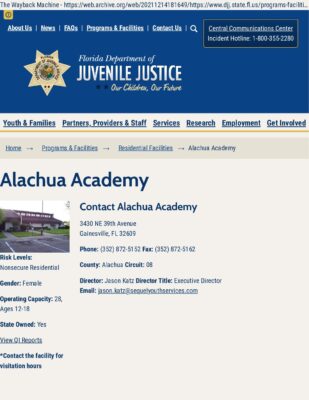 Djj.state.fl.us Programs-Facilities Residential-Facilities Alachua-Academy (Wayback 2021-12-14) Website capture
-
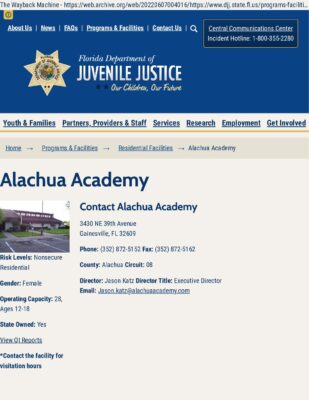 Djj.state.fl.us Programs-Facilities Residential-Facilities Alachua-Academy (Wayback 2022-06-07) Website capture
-
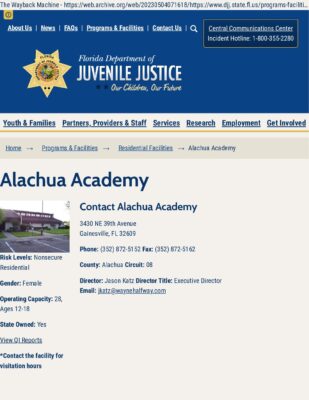 Djj.state.fl.us Programs-Facilities Residential-Facilities Alachua-Academy (Wayback 2023-05-04) Website capture
-
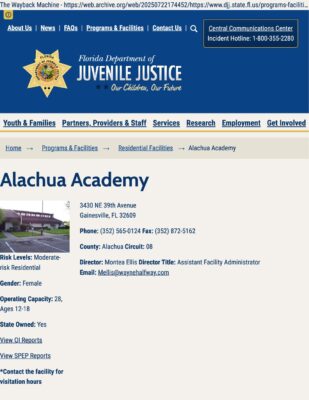 Djj.state.fl.us Programs-Facilities Residential-Facilities Alachua-Academy (Wayback 2025-07-22) Website capture
-
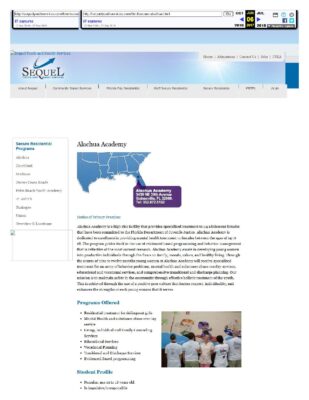 Sequel Website Alachua Academy 2017 Website capture
From the Unsilenced archive
1 document about Alachua Academy that Unsilenced collected and Kids Over Profits does not hold a copy of. They open on Unsilenced's Google Drive. Their whole folder: Alachua Academy.
We have questions about Alachua Academy
If you were there, worked there or sent your child there, you can help fill in what our records are missing. Each question takes a moment; skip anything you do not know.
Materials and links
External links
Archived pages
From SCIAD NET.