Facility profile Florida
Duval Academy
Duval Academy is a juvenile justice RTC in Jacksonville, Florida, operated by Rite of Passage, Inc. It has operated since 2013.
About Duval Academy
Youth Services International ran Duval Academy for Florida DJJ from July 2013 until Sequel TSI of Florida took over in 2016; DJJ listed Sequel through December 2021, Wayne Halfway House from at least March 2023 to December 2025, and Rite of Passage, Inc. in 2026.source 1, source 2
Florida DJJ lists Rite of Passage, Inc. as the provider of Duval Academy (October 2026); Sequel TSI of Florida ran it from 2016 to 2022 and Wayne Halfway House, a separate Tennessee company not part of Sequel, from about 2023 to 2025.source 1, source 2
Timeline
From the records: who ran it and the deals that moved it, its names, and the deaths, incidents, inspection findings, lawsuits and news stories on file. Point at an event, or tap "More about this", for the details.
2013
Youth Services International began running it
It ran the program until 2016.
Opened in Jacksonville, Florida
2016
Sequel Youth and Family Services took it over from Youth Services International
It ran the program until 2022.
2017
Sequel TSI: Sold a majority stake to Altamont Capital Partners
Sequel Youth and Family Services ran Duval Academy at the time.
Sequel TSI: Sold a majority stake to Altamont Capital Partners September 1, 2017
Altamont Capital Partners announced a majority equity investment in Sequel through a holding company, SYFS Parent; terms were not disclosed. At the time Sequel ran 44 programs in 19 states, and APM Reports counted 35 residential treatment centers in 16 states. CEO John Stupak stayed on and co-founder Jay Ripley remained board chairman. Altamont's portfolio page lists the investment as active and says SYFS Parent later acquired Rebecca & Aaron Schools (2017) and Pine Cone Therapies (2020).
2021
Vivant Behavioral Health: Founded by Sequel co-founder Jay Ripley and bought most of Sequel's remaining centers
Sequel Youth and Family Services ran Duval Academy at the time.
Vivant Behavioral Health: Founded by Sequel co-founder Jay Ripley and bought most of Sequel's remaining centers
Jay Ripley, one of Sequel's three founders, founded Vivant Behavioral Healthcare in 2021. Sequel sold most of its centers that had not closed to Vivant, which now controls most former Sequel treatment centers still open.
2023
Wayne Halfway House took it over from Sequel Youth and Family Services
It ran the program until 2025.
2025
Wayne Halfway House stopped running it
Business filings
The company registered with the state behind this program, as the state's business register lists it.
Duval Academy, Inc.
Florida profit corporation, document P94000029079, filed April 15, 1994, inactive. Federal employer number 65-0484183. Florida's record of it
- Principal address
- 602 Anderson Circle at Tivoli, Deerfield Beach, FL, 33441
- Officers on file
- Rena Smith, President
- Registered agent
- Ren'a L Smith
Filings since it was formed
- September 19, 2003: Admin dissolution for annual report
News coverage
-
Funding, Oversight Next Questions for Florida’s Private Youth Prison System
Following a whistleblower lawsuit alleging that contractor Youth Services International failed to provide appropriate services and falsified contract documents, Florida state officials moved to terminate remaining contracts with the for-profit company. The transition has prompted lawmakers and advocates to examine the state's reliance on private, for-profit juvenile facilities, focusing on funding levels, contract monitoring, and oversight practices.

Staff
Administration
-
Timothy Patterson
-
Claude Henderson
-
Edward Harrison (Current)
Licensing and inspections
- Program
- DJJ-duval-academy
- License category
- Moderate-risk Residential
- Executive director
- Mike Smith
- Licensed capacity
- 28
- Licensing action
- Active
- Phone on file
- (904) 777-0100
- Licensed address
- 7500 Ricker Road, Jacksonville, FL 32244-5052
40 inspection reports on file. Search all Florida reports
The newest 25 reports, by date: 50 findings in 6 reports
- Jun 30, 2026 SPEP - FY25-26
- Jun 30, 2026 SPEP - FY25-26
- Jun 30, 2026 SPEP - FY25-26
-
Jun 30, 2026
QI Residential - FY25-26
8 findings
-
Limited compliance, DJJ review : Indicator 2.04 Classifications Factors, Procedures, and Reassessment for Activities
The program originally received a Limited Compliance rating for this indicator during the 2024-2025 annual compliance review, conducted March 11, 2025, through March 14, 2025. The program has a written policy and procedures in place which addresses a classification system, is implemented in accordance with Florida Administrative Code, and promotes safety and security as well as the effective delivery of treatment services. The system is designed to ensure the safest room and dorm assignment for the arriving youth. Upon being admitted to the program the youth is assessed for youth demographic information, physical characteristics, level of maturity, background information, key indicators or abnormal behaviors, such as medical needs and mental health/substance abuse needs, youth’s skill level, current committing offense(s), demonstrated behavior at intake, the youth’s prior history, security risk, gang affiliation/involvement, internal alert classification, and vulnerability and or level of aggression. Missing from the program’s classification form and screening process was the youth’s perception of vulnerability as well as a review of the youth’s history of potential or verified human trafficking. The form classifies youth based on their risk. Five case management records were reviewed. All five reviewed records demonstrated the classification meeting was completed at the time of the youth’s admission. Two youth were admitted with verified medical alerts in the Department’s ...
-
Failed compliance, DJJ review : Indicator 2.05 Gang Identification: Notification of Law Enforcement
The program originally received a Failed Compliance rating for this indicator during the 2024- 2025 annual compliance review, conducted March 11, 2025, through March 14, 2025. The program has a written policy and procedures in place which outlines notification of law enforcement regarding youth entering the program with suspected gang affiliation, or documented gang membership, as well as for youth who are observed engaging in gang activities during their commitment to the program. Five case management records were reviewed; however, only one was applicable for gang affiliation or membership. The program was able to provide two additional records for review of gang identification and notification. Each of the youth were admitted with previous gang alerts from their home counties confirmed in the Department’s Juvenile Justice Information System (JJIS), as well as completed gang questionnaires. None of the identified youth had any documentation to support local law enforcement or law enforcement in the youth’s home county were contacted. Two of the three applicable youth records contained notifications to the school system and all three applicable youth had notifications to the juvenile probation officer (JPO). During the re-review the program received a Satisfactory Compliance rating for this indicator. The program has a policy and procedures for gathering information on gangs or youth involved in gang and sharing this information with law enforcement. Five youth case ...
-
Failed compliance, DJJ review : Indicator 2.06 Gang Identification: Prevention and Intervention Activities
The program originally received a Failed Compliance rating for this indicator during the 2024- 2025 annual compliance review, conducted March 11, 2025, through March 14, 2025. The program has a written policy and procedures in place which addresses the implementation of gang prevention and intervention strategies. During the admission process, youth are screened for gang involvement with the gang questionnaire and cross referencing the youth’s face sheet and alerts page in the Department’s Juvenile Justice Information System (JJIS). The policy stated the use of Impact of Crime curriculum (IOC) will be a component of the intervention strategies used. The policy further stated the program will also seek out “education and guest speakers”. The program provided a “gang binder” which offered “Gang 50 Stories” as an additional intervention activity, not mentioned in their policy; however, the program could not provide any completed assignments for any of the youth identified as gang members. Five records were reviewed and one youth was applicable. A review of the JJIS alerts and closed record samples revealed two additional samples. The one youth identified in JJIS was not identified as such in the program’s “gang binder”. Each of the identified youth had delinquency intervention goals related to completing IOC; however, none of the youth had any specific identified goals or objectives related to gang prevention/intervention. A review of sign-in sheets revealed each youth was ...
-
Limited compliance, DJJ review : Indicator 2.07 Residential Assessment for Youth (RAY) Assessments and Re-Assessments
The program originally received a Limited Compliance rating for this indicator during the 2024-2025 annual compliance review, conducted March 11, 2025, through March 14, 2025. The program has a policy and procedures in place to ensure a Residential Assessment for Youth (RAY) is completed within thirty days of the youth’s admission to the program and the RAY re-assessments are completed within ninety days after completion of the initial RAY . Five youth case management records were reviewed, and all five records contained an initial RAY completed within the required timeframe. All initial RAYs were completed with the Department’s Juvenile Justice Information System (JJIS). Five records were also reviewed for eligibility of RAY re-assessments. Four youth were eligible. All four records demonstrated the youth’s RAY re-assessments were completed beyond the ninety-day requirement. One record only had a modified initial RAY within the required timeframe. The remaining three records were twenty- three, nine, and one day late. None of the printed RAY re-assessments had corresponding comparative reports. During the re-review the program received a Satisfactory Compliance rating for this indicator. The program has a policy and procedures requiring an initial assessment of each youth is conducted within thirty days of admission, utilizing the Residential Assessment for Youth (RAY) tool. Documentation of the initial assessment process is maintained in the Department’s Juvenile Justice ...
-
Limited compliance, DJJ review : Indicator 2.11 Performance Summaries and Transmittals
The program originally received a Limited Compliance rating for this indicator during the 2024-2025 annual compliance review, conducted March 11, 2025, through March 14, 2025. The program has a policy and procedures in place to ensure performance summaries and transmittals are completed within required timeframes. At each ninety-day interval, beginning ninety days from the signing of the youth’s Individualized Performance Plan (IPP), the intervention and treatment team meets to create a performance summary. In addition, prior to the youth’s release, discharge, or transfer from the program, the intervention and treatment team will meet in order to create the performance summary. Five open and three closed youth records were reviewed for the completion of performance summaries. Three of the open youth and all three closed youth records were applicable for performance summaries. A total of eight summaries were reviewed. Seven of eight performance summaries reviewed were completed within timeframe requirements and the remaining one was twenty-three days late. Three of the five open youth performance summaries did not capture any youth comments, instead noting the section was “not applicable”. Each of the open youth summaries had corresponding transmittals to required individuals; however, the closed records did not have any corresponding transmittals. All performance summaries included the youth’s status on each performance and treatment plan goal, the youth’s overall adjustment ...
-
Limited compliance, DJJ review : Indicator 2.12 Parent/Guardian Invovement in Case Management Services
The program originally received a Limited Compliance rating for this indicator during the 2024-2025 annual compliance review, conducted March 11, 2025, through March 14, 2025. The program has a policy and procedures to encourage and facilitate the involvement of the youth’s parents/guardians in the case management process. The policy outlines how parent participation is facilitated throughout the entire youth’s length of stay in the program. If the parent/guardian is unable to attend any of the meetings in person, they are given the opportunity to participate by telephone and can provide verbal or written input as well. Five youth records were reviewed and reflected the youth’s parent/guardian are contacted at the time of admission and mailed an admission letter which is inclusive of a handbook and a questionnaire asking for input into treatment planning. There were no formal treatment teams scheduled or observed during the annual compliance review week. None of the five youth records indicated the parents/guardians were provided any advance notice of the youth’s formal treatment teams. Additionally, there was no correspondence inviting the parents/guardians to participate in the youth’s transition. The formal treatment teams reviewed indicated many parents/guardians participated by phone; however, there were no comments noted to confirm. The program reported they provide weekly visitation; however, documentation of visitation was sporadic. The facility administrator was ...
-
Limited compliance, DJJ review : Indicator 2.13 Treatment Team Members and Meetings (Formal and Informal Reviews)
The program originally received a Limited Compliance rating for this indicator during the 2024-2025 annual compliance review, conducted March 11, 2025, through March 14, 2025. The program has a policy and procedures in place to ensure each youth and their intervention and treatment team meet on a bi-weekly basis to review the youth’s performance, to include Residential Assessment for Youth (RAY) re-assessment results, progress on individualized performance plan (IPP) goals, positive and negative behaviors, including behavior resulting in physical interventions, and treatment plan progress. Five youth case management records were reviewed and a twenty-three formal treatment team reviews were reviewed. Each meeting was held at thirty day intervals and contained components which addressed a review of the Performance Plan Progress Report, performance plan goal focus for the month, stages of change, physical and medical progress report, education progress report, review of progress reports, mental health/substance abuse progress report, issues/concerns with peers or staff, overall program adjustment, and program behavior and performance progress report. The documentation contained evidence participants who actively participated could sign. This included the youth’s parents/guardians and juvenile probation officer (JPO). The reviews documented if the parent/guardian and JPO participated, it was by phone and there were no comments or signatures confirming their participation. Each ...
-
Limited compliance, DJJ review : Indicator 2.15 Exit Portfolio
The program originally received a Limited Compliance rating for this indicator during the 2024-2025 annual compliance review, conducted March 11, 2025, through March 14, 2025. The program has a policy and procedures in place addressing the program’s exit process to include assembling an exit portfolio for each youth to assist them once they are released back into their home community. A review of three closed youth case management records found all contained elements of an exit portfolio. None of the records verified the exit portfolio was initiated during the youth’s transition conference. None of the portfolios contained state issued identification cards, social security cards, or birth certificates; however, there was evidence these documents were solicited from the parents/guardians at admission. None of the exit portfolios contained a calendar with all dates, times, and locations of upcoming community appointments. All three exit portfolios contained a copy of the youth’s transition conference. Two of the three portfolios contained the following: vocational certificates, educational records, school transcripts, and resumes. Only one youth portfolio contained a sample of employment application. None of the youth’s portfolios contained evidence they were verified at the youth’s exit conference, provided to the youth upon their release, or forwarded to the youth’s juvenile probation officer. A review of the program’s contract did not reveal any additional requirements for ...
-
- Jun 30, 2026 QI Detention - FY25-26
-
Jun 30, 2026
QI Residential - FY25-26
8 findings
-
Limited compliance, DJJ review : Indicator 2.04 Classifications Factors, Procedures, and Reassessment for Activities
The program originally received a Limited Compliance rating for this indicator during the 2024-2025 annual compliance review, conducted March 11, 2025, through March 14, 2025. The program has a written policy and procedures in place which addresses a classification system, is implemented in accordance with Florida Administrative Code, and promotes safety and security as well as the effective delivery of treatment services. The system is designed to ensure the safest room and dorm assignment for the arriving youth. Upon being admitted to the program the youth is assessed for youth demographic information, physical characteristics, level of maturity, background information, key indicators or abnormal behaviors, such as medical needs and mental health/substance abuse needs, youth’s skill level, current committing offense(s), demonstrated behavior at intake, the youth’s prior history, security risk, gang affiliation/involvement, internal alert classification, and vulnerability and or level of aggression. Missing from the program’s classification form and screening process was the youth’s perception of vulnerability as well as a review of the youth’s history of potential or verified human trafficking. The form classifies youth based on their risk. Five case management records were reviewed. All five reviewed records demonstrated the classification meeting was completed at the time of the youth’s admission. Two youth were admitted with verified medical alerts in the Department’s ...
-
Failed compliance, DJJ review : Indicator 2.05 Gang Identification: Notification of Law Enforcement
The program originally received a Failed Compliance rating for this indicator during the 2024- 2025 annual compliance review, conducted March 11, 2025, through March 14, 2025. The program has a written policy and procedures in place which outlines notification of law enforcement regarding youth entering the program with suspected gang affiliation, or documented gang membership, as well as for youth who are observed engaging in gang activities during their commitment to the program. Five case management records were reviewed; however, only one was applicable for gang affiliation or membership. The program was able to provide two additional records for review of gang identification and notification. Each of the youth were admitted with previous gang alerts from their home counties confirmed in the Department’s Juvenile Justice Information System (JJIS), as well as completed gang questionnaires. None of the identified youth had any documentation to support local law enforcement or law enforcement in the youth’s home county were contacted. Two of the three applicable youth records contained notifications to the school system and all three applicable youth had notifications to the juvenile probation officer (JPO). During the re-review the program received a Satisfactory Compliance rating for this indicator. The program has a policy and procedures for gathering information on gangs or youth involved in gang and sharing this information with law enforcement. Five youth case ...
-
Failed compliance, DJJ review : Indicator 2.06 Gang Identification: Prevention and Intervention Activities
The program originally received a Failed Compliance rating for this indicator during the 2024- 2025 annual compliance review, conducted March 11, 2025, through March 14, 2025. The program has a written policy and procedures in place which addresses the implementation of gang prevention and intervention strategies. During the admission process, youth are screened for gang involvement with the gang questionnaire and cross referencing the youth’s face sheet and alerts page in the Department’s Juvenile Justice Information System (JJIS). The policy stated the use of Impact of Crime curriculum (IOC) will be a component of the intervention strategies used. The policy further stated the program will also seek out “education and guest speakers”. The program provided a “gang binder” which offered “Gang 50 Stories” as an additional intervention activity, not mentioned in their policy; however, the program could not provide any completed assignments for any of the youth identified as gang members. Five records were reviewed and one youth was applicable. A review of the JJIS alerts and closed record samples revealed two additional samples. The one youth identified in JJIS was not identified as such in the program’s “gang binder”. Each of the identified youth had delinquency intervention goals related to completing IOC; however, none of the youth had any specific identified goals or objectives related to gang prevention/intervention. A review of sign-in sheets revealed each youth was ...
-
Limited compliance, DJJ review : Indicator 2.07 Residential Assessment for Youth (RAY) Assessments and Re-Assessments
The program originally received a Limited Compliance rating for this indicator during the 2024-2025 annual compliance review, conducted March 11, 2025, through March 14, 2025. The program has a policy and procedures in place to ensure a Residential Assessment for Youth (RAY) is completed within thirty days of the youth’s admission to the program and the RAY re-assessments are completed within ninety days after completion of the initial RAY . Five youth case management records were reviewed, and all five records contained an initial RAY completed within the required timeframe. All initial RAYs were completed with the Department’s Juvenile Justice Information System (JJIS). Five records were also reviewed for eligibility of RAY re-assessments. Four youth were eligible. All four records demonstrated the youth’s RAY re-assessments were completed beyond the ninety-day requirement. One record only had a modified initial RAY within the required timeframe. The remaining three records were twenty- three, nine, and one day late. None of the printed RAY re-assessments had corresponding comparative reports. During the re-review the program received a Satisfactory Compliance rating for this indicator. The program has a policy and procedures requiring an initial assessment of each youth is conducted within thirty days of admission, utilizing the Residential Assessment for Youth (RAY) tool. Documentation of the initial assessment process is maintained in the Department’s Juvenile Justice ...
-
Limited compliance, DJJ review : Indicator 2.11 Performance Summaries and Transmittals
The program originally received a Limited Compliance rating for this indicator during the 2024-2025 annual compliance review, conducted March 11, 2025, through March 14, 2025. The program has a policy and procedures in place to ensure performance summaries and transmittals are completed within required timeframes. At each ninety-day interval, beginning ninety days from the signing of the youth’s Individualized Performance Plan (IPP), the intervention and treatment team meets to create a performance summary. In addition, prior to the youth’s release, discharge, or transfer from the program, the intervention and treatment team will meet in order to create the performance summary. Five open and three closed youth records were reviewed for the completion of performance summaries. Three of the open youth and all three closed youth records were applicable for performance summaries. A total of eight summaries were reviewed. Seven of eight performance summaries reviewed were completed within timeframe requirements and the remaining one was twenty-three days late. Three of the five open youth performance summaries did not capture any youth comments, instead noting the section was “not applicable”. Each of the open youth summaries had corresponding transmittals to required individuals; however, the closed records did not have any corresponding transmittals. All performance summaries included the youth’s status on each performance and treatment plan goal, the youth’s overall adjustment ...
-
Limited compliance, DJJ review : Indicator 2.12 Parent/Guardian Invovement in Case Management Services
The program originally received a Limited Compliance rating for this indicator during the 2024-2025 annual compliance review, conducted March 11, 2025, through March 14, 2025. The program has a policy and procedures to encourage and facilitate the involvement of the youth’s parents/guardians in the case management process. The policy outlines how parent participation is facilitated throughout the entire youth’s length of stay in the program. If the parent/guardian is unable to attend any of the meetings in person, they are given the opportunity to participate by telephone and can provide verbal or written input as well. Five youth records were reviewed and reflected the youth’s parent/guardian are contacted at the time of admission and mailed an admission letter which is inclusive of a handbook and a questionnaire asking for input into treatment planning. There were no formal treatment teams scheduled or observed during the annual compliance review week. None of the five youth records indicated the parents/guardians were provided any advance notice of the youth’s formal treatment teams. Additionally, there was no correspondence inviting the parents/guardians to participate in the youth’s transition. The formal treatment teams reviewed indicated many parents/guardians participated by phone; however, there were no comments noted to confirm. The program reported they provide weekly visitation; however, documentation of visitation was sporadic. The facility administrator was ...
-
Limited compliance, DJJ review : Indicator 2.13 Treatment Team Members and Meetings (Formal and Informal Reviews)
The program originally received a Limited Compliance rating for this indicator during the 2024-2025 annual compliance review, conducted March 11, 2025, through March 14, 2025. The program has a policy and procedures in place to ensure each youth and their intervention and treatment team meet on a bi-weekly basis to review the youth’s performance, to include Residential Assessment for Youth (RAY) re-assessment results, progress on individualized performance plan (IPP) goals, positive and negative behaviors, including behavior resulting in physical interventions, and treatment plan progress. Five youth case management records were reviewed and a twenty-three formal treatment team reviews were reviewed. Each meeting was held at thirty day intervals and contained components which addressed a review of the Performance Plan Progress Report, performance plan goal focus for the month, stages of change, physical and medical progress report, education progress report, review of progress reports, mental health/substance abuse progress report, issues/concerns with peers or staff, overall program adjustment, and program behavior and performance progress report. The documentation contained evidence participants who actively participated could sign. This included the youth’s parents/guardians and juvenile probation officer (JPO). The reviews documented if the parent/guardian and JPO participated, it was by phone and there were no comments or signatures confirming their participation. Each ...
-
Limited compliance, DJJ review : Indicator 2.15 Exit Portfolio
The program originally received a Limited Compliance rating for this indicator during the 2024-2025 annual compliance review, conducted March 11, 2025, through March 14, 2025. The program has a policy and procedures in place addressing the program’s exit process to include assembling an exit portfolio for each youth to assist them once they are released back into their home community. A review of three closed youth case management records found all contained elements of an exit portfolio. None of the records verified the exit portfolio was initiated during the youth’s transition conference. None of the portfolios contained state issued identification cards, social security cards, or birth certificates; however, there was evidence these documents were solicited from the parents/guardians at admission. None of the exit portfolios contained a calendar with all dates, times, and locations of upcoming community appointments. All three exit portfolios contained a copy of the youth’s transition conference. Two of the three portfolios contained the following: vocational certificates, educational records, school transcripts, and resumes. Only one youth portfolio contained a sample of employment application. None of the youth’s portfolios contained evidence they were verified at the youth’s exit conference, provided to the youth upon their release, or forwarded to the youth’s juvenile probation officer. A review of the program’s contract did not reveal any additional requirements for ...
-
-
Jun 30, 2025
QI Residential - FY24-25 - 16 findings
16 findings
-
Limited compliance, DJJ review : Indicator 1.08 In-Service Training
Residential contracted provider staff shall complete twenty-four hours of in-service training, including mandatory topics specified in Florida Administrative Code, each calendar year, effective the year after pre-service/certification training is completed. Supervisory staff shall complete eight hours of training in addition to the twenty-four hours of annual in-service training) in the areas specified in Florida Administrative Code. The program has a policy and procedures for annual in-service training. Five staff training records were reviewed for in-service training. A review of both the Department’s Learning Management System (SkillPro) and on-site training records was conducted due to the SkillPro) being offline during a portion of the annual compliance review period. Two of the five reviewed staff did not complete the required hours and only completed fourteen and eighteen hours respectively, the remaining three staff completed the required twenty-four hours of in-service training. Three of five staff did not complete active shooter training. Four of the five staff did not complete information security awareness and mental health and substance abuse. Three out of five staff did not complete professionalism, interpersonal communication, and ethics. One staff did not complete sexual harassment. Two out of five staff did not complete suicide prevention and trauma responsive practices. All five staff completed or were currently certified in cardiopulmonary resuscitation ...
-
Limited compliance, DJJ review : Indicator 1.13 Internal Alerts System and Alerts (JJIS) (Critical)
The program shall maintain and use an internal alert system easily accessible to program staff and keeps staff alerted about youth who are security or safety risks, and youth with health-related concerns, including food allergies and special diets. When risk factors or special needs are identified during or after the classification process, the program immediately enters this information into the internal alert system. The program ensures only appropriate staff may recommend downgrading or discontinuing a youth’s alert status. When risk factors or special needs are identified during, or after, the classification process, the program immediately enters this information into the Department’s Juvenile Justice Information System (JJIS). Upon recommendation from appropriate staff, JJIS alerts are downgraded or discontinued. According to the program’s written policy, the program’s internal alert system is updated on a continual basis and all staff have access to alerts. A review of five youth records was conducted. All of the youth had alerts placed in the Department’s Juvenile Justice Information System (JJIS). Each of the alerts were removed or downgraded by medical or mental health staff, as required. Each applicable alert was documented in the program’s logbook. The program utilizes an alert board as a direct way of informing staff of any updated alerts for all youth. The alert board updates were found to be inconsistent and not current. Youth were listed who had been ...
-
Limited compliance, DJJ review : Indicator 2.04 Classification Factors, Procedures, and Reassessment for
Activities The program utilizes a classification system, in accordance with Florida Administrative Code, promoting safety and security, as well as effective delivery of treatment services. Initial classification should be used for the purposes of assigning each newly admitted youth to a living unit, sleeping room, and youth group or staff advisor. Youth are reassessed and reclassified, if warranted, prior to considering an increase in privileges or freedom of movement, participation in work projects, or other activities involving tools or instruments which may be used as potential weapons or means of escape, or participation in any off- campus activity. All youth admitted to residential commitment programs shall be screened for vulnerability to victimization and sexually aggressive behavior prior to room assignment. Room assignments by staff shall ensure a youth’s potential for victimization or predatory risk has been reviewed. The screening shall be completed in JJIS. The program has a written policy and procedures in place which addresses a classification system,is implemented in accordance with Florida Administrative Code, and promotes safety and security as well as the effective delivery of treatment services. The system is designed to ensure the safest room and dorm assignment for the arriving youth. Upon being admitted to the program the youth is assessed for youth demographic information, physical characteristics, level of maturity, background information, key ...
-
Failed compliance, DJJ review : Indicator 2.05 Gang Identification: Notification of Law Enforcement
The program shall gather information on gangs, (e.g., gang members, tattoos, other body markings) and share this information with law enforcement. The program has a written policy and procedures in place which outlines notification of law enforcement regarding youth entering the program with suspected gang affiliation, or documented gang membership, as well as for youth who are observed engaging in gang activities during their commitment to the program. Five case management records were reviewed; however, only one was applicable for gang affiliation or membership. The program was able to provide two additional records for review of gang identification and notification. Each of the youth were admitted with previous gang alerts from their home counties confirmed in the Department’s Juvenile Justice Information System (JJIS), as well as completed gang questionnaires. None of the identified youth had any documentation to support local law enforcement or law enforcement in the youth’s home county were contacted. Two of the three applicable youth records contained notifications to the school system and all three applicable youth had notifications to the juvenile probation officer (JPO).
-
Failed compliance, DJJ review : Indicator 2.06 Gang Identification: Prevention and Intervention Activities
A program shall implement gang prevention and intervention strategies. The program shall provide intervention strategies when youth are identified as a criminal street gang member, are affiliated with any criminal street gang, or are at high-risk for gang involvement. The program has a written policy and procedures in place which addresses the implementation of gang prevention and intervention strategies. During the admission process, youth are screened for gang involvement with the gang questionnaire and cross referencing the youth’s face sheet and alerts page in the Department’s Juvenile Justice Information System (JJIS). The policy stated the use of Impact of Crime curriculum (IOC) will be a component of the intervention strategies used. The policy further stated the program will also seek out “education and guest speakers”. The program provided a “gang binder” which offered “Gang 50 Stories” as an additional intervention activity, not mentioned in their policy; however, the program could not provide any completed assignments for any of the youth identified as gang members. Five records were reviewed and one youth was applicable. A review of the JJIS alerts and closed record samples revealed two additional samples. The one youth identified in JJIS was not identified as such in the program’s “gang binder”. Each of the identified youth had delinquency intervention goals related to completing IOC; however, none of the youth had any specific identified goals or objectives ...
-
Limited compliance, DJJ review : Indicator 2.07 Residential Assessment for Youth (RAY) Assessments and
Re-Assessments The program shall ensure an initial assessment of each youth is conducted within thirty days of admission. Documentation of the initial assessment process is to be maintained in JJIS. The program shall ensure reassessments are completed for each youth at least every ninety days from the initial assessment. The program shall ensure any other updates or reassessments are completed, when deemed necessary, by the intervention and treatment team to effectively manage the youth’s case. The program shall maintain all reassessment documentation in the youth’s official youth case record. The program has a policy and procedures in place to ensure a Residential Assessment for Youth (RAY) is completed within thirty days of the youth’s admission to the program and the RAY re-assessments are completed within ninety days after completion of the initial RAY . Five youth case management records were reviewed, and all five records contained an initial RAY completed within the required timeframe. All initial RAYs were completed with the Department’s Juvenile Justice Information System (JJIS). Five records were also reviewed for eligibility of RAY re-assessments. Four youth were eligible. All four records demonstrated the youth’s RAY re-assessments were completed beyond the ninety-day requirement. One record only had a modified initial RAY within the required timeframe. The remaining three records were twenty- three, nine, and one day late. None of the printed RAY re-assessments ...
-
Limited compliance, DJJ review : Indicator 2.11 Performance Summaries and Transmittals
The intervention and treatment team shall prepare a Performance Summary at ninety day intervals, beginning ninety-days from the signing of the youth’s performance plan, or at shorter intervals when requested by the youth’s committing court. Additionally, the intervention and treatment team shall prepare a performance summary prior to the youth’s release, discharge, or transfer from the program. The program shall distribute the Performance Summary, as required, within ten working days of signing. The program has a policy and procedures in place to ensure performance summaries and transmittals are completed within required timeframes. At each ninety-day interval, beginning ninety days from the signing of the youth’s Individualized Performance Plan (IPP), the intervention and treatment team meets to create a performance summary. In addition, prior to the youth’s release, discharge, or transfer from the program, the intervention and treatment team will meet in order to create the performance summary. Five open and three closed youth records were reviewed for the completion of performance summaries. Three of the open youth and all three closed youth records were applicable for performance summaries. A total of eight summaries were reviewed. Seven of eight performance summaries reviewed were completed within timeframe requirements and the remaining one was twenty-three days late. Three of the five open youth performance summaries did not capture any youth comments, instead noting ...
-
Limited compliance, DJJ review : Indicator 2.12 Parent/Guardian Involvement in Case Management
Services The program shall, to the extent possible and reasonable, encourage and facilitate involvement of the youth’s parent/guardian in the case management process. The program has a policy and procedures to encourage and facilitate the involvement of the youth’s parents/guardians in the case management process. The policy outlines how parent participation is facilitated throughout the entire youth’s length of stay in the program. If the parent/guardian is unable to attend any of the meetings in person, they are given the opportunity to participate by telephone and can provide verbal or written input as well. Five youth records were reviewed and reflected the youth’s parent/guardian are contacted at the time of admission and mailed an admission letter which is inclusive of a handbook and a questionnaire asking for input into treatment planning. There were no formal treatment teams scheduled or observed during the annual compliance review week. None of the five youth records indicated the parents/guardians were provided any advance notice of the youth’s formal treatment teams. Additionally, there was no correspondence inviting the parents/guardians to participate in the youth’s transition. The formal treatment teams reviewed indicated many parents/guardians participated by phone; however, there were no comments noted to confirm. The program reported they provide weekly visitation; however, documentation of visitation was sporadic. The facility administrator was interviewed ...
-
Limited compliance, DJJ review : Indicator 2.13 Treatment Team Members and Meetings (Formal and
Informal Reviews) The treatment team members include, at a minimum, the youth, representatives from the program’s administration and residential living unit, education, and others responsible for providing or overseeing the provision of intervention and treatment services. The program has a policy and procedures in place to ensure each youth and their intervention and treatment team meet on a bi-weekly basis to review the youth’s performance, to include Residential Assessment for Youth (RAY) re-assessment results, progress on individualized performance plan (IPP) goals, positive and negative behaviors, including behavior resulting in physical interventions, and treatment plan progress. Five youth case management records were reviewed and a twenty-three formal treatment team reviews were reviewed. Each meeting was held at thirty day intervals and contained components which addressed a review of the Performance Plan Progress Report , performance plan goal focus for the month, stages of change, physical and medical progress report, education progress report, review of progress reports, mental health/substance abuse progress report, issues/concerns with peers or staff, overall program adjustment, and program behavior and performance progress report. The documentation contained evidence participants who actively participated could sign. This included the youth’s parents/guardians and juvenile probation officer (JPO). The reviews documented if the parent/guardian and JPO ...
-
Limited compliance, DJJ review : Indicator 2.15 Exit Portfolio
The program will assemble an Exit Portfolio for each youth to assist once released back into the community. The program has a policy and procedures in place addressing the program’s exit process to include assembling an exit portfolio for each youth to assist them once they are released back into their home community. A review of three closed youth case management records found all contained elements of an exit portfolio. None of the records verified the exit portfolio was initiated during the youth’s transition conference. None of the portfolios contained state issued identification cards, social security cards, or birth certificates; however, there was evidence these documents were solicited from the parents/guardians at admission. None of the exit portfolios contained a calendar with all dates, times, and locations of upcoming community appointments. All three exit portfolios contained a copy of the youth’s transition conference. Two of the three portfolios contained the following: vocational certificates, educational records, school transcripts, and resumes. Only one youth portfolio contained a sample of employment application. None of the youth’s portfolios contained evidence they were verified at the youth’s exit conference, provided to the youth upon their release, or forwarded to the youth’s juvenile probation officer. A review of the program’s contract did not reveal any additional requirements for the youth’s portfolios.
-
Limited compliance, DJJ review : Indicator 3.06 Mental Health and Substance Abuse Treatment (Critical)
Youth determined to have a serious mental disorder or substance abuse impairment and are receiving mental health or substance abuse treatment in a program, shall have an Initial or Individualized Mental Health or Substance Abuse Treatment Plan. When mental health or substance abuse treatment is initiated, an Initial or Individualized Mental Health or Substance Abuse Treatment Plan is completed. Five youth mental health records were reviewed for mental health and substance abuse treatment. All five records included documentation the initial treatment plan was developed within seven days of initiation of treatment. Each initial treatment plan was documented on the Department’s Initial Mental Health/Substance Abuse Treatment Plan form. Two records were applicable for psychiatric services to be included on the initial treatment plan and both were missing documentation of those services. All five initial treatment plans were signed by the clinical staff who completed the form and signed by the licensed clinical supervisor within ten days of completion. Four of the five initial treatment plans were signed by all required members of the treatment team who participated in the development of the plan and included documentation of the initial treatment plan being mailed to the parents/guardians. The remaining plan did not have documentation the initial treatment plan was mailed to the parent/guardian. Four youth mental health records were applicable for review of Individualized ...
-
Limited compliance, DJJ review : Indicator 3.13 Suicide Precaution Observation Logs (Critical)
Youth placed on suicide precautions shall be maintained on one-to-one or constant supervision. The staff assigned to observe the youth shall provide the appropriate level of supervision and record observations of the youth's behavior at intervals of thirty minutes, at a minimum. Five youth records were reviewed and only one was applicable for Suicide Precaution Observation (PO) logs; however, this youth had two applicable incidents which were reviewed. One additional applicable record was provided and reviewed. In all three reviewed incidents, the PO logs were maintained for the duration the youth was on suicide precaution. In one record reviewed, the appropriate level of supervision and observations of the youth’s behavior was documented in real time and did not exceed thirty-minute intervals. In the second record reviewed, a total of twenty-one Precautionary Observation Logs were reviewed for all incidents. Sixteen of the twenty-one logs had one or more late checks documented; one log had a three- hour gap and another had a four-hour gap. Nine logs were missing a supervisor signature and/or the date and time.Nineteen of the twenty-one logs had no notation of warning signs being observed, and there was no documentation of notification to the program director or designee and mental health clinical staff. One log had indication of pre-populated times being documented. One log was missing a mental health clinical staff signature. None of the logs reviewed documented safe ...
-
Limited compliance, DJJ review : Indicator 5.06 Logbook Entries and Shift Report Review
The program maintains a chronological record of events, incidents, and activities in a central logbook maintained at master control, living unit logbooks, or both. The program ensures direct-care staff, including each supervisor, are briefed when coming on-duty. The program has a policy and procedures requiring a chronological record of routine events, incidents, activities, and emergency situations in a logbook in accordance with Florida Administrative Code. A review of the program logbooks confirmed the logbooks were bound with pre-printed numbered pages; however, the logbook for a portion of September, all of October, and some of November were severely damaged. Pages were torn out and stapled in, with half of the pages being out of order. The February logbook was found to be missing large sections of the chronological narrative with no explanation. Observations and a review of logbooks during the annual compliance review period found logbook entries were documented in ink with no erasures or white-out errors. Errors were typically struck through with a single line, dated, and initialed by the staff correcting the error; however, in two of the months, the sampled days each contained instances of completely scratched through information with no indication of what was removed or who removed it. The logbook’s highlights, indicating important information categorized according to color, was inconsistent as well as the supervisor’s turn-over signature and shift labels. Reviewed ...
-
Limited compliance, DJJ review : Indicator 5.16 Fire, Safety, and Evacuation Drills
The program shall conduct fire, safety, and evacuation drills to ensure youth and staff are prepared for immediate implementation or mobilization in the event of an emergency or disaster. The program has a policy and procedures for fire and safety drills. Egress Plans are documented throughout the living modules and general-purpose areas throughout the program. Exit signs are clearly visible throughout the program. All eight fire extinguishers were inspected within the program had a current, annual fire extinguisher tag and were inspected monthly. Five staff were interviewed about their participation in drills within the past twelve months. Four staff reported having participated in drills. One staff had not been employed long enough to participate in any drills. Five youth interviewed were able to articulate what to do in case of a fire and indicated fire drills occur anywhere from monthly to two times each month. The facility administrator indicated drills are conducted monthly for each shift. Fire drills and safety drills were reviewed since the last annual compliance review. A drill was located for each month on both shifts except for November. The drill documentation only contained the date, time, and the staff participants. The other required components such as scenario, findings, and recommendations were missing from all fire and safety drills.
-
Limited compliance, DJJ review : Indicator 5.18 Storage, Inventory, and Disposal of Flammable,
Poisonous, and Toxic Items and Materials The program director or designee shall maintain strict control of flammable, poisonous, and toxic items and materials and a complete inventory of all such items. The maintenance personnel, or other trained staff who have the safety equipment for diluting, handling, and disposing of hazardous and/or solid waste, shall be responsible for disposing of hazardous items and toxic materials. The program has a policy and procedures for the storage and inventory of all flammables, poisonous, and toxic items. The safety and security officer and plant manager maintain inventories. Items identified as flammable, poisonous, or toxic fluids may only be drawn by an authorized person. The youth are not allowed to handle these items and do not have access to where they are being used or stored. Youth are not permitted to clean, handle, or dispose of other person’s bio-hazardous material, bodily fluids, or human wastes. The program flammable, poisonous, and toxic chemicals are maintained in fireproof secured cabinets. The program’s disposal procedures are in accordance with Occupational Safety and Health Administration (OSHA) standards. During the review, at no time were chemicals found outside their secured locations unless they were actively being used. Ten chemicals were selected and reviewed for accuracy on the facility inventory. Five chemicals were not accurate to the inventory and one was not located on the inventory at all. A review of the ...
-
Limited compliance, DJJ review : Indicator 6.08 Florida Youth College (Post-Secondary Contract Provider)
The post-secondary provider, upon receiving the referral for services, shall assign a Florida Youth College Career Navigator to each youth. Each youth shall attend an orientation session to develop a career pathway plan. The career pathway plan shall include postsecondary education options at a state or technical college or pre-apprenticeship/apprenticeship programming that leads to an industry credential or academic credit. For youth transitioning from the Department, follow-up shall be completed in thirty, sixty, ninety, and 180 days after their release. Two applicable youth were referred for post-secondary provider services though Florida Youth College (FYC). No other youth were referred during the annual compliance review period. Both reviewed records documented the required information regarding the completed orientation. Neither youth record included a career plan. The provider stated no formal career plans are being developed, just notes being entered with the youth’s career interest; however, the provider is in the process of obtaining a career assessment platform for future use. Only one reviewed closed record documented the required support follow-ups in the required timeframes. The other closed record did not document any youth contact being made after the youth was released from the residential program. Of the five interviewed youth, two are participating in or are preparing to participate in post-secondary education. One youth has received their General ...
-
-
Jun 30, 2025
QI Detention - FY24-25 - 1 finding
1 finding
-
Limited compliance, DJJ review : Indicator 2.10 Educational Access (Critical)
The center shall integrate educational instruction (career and technical education, as well as academic instruction) into the daily schedule in such a way which ensures the integrity of required instructional time. The program has a facility operating procedure (FOP) to provide educational access. The center provides education services through the Duval County School Board and the 250-day calendar, distributed over twelve months, includes ten days used for teacher training and planning. A review of the daily school schedule revealed the center provides four forty-five-minute classes, one seventy-five-minute class, and one sixty-five-minute class from 8:00 a.m. through 1:30 p.m., with a twenty-minute lunch incorporated in the schedule, fulfilling the weekly requirement of twenty-five hours of instructional time. All youth receive credit for course completion as appropriate. The superintendent reported the center interferes minimally with educational instruction. A review of one day each month in the center’s logbook since the last annual compliance review revealed classes started late, ended early, or were missing documentation in seven of the twelve reviewed dates. Three of the dates documented reasons for the discrepancy in educational times, for two days the youth were delayed due to an incident, and the remaining day school time was made up at the end of the day after the youth started late. Nine youth and nine staff were interviewed and all reported little to no ...
-
- Jun 30, 2024 SPEP - FY23-24
- Jun 30, 2024 SPEP - FY23-24
- Jun 30, 2024 SPEP - FY23-24
-
Jun 30, 2024
QI Residential - FY23-24 - 1 finding
1 finding
-
Limited compliance, DJJ review : Indicator 2.16 Exit Portfolio
The program will assemble an Exit Portfolio for each youth to assist once released back into the community. Three closed youth case management records were reviewed for Exit Portfolios. The Exit Portfolio was discussed and initiated for the youth during the transition conference in all three records. All three records included a copy of the youth’s transition plan, educational and/or vocational certificates earned in the program, educational records/documents, school transcripts, résumé, and a completed sample employment application. All three youth were missing copies of their state-issued identification card, Social Security card, and birth certificate, and no evidence was found to show the program attempted to obtain the documents. Two of three records were missing the youth’s Plan for Success, which included a calendar with all dates, times and locations of upcoming community appointments. One youth record included the youth’s Plan for Success, as required. Reviewed documentation did not indicate the Exit Portfolio was completed and given to the youth upon release or forwarded to the youth’s juvenile probation officer for any of the three youth records.
-
- Jun 30, 2024 QI Detention - FY23-24
- Jun 30, 2022 SPEP - FY21-22
- Jun 30, 2022 SPEP - FY21-22
- Jun 30, 2022 SPEP - FY21-22
- Jun 30, 2021 SPEP - FY20-21
- Jun 30, 2021 SPEP - FY20-21
- Jun 30, 2021 SPEP - FY20-21
- Jun 30, 2020 SPEP - FY19-20
- Jun 30, 2020 SPEP - FY19-20
- Jun 30, 2020 SPEP - FY19-20
- Jun 30, 2019 SPEP - FY18-19
- Jun 30, 2019 SPEP - FY18-19
Connections on the network map
The companies, people and programs our research map ties to this program. Open it on the network map.
Acquisitions
- Vivant Behavioral Healthcare
Ownership
- Sequel Youth and Family Services
Documents
-
 Four Terminated, Widespread Corrective Action Follows Duval... - 104.5 WOKV
-
 Djj.state.fl.us Programs-Facilities Residential-Facilities Duval-Academy (Wayback 2021-12-14) Website capture
-
 Djj.state.fl.us Programs-Facilities Residential-Facilities Duval-Academy (Wayback 2023-03-13) Website capture
-
 Djj.state.fl.us Programs-Facilities Residential-Facilities Duval-Academy (Wayback 2025-12-28) Website capture
-
 Djj.state.fl.us Programs-Facilities Residential-Facilities Residential-Facility-Detail (Wayback 2015-01-14) Website capture
-
 Djj.state.fl.us Programs-Facilities Residential-Facilities Residential-Facility-Detail (Wayback 2019-02-02) Website capture
-
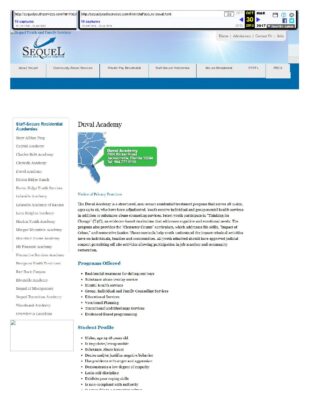 Sequel Website Duval Academy 2016 Website capture
We have questions about Duval Academy
If you were there, worked there or sent your child there, you can help fill in what our records are missing. Each question takes a moment; skip anything you do not know.
Materials and links
External links
Archived pages
From SCIAD NET.