Facility profile Florida
Marion Youth Academy
Now known as Silver Springs Youth Academy
Formerly Three Springs of Marion (2007 to 2010)
Marion Youth Academy is a residential treatment center in Ocala, Florida, operated by Youth Opportunity Investments. It has operated since 2010.
About Marion Youth Academy
The same 40-bed DJJ program at 10420 NW Gainesville Rd, Ocala, run by Sequel TSI of Florida through 2022, operates as Silver Springs Youth Academy under Youth Opportunity Investments by 2025.source
Florida DJJ listed Youth Services International as provider of Marion Youth Academy in 2015 and Sequel TSI of Florida from 2016 through June 2022; the program at 10420 NW Gainesville Road now runs as Silver Springs Youth Academy under Youth Opportunity Investments.source 1, source 2, source 3
Also drawn on: DJJ press release, Marion County.
Timeline
From the records: who ran it and the deals that moved it, its names, and the deaths, incidents, inspection findings, lawsuits and news stories on file. Point at an event, or tap "More about this", for the details.
2007
2010
Youth Services International took it over from Three Springs Inc.
It ran the program until 2016.
Opened in Ocala, Florida
2016
Sequel Youth and Family Services took it over from Youth Services International
It ran the program until 2022.
2017
Sequel TSI: Sold a majority stake to Altamont Capital Partners
Sequel Youth and Family Services ran Marion Youth Academy at the time.
Sequel TSI: Sold a majority stake to Altamont Capital Partners September 1, 2017
Altamont Capital Partners announced a majority equity investment in Sequel through a holding company, SYFS Parent; terms were not disclosed. At the time Sequel ran 44 programs in 19 states, and APM Reports counted 35 residential treatment centers in 16 states. CEO John Stupak stayed on and co-founder Jay Ripley remained board chairman. Altamont's portfolio page lists the investment as active and says SYFS Parent later acquired Rebecca & Aaron Schools (2017) and Pine Cone Therapies (2020).
2021
Vivant Behavioral Health: Founded by Sequel co-founder Jay Ripley and bought most of Sequel's remaining centers
Sequel Youth and Family Services ran Marion Youth Academy at the time.
Vivant Behavioral Health: Founded by Sequel co-founder Jay Ripley and bought most of Sequel's remaining centers
Jay Ripley, one of Sequel's three founders, founded Vivant Behavioral Healthcare in 2021. Sequel sold most of its centers that had not closed to Vivant, which now controls most former Sequel treatment centers still open.
2022
Sequel Youth and Family Services stopped running it
As Three Springs of Marion
Staff
Administration
-
Terrence Brown (Current)
As Marion Youth Academy
News coverage
-
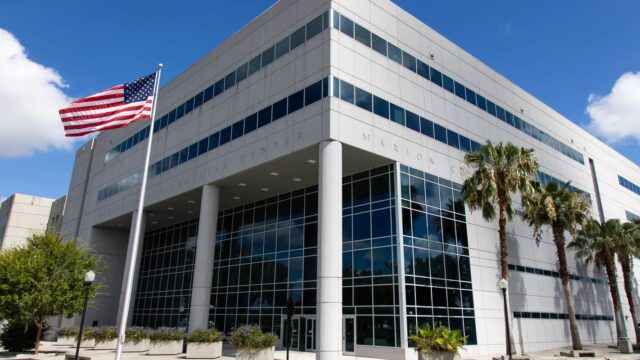
Two Defendants Resolve Criminal Cases with Plea Deals at Ocala Courthouse
The article text is inaccessible due to a restricted access message on the publisher's website. Consequently, no factual details regarding the reported court proceedings or felony charges could be extracted.
-
Marion Youth Academy Employee Arrested on Child Abuse Charges
An employee at Marion Youth Academy was arrested and charged with child abuse following an investigation into staff misconduct at the facility. The report involves allegations of unlawful actions by a staff member against a youth in residential custody.
-
Funding, Oversight Next Questions for Florida’s Private Youth Prison System
Following a whistleblower lawsuit alleging that contractor Youth Services International failed to provide appropriate services and falsified contract documents, Florida state officials moved to terminate remaining contracts with the for-profit company. The transition has prompted lawmakers and advocates to examine the state's reliance on private, for-profit juvenile facilities, focusing on funding levels, contract monitoring, and oversight practices.
-
Marion Youth Academy Counselor Arrested Following Physical Assault of Resident
A youth counselor at Marion Youth Academy was arrested and charged with two counts of aggravated child abuse after surveillance footage showed him striking a 16-year-old resident with a handheld radio. The incident reportedly occurred following an argument involving the resident throwing paper. The facility superintendent reported the altercation to deputies.
-
Marion Youth Academy counselor charged with aggravated child abuse
A counselor at the Marion Youth Academy was arrested and charged with aggravated child abuse after security video captured him striking a 16-year-old resident in the head with a portable radio. The resident sustained a laceration requiring medical treatment. The facility, operated by Youth Services International, provides services to youth involved in the juvenile justice system.
-
Marion Youth Academy Staff Member Arrested on Child Abuse Charges
A staff member at the Marion Youth Academy in Ocala, Florida, was arrested and charged with aggravated child abuse following an incident captured on surveillance video. According to incident reports, the employee struck a resident in the head with a hand-held radio and physically assaulted him, resulting in injuries that required medical treatment.


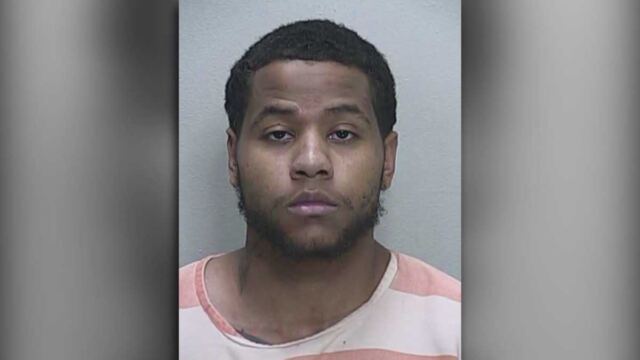
Videos
Licensing and inspections
- Licensed as
- Silver Springs Youth Academy
- Program
- DJJ-silver-springs-youth-academy
- License category
- Moderate-risk Residential
- Executive director
- Terrence Brown
- Licensed capacity
- 40
- Licensing action
- Active
- Phone on file
- (352) 282-0593
- Licensed address
- 10420 NW Gainesville Road, Ocala, FL 34482-1446
30 inspection reports on file. Search all Florida reports
The newest 25 reports, by date: 15 findings in 4 reports
- Jun 30, 2027 QI Residential - FY26-27
- Jun 30, 2027 QI Residential - FY26-27
-
Jun 30, 2026
QI Residential - FY25-26 - 3 findings
3 findings
-
Failed compliance, DJJ review : Indicator 1.04 Education Staff Training (Education Contract Provider)
The Educational Provider staff shall complete staff training as outlined within the contract. The contracted educational provider is required to provide assigned staff with professional development/training as specified in their contract. Four of twelve teachers who worked within the program had all required training; eight virtual or flex teachers had none of the required training as indicated in the contract. It was also noted not all training was reflected in Skillpro; however, the provider was able to provide documentation to support training was completed for on-site training and Exceptional Student Education.
-
Limited compliance, DJJ review : Indicator 1.05 Exit Portfolio (Education Contract Provider)
The Educational Provider shall develop and upload an Exit portfolio at least three school days prior to the youth’s exit from a residential commitment program. The contracted educational provider is required to develop and upload an exit portfolio for each youth. Three closed youth records were reviewed and documentation from each showed none of these records contained a Progress Monitoring Plan or any industry certifications earned. All other required documentation was included in the exit portfolio.
-
Failed compliance, DJJ review : Indicator 1.06 Career Education (Education Contract Provider)
Education staff shall develop and implement a career education competency development program. Florida Scholars Academy, the education contract provider, is currently in the process of developing the Career Education curriculum. At the time of review, no documentation on career education was available. Currently, students at all programs are working with Career Power Workplace Skills workbooks. A review of program activities confirmed no career exploration services are being provided beyond soft skills instruction. There has been no lead response from Florida Virtual School (FLVS) regarding additional career exploration or coursework options. According to the program schedule, eligible youth participate in Career Power Workplace Skills activities during designated instructional periods Monday through Friday. The instructional leader indicated career education activities are limited to the use of the workbooks, with no additional curriculum or industry-recognized credential instruction currently available. Seven Interviewed youth confirmed the absence of career exploration opportunities beyond the soft skills content provided. To fully meet contractual requirements and promote workforce readiness, the program is encouraged to finalize and implement the Career Education curriculum and secure additional career exploration resources, including collaboration with FLVS.
-
- Jun 30, 2026 SPEP - FY25-26
-
Jun 30, 2026
QI Residential - FY25-26 - 3 findings
3 findings
-
Failed compliance, DJJ review : Indicator 1.04 Education Staff Training (Education Contract Provider)
The Educational Provider staff shall complete staff training as outlined within the contract. The contracted educational provider is required to provide assigned staff with professional development/training as specified in their contract. Four of twelve teachers who worked within the program had all required training; eight virtual or flex teachers had none of the required training as indicated in the contract. It was also noted not all training was reflected in Skillpro; however, the provider was able to provide documentation to support training was completed for on-site training and Exceptional Student Education.
-
Limited compliance, DJJ review : Indicator 1.05 Exit Portfolio (Education Contract Provider)
The Educational Provider shall develop and upload an Exit portfolio at least three school days prior to the youth’s exit from a residential commitment program. The contracted educational provider is required to develop and upload an exit portfolio for each youth. Three closed youth records were reviewed and documentation from each showed none of these records contained a Progress Monitoring Plan or any industry certifications earned. All other required documentation was included in the exit portfolio.
-
Failed compliance, DJJ review : Indicator 1.06 Career Education (Education Contract Provider)
Education staff shall develop and implement a career education competency development program. Florida Scholars Academy, the education contract provider, is currently in the process of developing the Career Education curriculum. At the time of review, no documentation on career education was available. Currently, students at all programs are working with Career Power Workplace Skills workbooks. A review of program activities confirmed no career exploration services are being provided beyond soft skills instruction. There has been no lead response from Florida Virtual School (FLVS) regarding additional career exploration or coursework options. According to the program schedule, eligible youth participate in Career Power Workplace Skills activities during designated instructional periods Monday through Friday. The instructional leader indicated career education activities are limited to the use of the workbooks, with no additional curriculum or industry-recognized credential instruction currently available. Seven Interviewed youth confirmed the absence of career exploration opportunities beyond the soft skills content provided. To fully meet contractual requirements and promote workforce readiness, the program is encouraged to finalize and implement the Career Education curriculum and secure additional career exploration resources, including collaboration with FLVS.
-
- Jun 30, 2026 QI Residential - FY25-26
-
Jun 30, 2026
QI Residential - FY25-26 - 3 findings
3 findings
-
Failed compliance, DJJ review : Indicator 1.04 Education Staff Training (Education Contract Provider)
The Educational Provider staff shall complete staff training as outlined within the contract. The contracted educational provider is required to provide assigned staff with professional development/training as specified in their contract. Four of twelve teachers who worked within the program had all required training; eight virtual or flex teachers had none of the required training as indicated in the contract. It was also noted not all training was reflected in Skillpro; however, the provider was able to provide documentation to support training was completed for on-site training and Exceptional Student Education.
-
Limited compliance, DJJ review : Indicator 1.05 Exit Portfolio (Education Contract Provider)
The Educational Provider shall develop and upload an Exit portfolio at least three school days prior to the youth’s exit from a residential commitment program. The contracted educational provider is required to develop and upload an exit portfolio for each youth. Three closed youth records were reviewed and documentation from each showed none of these records contained a Progress Monitoring Plan or any industry certifications earned. All other required documentation was included in the exit portfolio.
-
Failed compliance, DJJ review : Indicator 1.06 Career Education (Education Contract Provider)
Education staff shall develop and implement a career education competency development program. Florida Scholars Academy, the education contract provider, is currently in the process of developing the Career Education curriculum. At the time of review, no documentation on career education was available. Currently, students at all programs are working with Career Power Workplace Skills workbooks. A review of program activities confirmed no career exploration services are being provided beyond soft skills instruction. There has been no lead response from Florida Virtual School (FLVS) regarding additional career exploration or coursework options. According to the program schedule, eligible youth participate in Career Power Workplace Skills activities during designated instructional periods Monday through Friday. The instructional leader indicated career education activities are limited to the use of the workbooks, with no additional curriculum or industry-recognized credential instruction currently available. Seven Interviewed youth confirmed the absence of career exploration opportunities beyond the soft skills content provided. To fully meet contractual requirements and promote workforce readiness, the program is encouraged to finalize and implement the Career Education curriculum and secure additional career exploration resources, including collaboration with FLVS.
-
- Jun 30, 2026 QI Residential - FY25-26
- Jun 30, 2022 SPEP - FY21-22
- Jun 30, 2022 SPEP - FY21-22
- Jun 30, 2022 SPEP - FY21-22
-
Jun 30, 2022
QI Residential - FY21-22 - FINAL - 6 findings
6 findings
-
Limited compliance, DJJ review : Indicator 1.07 Pre-Service/Certification Requirements (Critical)
Residential contracted provider staff satisfies pre-service/certification requirements specified by Florida Administrative Code within 180 days of hiring. The program has a policy and procedures regarding pre-service training. The program has a pre-service training plan which was submitted to the Department’s Office of Staff Development and Training on January 20, 2021. A new pre-service training plan has been submitted. Three staff training records were reviewed for pre-service requirements. Each staff completed a minimum of 120 hours of pre-service training within 180 days of hire. Only one staff record documented completion of the essential pre-service trainings which must be completed prior to any contact with youth, including cardiopulmonary resuscitation (CPR), first-aid, automated external defibrillator (AED), forty hours of Protective Action Response (PAR), professionalism and ethics, suicide prevention/intervention, emergency procedures, child abuse reporting, Prison Rape Elimination Act (PREA), human trafficking, and active shooter training. One staff did not have documentation of completion for CPR, first aid, AED, human trafficking, or active shooting training. One staff did not have human trafficking and active shooter training. One staff completed all contractually required trainings, as well as training on mental health and substance abuse treatment services. The two remaining staff did not complete diversity, Massachusetts Youth Screening Instrument - Second ...
-
Limited compliance, DJJ review : Indicator 1.08 In-Service Training
Residential contracted provider staff complete twenty-four hours of in-service training, including mandatory topics specified in Florida Administrative Code, each calendar year, effective the year after pre-service/certification training is completed. Supervisory staff completes eight hours of training (as part of the twenty-four hours of annual in- service training) in the areas specified in Florida Administrative Code. The program has a policy and procedures regarding in-service training. Five staff records were reviewed for in-service training. Each staff completed a minimum of twenty-four hours of annual in-service training. Two staff completed the mandatory in-service trainings, to include cardiopulmonary resuscitation (CPR), first-aid, automated external defibrillator (AED), an eight- hour Protective Action Response (PAR) update, professionalism and ethics training, human trafficking, active shooter, two-hour suicide prevention training in the Department’s Learning Management System (SkillPro), and a four-hour instructor-led suicide prevention training. One staff did not have documentation of being trained in CPR. One staff did not have documentation f of completing diversity training. The remain staff did not complete professionalism and ethics, human trafficking, active shooter, trauma informed care, youth management, diversity, and transportation. Three of the reviewed training records were for supervisory staff. All reviewed supervisory staff received at least ...
-
Limited compliance, DJJ review : Indicator 1.13 Gender-Specific Programming
The program provides delinquency intervention and gender-specific treatment services. The program has a policy and procedures ensuring they provide delinquency intervention and gender-specific treatment services. The program’s contract identifies Young Men’s Work as the program’s gender-specific programming. Young Men’s Work is a practice with demonstrated effectiveness. Each group addresses the needs of the targeted gender group and are designed based on the common characteristics of the primary target population. Group sign-in sheets and the program’s activity schedule confirmed gender-specific groups were provided, as required, when the program was conducting the group. Sign-in sheets could not be located from June 25, 2021 to October 16, 2021. Two of the Young Men’s Work groups had more than the required maximum number of fifteen youth for each group, one and three youth over the required maximum. Interviews with the designated mental health clinician authority (DMHCA) and executive director (ED) indicated gender-specific groups and activities are provided to youth through Young Men’s Work and community male conferences. An interview with five youth indicated four are attending a gender-specific group. One youth stated they have not yet started attending the gender-specific group.
-
Limited compliance, DJJ review : Indicator 3.07 Treatment and Discharge Planning (Critical)
Mental health and substance abuse treatment planning in programs focus on providing mental health and/or substance abuse interventions and treatment to reduce or alleviate the youth's symptoms of mental disorder and/or substance abuse impairment and enable youth to function adequately in the juvenile justice setting. The treatment team is responsible for assisting in developing, reviewing, and updating the youth's Individualized and Initial Mental Health/Substance Abuse Treatment Plans. All youth who receive mental health and/or substance abuse treatment while in a program shall have a discharge summary completed documenting the focus and course of the youth's treatment and recommendations for mental health and/or substance abuse services upon youth's release from the program. Five youth mental health records were reviewed, and each record included documentation the youth was assigned to a treatment team upon admission. Each youth’s treatment team included all required members who were found to have participated in the youth’s treatment team meetings. Each of the five youth were determined to be in need of mental health and substance abuse services which were provided by qualified clinicians. Each record included a valid Authority for Evaluation and Treatment (AET) and Youth Consent for Substance Abuse Treatment. Each youth record included progress notes for all services provided to youth documented on a form which included all elements of the required Department form. Each ...
-
Limited compliance, DJJ review : Indicator 3.08 Specialized Treatment Services (Critical)
Specialized treatment services shall be provided in programs designated as “Specialized Treatment Services Programs” or are designated to provide “Specialized Treatment Overlay Services.” The program’s contract with the Department required the program to provide Mental Health Overlay Services (MHOS) and/or Substance Abuse Treatment Overlay Services (SAOS) to youth in the program. Interviews with the designated mental health clinician authority (DMHCA) and executive director were conducted, and each indicated all youth in the program receive SAOS. The program holds a Chapter 397 license to provide substance abuse services and the DMHCA is on-site at least five days a week and non-licensed clinicians are on-site seven days a week. The program provides youth daily therapeutic intervention to include individual, group, and family therapy and psychosocial skills training. Each youth’s Individualized Treatment Plan includes a table of prescribed services which includes each required intervention. Each youth in the program has co-occurring disorders and received both mental health and substance abuse services. The program utilizes three non-licensed clinicians to provides services and each clinician has a caseload with no more than twelve youth, each having an average of nine youth. Group sign-in sheets were reviewed for the annual compliance review period and found all mental health and substance abuse groups were facilitated by qualified staff and all substance abuse groups had ...
-
Failed compliance, DJJ review : Indicator 3.09 Psychiatric Services (Critical)
Psychiatric services include psychiatric evaluation, psychiatric consultation, medication management, and medical supportive counseling provided to youth with a diagnosed DSM-IV- TR or DSM-5 mental disorder and each youth receiving psychotropic medication in the program as set forth in Rule 63N-1, F.A.C. ***Tele-psychiatry is not currently approved for use in Residential Programs. Residential must have given prior approval for the telehealth plan if services are not provided on-site. *** The program has a contract with a psychiatrist to provide psychiatric services at the program. The psychiatrist is a medical doctor with a clear and active license in the State of Florida, which expires January 31, 2024 and is board certified in child and adolescent psychiatry. The program did not utilize a back-up psychiatrist during the annual compliance review period and does not utilize a psychiatric advanced practice registered nurse (APRN). The program’s contract with the psychiatrist requires the psychiatrist to have the responsibility for and actively participate in all psychiatric services and medication management at the program, which was confirmed through a review of five youth mental health records. The contract with the psychiatrist requires them to be on-site for a minimum of four hours every fourteen days. A review of the sign-in logs for the annual compliance review found the psychiatrist was on-site weekly for one hour each week for a total of two hours every fourteen days ...
-
- Jun 30, 2021 SPEP - FY20-21
- Jun 30, 2021 SPEP - FY20-21
- Jun 30, 2021 SPEP - FY20-21
- Jun 30, 2020 SPEP - FY19-20
- Jun 30, 2020 SPEP - FY19-20
- Jun 30, 2020 SPEP - FY19-20
- Jun 30, 2019 SPEP - FY18-19
- Jun 30, 2019 SPEP - FY18-19
- Jun 30, 2019 SPEP - FY18-19
- Jun 30, 2018 SPEP - FY17-18
- Jun 30, 2018 SPEP - FY17-18
- Jun 30, 2018 SPEP - FY17-18
- Jun 30, 2017 SPEP - FY16-17
Connections on the network map
The companies, people and programs our research map ties to this program. Open it on the network map.
Acquisitions
- Vivant Behavioral Healthcare
Names
- Silver Springs Youth Academy
Ownership
- Sequel Youth and Family Services
Documents
-
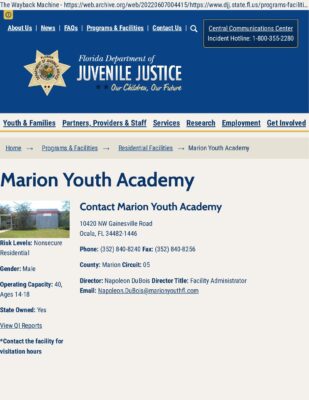 Djj.state.fl.us Programs-Facilities Residential-Facilities Marion-Youth-Academy (Wayback 2022-06-07) Website capture
-
 Djj.state.fl.us Programs-Facilities Residential-Facilities Residential-Facility-Detail (Wayback 2015-04-23) Website capture
-
 Djj.state.fl.us Programs-Facilities Residential-Facilities Residential-Facility-Detail (Wayback 2018-05-27) Website capture
-
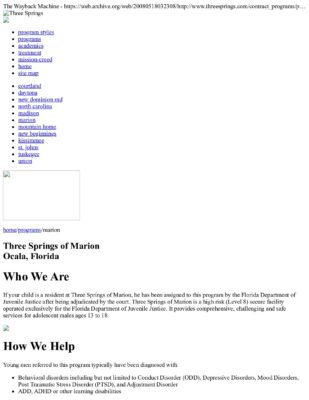 Threesprings.com Contract_Programs Programs Marion.html (Wayback 2008-05-18) Website capture
We have questions about Marion Youth Academy
If you were there, worked there or sent your child there, you can help fill in what our records are missing. Each question takes a moment; skip anything you do not know.
Materials and links
Materials the project holds for this facility. Ask through the correction form to see any of them.
Other documentation
- Archived website