
Facility profile Florida
Kissimmee Youth Academy
Formerly Three Springs of Osceola (2002 to 2009), Kissimmee Juvenile Correctional Facility, Sequel TSI Kissimmee (2009 to 2016)
Also known as Three Springs of Kissimmee School
Kissimmee Youth Academy is a juvenile justice Maximum-Risk in Kissimmee, Florida, operated by Youth Opportunity Investments. It has operated since 2016.
About Kissimmee Youth Academy
The program at 2330 New Beginnings Road was Three Springs of Osceola (Three Springs, Inc., from 2002), run by Sequel TSI of Florida after Sequel took over Three Springs in January 2010 (DJJ 2015: Kissimmee Juvenile Correctional Facility), and by Youth Opportunity Investments as Kissimmee Youth Academy from 2016.source 1, source 2, source 3
As Three Springs of Osceola
News coverage
-
Mother Reaches Settlement in Juvenile Facility Custody Death Case
The mother of a 14-year-old boy who experienced a death by suicide while in state custody at a juvenile facility operated by Three Springs Inc. has reached a confidential financial settlement with the company and four employees. The lawsuit alleged that staff failed in their supervisory duties and that required prescription medication was not administered to the youth prior to the incident.

As Sequel TSI Kissimmee
News coverage
-
In wake of killing and escapes, Madison revokes Three Springs business license
Madison officials revoked the business license of Three Springs after a teen death and multiple escape incidents were reported at the facility. The revocation follows investigations into safety violations and the circumstances surrounding the killing.
-
Youth Services International Terminates Acquisition of Three Springs Inc.
Youth Services International Inc. terminated its planned acquisition of Three Springs Inc., a provider of adolescent residential and wilderness programs, after financial reviews indicated the earnings expectations were misaligned. The decision resulted in a stock price decline for the publicly traded acquiring company. Both corporate entities operate programs for youths.
-
Youth Services International Announces Acquisition of Three Springs Inc.
Youth Services International Inc. announced a letter of intent to acquire Three Springs Inc., an Alabama-based operator of adolescent programs including a therapeutic wilderness program, for approximately $27 million in stock. Financial analysts noted the acquisition would expand Youth Services' market reach and increase revenue by more than a third.



Staff
Administration
-
Dana Hampson
Former Group Administrator, Paint Rock and Duck River Programs (2008)source
-
Angie Fusco
Former Counselor, Counselor Supervisor, Assistant Administrator, Special Projects Manager, Program Administrator and Director of Organizational Development, Director of Organizational Development (before 2009)source
Elsewhere in the industry
- Eagle Summit Program Administrator, Administrator, Executive Director, 2008-2011
- Presbyterian Children's Services Director of staff development and training, before 2009
- Auldern Academy Executive Director, 2013
- Three Springs Paint Rock Valley Residential Counselor (1992)
- Three Springs Inc. Executive Director at Eagle Summit
-
Aida Porras
Former Vice President of Marketing (2009)source
Elsewhere in the industry
- Pathway of Madison County Director of Marketing, Private Programs, VP Marketing, 2007-2009
- Three Springs Inc. V.P. Marketing at Three Springs (Sequel-affiliated)
Notable staff
-
Douglas W. Adams
Former Consulting Psychiatrist (2008)source
-
Candace Bynum
Former Admissions and Marketing Director (before 2007)source
Elsewhere in the industry
- Eckerd Youth Alternatives, Inc. Referral Relations Representative, Admissions and Marketing Director, 2006
- Three Springs Paint Rock Valley Admissions Contact
-
Tere Snodgrass
Former Admissions and marketing (before 2006)source
Elsewhere in the industry
- Provo Canyon School Southeast Regional Director of Business Development, 2006
- Silverado Academy Assistant Admissions Director, 2007
- Aspen Achievement Academy Admissions and marketing, before 2007
- Auldern Academy Admissions and marketing, before 2007
- Academy at Canyon Creek Admissions and marketing, before 2007
- Second Nature Wilderness Program Former Admissions (2021)
- Blue Ridge Therapeutic Wilderness Former Admissions (2021)
- Open Sky Wilderness Therapy Former Professional Relations/Admissions Director (2025)
- Three Springs Inc. admissions, marketing director
-
Susan Hardy
Former Staff (before 2006)source
Elsewhere in the industry
- Adirondack Leadership Expeditions Executive Director, 2006
- Stone Mountain School Executive Director, 2007-2009
- Lake House Academy Academic Director, 2011
-
Dean Porterfield
Former Director of Clinical Programming for Private Programs (2008)source
Elsewhere in the industry
- Three Springs of Duck River Program Administrator, 2008
- Cumberland Heights Treatment Center Clinical Coordinator for the Youth Program, 2010
-
Sharon Laney
NATSAP Ex-Officio Board member, COO, Chief Operating Officer (2008)source
Elsewhere in the industry
- Natsap President, 2007
- Three Springs Paint Rock Valley Program Administrator, 2009
- Lake House Academy Executive Director, 2011-2013
- Trails Carolina Director of Operations, before 2011
- National Association of Therapeutic Schools and Programs (NATSAP) President, 2011
-
Sarah Raynor
Former Staff Psychologist, Paint Rock Programs (2008)source
As Kissimmee Youth Academy
Staff
Administration
-
Dawn Buchanan
Licensing and inspections
- Program
- DJJ-kissimmee-youth-academy
- License category
- High-risk Residential, Maximum-risk Residential
- Executive director
- Dawn Buchanan
- Licensed capacity
- 95
- Licensing action
- Active
- Phone on file
- (407) 350-4900
- Licensed address
- 2330 New Beginnings Road Kissimmee , FL 34744
53 inspection reports on file. Search all Florida reports
The newest 25 reports, by date: 17 findings in 4 reports
-
Jun 30, 2026
QI Residential - FY25-26 - 5 findings
5 findings
-
Limited compliance, DJJ review : Indicator 1.02 Education Transition Plan (Education Contract Provider)
Upon admission, education staff and youth develop an education transition plan which includes provisions for continuation of education and/or employment. MHOS/SAOS/MAX The contracted educational provider is contractually required to develop an Education Transition Plan for each youth. Three closed youth records were reviewed; all three closed records did not contain an Education Transition Plan; however, information needed for transition activities was obtained from the Electronic Education Exit Plan (EEEP). Many youth entered the program before December 12, 2024, when the new education provider, Florida Virtual School (FLVS), started their initiation of transition plans; therefore, those youth did not have an Education Transition Plan developed by the provider. The key personnel elated to transition activities for each youth included the youth, parent/guardian, Department staff for youth in residential programs, staff from the post-release school district, instructional personnel in the juvenile justice education program, and certified school counselor from school district or program staff responsible for providing guidance services. Each youth’s EEEP was developed with the youth and program, education, and aftercare staff with specific plans for continuation of education and/or employment. The plan/activities addressed at a minimum, services and interventions based on each youth’s assessed educational needs and post-release education plans, the recommended educational ...
-
Failed compliance, DJJ review : Indicator 1.04 Education Staff Training (Education Contract Provider)
The Educational Provider staff shall complete staff training as outlined within the contract. MHOS/SAOS/MAX The contracted educational provider is contractually required to provide its assigned staff with professional development/training. Twenty-five teachers were reviewed, seven on-site teachers and eighteen flex/off-site teachers. Twenty of the teachers, all eighteen flex teachers and two on-site teachers, did not have the required training: behavioral management and de-escalation, suicide awareness and prevention, child abuse, and professionalism, interpersonal communication, and ethics to include standards of conduct. Five on-site teachers did not have mental health and substance abuse training, one did not have trauma informed care/trauma responsive practices, two were missing facility emergency procedures, two were missing facility operating procedures, one did not have Prison Rape Elimination Act (PREA), two had no human trafficking intervention, and one was missing adolescent development. Not all training was entered into the Department’s Learning Management System (SkillPro). BIF/DD The contracted educational provider is contractually required to provide its assigned staff with professional development/training. Twenty-one teachers were reviewed; eight on-site and thirteen flex teachers. Two on-site and thirteen flex teachers did not have the required training: behavioral management and de-escalation, suicide awareness and prevention, child abuse, and ...
-
Limited compliance, DJJ review : Indicator 1.05 Exit Portfolio (Education Contract Provider)
The Educational Provider shall develop and upload an Exit portfolio at least three school days prior to the youth’s exit from a residential commitment program. MHOS/SAOS/MAX The contracted educational provider is contractually required to develop and upload an exit portfolio for each youth. A review of three closed youth case management records found none of the exit portfolios contained the individual Education Transition Plan. All three youth records included results of district and statewide assessments. Two of the three youth records did not have a progress monitoring plan; the remaining youth was not applicable for the plan. None of the three youth were applicable for the Section 504 plan, English Language Learner plan, or behavior intervention plan. One of the three youth had an individual education plan while the other two were not applicable. Two of the three youth had cumulative transcripts in their exit portfolio, the remaining youth was not applicable. Both applicable records included a list of courses in progress with grades; the remaining one was not applicable. None of the youth earned industry certifications. All three youth had documents uploaded into the Department’s Juvenile Justice Information System (JJIS) within three school days prior to their release. BIF/DD The contracted educational provider is contractually required to develop and upload an exit portfolio for each youth. A review of three closed youth case management records found none of the exit ...
-
Limited compliance, DJJ review : Indicator 1.06 Career Education (Education Contract Provider)
Education staff shall develop and implement a career education competency development program. The provider maintains a career education competency development program. The career education program is appropriate for the educational abilities and goals, as well as the length of stay and classification of youth in the program. The residential juvenile justice education program does not include required courses leading to pre-apprentice certifications and industry certification or career exploitation services. The program does not provide Type 2 vocational competency; however, they provide Type 3 vocational competency development programming, including personal accountability skills and behaviors leading to appropriate work habits for employment and living standards, as well as providing program content and the competencies or the prerequisites needed for entry into a specific occupation. The provider’s career education programming includes communication, interpersonal, and decision-making skills. The lead teacher was interviewed and stated career technical education (CTE) services and assessment are provided in the program through Florida Virtual School (FLVS) and include Digital Information Technology, financial planning, literacy, and business management. The lead teacher acknowledged areas for improvement and committed to enhancing lesson plans, incorporating structured career exploration activities, and ensuring competency development directly linked to employability ...
-
Limited compliance, DJJ review : Indicator 1.08 Florida Youth College Post-Release (Post-Secondary
Education Contract Provider) The post-secondary providers shall continue to assist youth post-release, defined as PCP or conditional release, by providing additional assistance with post-secondary education opportunities, pre-apprenticeships, or registered apprenticeships, and assist with connecting to CareerSource Florida local workforce development boards, probation officers, and other education and workforce resources. Post release, the career navigator will contact each youth within five days of release and then for every thirty days up until 180 days, or when the youth declines services. MHOS/SAOS The contracted post-secondary provider has established procedures to provide ongoing support to youth following their release, including additional assistance. A review of three youth closed case management records revealed all three youth lacked documentation indicating a career navigator attended their residential transition meeting; however, the career navigators were not invited to participate in the residential transition meetings. The provider showed documentation an email was sent to the program on July 31, 2025 requesting the career navigators be invited to all residential transition meetings. Only two of the three reviewed youth were applicable for post-release follow-up, as the additional youth was a direct release from the program. There was no documentation showing a career navigator contacted or provided follow-up support within five days of release for either ...
-
-
Jun 30, 2026
QI Residential - FY25-26 - 4 findings
4 findings
-
Failed compliance, DJJ review : Indicator 5.04 Ten-Minute Checks (Critical)
A program shall ensure staff observe youth at least every ten minutes while the youth are in their sleeping quarters, either during sleep time or at other times, such as during an illness or room restriction. Staff shall conduct the observations in a manner to ensure the safety and security of each youth and shall document real time observations manually or electronically. The program has a policy and procedures to ensure youth are observed at a minimum of every ten minutes when youth are in their rooms. The program has 128 video cameras, and all were operational during the annual compliance review week. Video coverage is stored for thirty days. Staff are required to conduct room checks every ten minutes when youth are in their rooms and document the check in real time along with the initials of staff conducting the check. A random sample of ten-minute check sheets for each month of the annual compliance review period found one check was completed five minutes late, two checks were not initialed by the staff member completing the check as required, and all remaining checks were documented as required. A video review of nine different dates of ten-minute checks was compared to the ten- minute check logs. Thirteen checks were not completed as required. Two different youth rooms contained white paper covering the window on the door, not allowing staff to observe the youth during three of the ten-minute checks, the staff member did not pause to look into the rooms for three ...
-
Limited compliance, DJJ review : Indicator 5.09 Searches and Full Body Visual Searches
The program shall perform searches to ensure no contraband is introduced into the facility. The program has a policy and procedures to ensure the program performs searches and full body visual searches. The program conducts searches as a method to prevent the introduction of contraband and unauthorized items into the facility. The annual compliance review team observed several youth searches during the week of the annual compliance review week including transition to school and from school, moving from the module to treatment team meetings, to recreation, and back to the module. The program did not have any admissions, transports, visitations, off-campus activities, nor was there an observation of youth access or ability to obtain tools during the annual compliance review week. Searches were conducted by staff of the same gender as the youth, while a second staff member assisted with supervision. Search procedures and expectations were properly explained to all youth before searches were conducted. Searches were thorough and completed in a manner to minimize the youth’s stress and embarrassment. Searches were conducted as required by the Right Interactions (RI) training manual. Video review of five random days of staff and visitor searches found three days searches were not completed as required. On two days, two staff entered the search area of the program, and their belongings were not thoroughly searched prior to entering the secure area, and the remaining, day a ...
-
Failed compliance, DJJ review : Indicator 5.13 Tool Inventory and Management
The program shall have a tool management system ensuring youth do not use tools or equipment as weapons or security breaches. The program has a policy and procedures addressing the issuance, inventory, and control of equipment and tools, missing/lost tools, and dysfunctional tools and their disposal. The policy confirms machetes, bowie knives, or other long blade knives are prohibited. The maintenance supervisor indicated when a tool is dysfunctional, it is disposed of according to policy. He further stated they have not had any lost or missing tools since the last annual compliance review. A review of tool inventory for the program’s maintenance shed since the last annual compliance review confirmed a perpetual inventory is kept anytime a tool is used and a daily inventory is maintained. Ten tools were compared to the tool inventory and two were not able to be located in the maintenance shed. Two screwdrivers in the toolbox drawer had no identification markings and were not on the tool inventory. There were also multiple tools in the maintenance shed not found on the tool inventory; specifically, two shovels, a drill bit set, and an Allen-wrench T- handled set. Multiple tools had no label/inventory number or any identification markings on the items and were not located on the inventory list. The current inventory was not completed on Class A tools for two days of the annual compliance review week. An observation of tools/kitchen utensils was completed. Multiple items in the ...
-
Failed compliance, DJJ review : Indicator 5.18 Storage, Inventory, and Disposal of Flammable, Poisonous,
and Toxic Items and Materials The program director or designee shall maintain strict control of flammable, poisonous, and toxic items and materials and a complete inventory of all such items. The maintenance personnel, or other trained staff who have the safety equipment for diluting, handling, and disposing of hazardous and/or solid waste, shall be responsible for disposing of hazardous items and toxic materials. The program has a policy and procedures addressing the process for chemical spills, disposal, storage, and inventory of flammable, poisonous, and toxic items and materials. The program maintains a list of staff who are authorized to dispose of chemicals and who have access to chemicals. The program’s policy and procedures related to the disposal of chemicals was in accordance with the Occupational Health and Safety Act (OHSA) Standards. An interview with the facility administrator (FA) confirmed the program uses all of the chemicals/cleaning products in their entirety, requiring no unused chemicals to be disposed of by the program. As a result, the program does not maintain a disposal log. The FA explained a local company disposes of all kitchen grease, which is stored in a grease trap until the company arrives for pickup. All liquid waste, such as dirty mop water, unused beverages and kitchen liquid waste are disposed of in the program’s drains. The program did not have any chemical spills requiring them to activate the program’s procedures regarding chemical ...
-
-
Jun 30, 2026
QI Residential - FY25-26 - 6 findings
6 findings
-
Limited compliance, DJJ review : Indicator 2.18 Educational Access (Residential Contract Provide)
The program shall integrate educational instruction (career and technical education, as well as academic instruction) into the daily schedule in such a way ensuring the integrity of required instructional time. The program has a written policy and procedures to provide for educational access. The program integrates education into the daily schedule. A sample of three days of videos and coordinating logbook reviews showed youth missed the required amount of daily education times seventy-one minutes, nine minutes, and seven minutes, respectively. In addition, logbook reviews for one random day a month for the annual compliance review period were reviewed, and youth were moved accordingly with little deviation. Five youth were interviewed and stated there are no interruptions during the school day.
-
Limited compliance, DJJ review : Indicator 2.19 Contract Specific Career and Technical Education Services
(Residential Contract Provider) The program shall implement all career and technical education services (formerly referred to as pre-vocational and vocational services) negotiated or outlined in the contract which are considered Contract Specific Conditions or listed within the Scope of Services Attachment. These may be referenced as the Memorandum of Negotiation (MON), Summary of Negotiated Points, Summary of Supplemental Response Request (SSRR), Best and Final Offer (BAFO), or Special Conditions. Older contracts may not have them clearly identified as a special condition. Career and technical education service instruction shall be provided so the interests, aptitudes, and skills of the youth are developed, while building upon their existing strengths, in a manner supportive of their employability goals which provide an occupational advantage and workforce readiness in their community. These items may exceed the minimum requirements outlined in Florida Statutes and Florida Administrative Code. The program’s contractually required career and technical education (CTE) services include soft skill credentials in Florida Ready to Work, Occupational Safety and Health Administration (OSHA) 10-hour training course, and first-aid/cardiopulmonary resuscitation (CPR) training. The program shall serve as a collaborative partner who provides CTE services which lead to career pathways with student outcomes which must include industry certifications earned from the master credentials list ...
-
Limited compliance, DJJ review : Indicator 5.04 Ten-Minute Checks (Critical)
A program shall ensure staff observe youth at least every ten minutes while the youth are in their sleeping quarters, either during sleep time or at other times, such as during an illness or room restriction. Staff shall conduct the observations in a manner to ensure the safety and security of each youth and shall document real time observations manually or electronically. The program has a policy and procedures to ensure youth are observed at a minimum of every ten minutes when youth are placed within their rooms. The program has 128 video cameras, and all were operational during the annual compliance review week. Video coverage is stored for thirty days. Staff are required to conduct room checks every ten minutes when youth are in their rooms and document the check in real time along with the initials of staff conducting the check. A random sample of ten-minute check sheets for each month of the annual compliance review period found no more than ten minutes passed without the staff actively observing each youth and the staff completing the check initialed the check sheets. A video review of nine different dates of ten-minute checks was compared to the ten-minute check logs. Eleven checks were not completed as required. Two different youth rooms contained white paper covering the window on the door, not allowing staff to observe the youth during a total of five ten-minute checks, for four checks the staff member did not pause to look into the rooms, one check was two ...
-
Limited compliance, DJJ review : Indicator 5.09 Searches and Full Body Visual Searches
The program shall perform searches to ensure no contraband is introduced into the facility. The program has a policy and procedures to ensure the program performs searches and full body visual searches. The program conducts searches as a method to prevent the introduction of contraband and unauthorized items into the facility. The annual compliance review team observed several youth searches during the week of the annual compliance review including transition to and from school, moving from the module to treatment team meetings, to recreation, and back to the module. The program did not have any admissions, transports, visitations, off-campus activities, nor was there an observation of youth access or ability to obtain tools during the annual compliance review week. Searches were conducted by staff of the same gender as the youth, while a second staff member assisted with supervision. Search procedures and expectations were properly explained to all youth before searches were conducted. Searches were thorough and completed in a manner to minimize the youth’s stress and embarrassment. Searches were conducted as required by the Right Interactions (RI) training manual. Video review of five random days of staff and visitor searches found three days searches were not completed as required. On two days two staff entered the search area of the program, and their belongings were not thoroughly searched prior to entering the secure area, and the remaining day a visitor’s bag was not ...
-
Failed compliance, DJJ review : Indicator 5.13 Tool Inventory and Management
The program shall have a tool management system ensuring youth do not use tools or equipment as weapons or security breaches. The program has a policy and procedures addressing the issuance, inventory, and control of equipment and tools, missing/lost tools, and dysfunctional tools and their disposal. The policy confirms machetes, bowie knives, or other long blade knives are prohibited. The maintenance supervisor indicated when a tool is dysfunctional, it is disposed of according to policy. He further stated they have not had any lost or missing tools since the last annual compliance review. A review of tool inventory for the program’s maintenance shed since the last annual compliance review confirmed a perpetual inventory is kept anytime a tool is used and a daily inventory is maintained. Ten tools were compared to the tool inventory and two were not able to be located in the maintenance shed. Two screwdrivers in the toolbox drawer had no identification markings and were not on the tool inventory. There were also multiple tools in the maintenance shed not found on the tool inventory; specifically, two shovels, a drill bit set, and an Allen-wrench T- handled set. Multiple tools had no label/inventory number or any identification markings on the items and were not located on the inventory list. The current inventory was not completed on Class A tools for two days of the annual compliance review week. An observation of tools/kitchen utensils was completed. Multiple items in the ...
-
Failed compliance, DJJ review : Indicator 5.18 Storage, Inventory, and Disposal of Flammable, Poisonous,
and Toxic Items and Materials The program director or designee shall maintain strict control of flammable, poisonous, and toxic items and materials and a complete inventory of all such items. The maintenance personnel, or other trained staff who have the safety equipment for diluting, handling, and disposing of hazardous and/or solid waste, shall be responsible for disposing of hazardous items and toxic materials. The program has a policy and procedures addressing the process for chemical spills, disposal, storage, and inventory of flammable, poisonous, and toxic items and materials. The program maintains a list of staff who are authorized to dispose of chemicals and who have access to chemicals. The program’s policy and procedures related to the disposal of chemicals was in accordance with the Occupational Health and Safety Act (OHSA) Standards. An interview with the facility administrator (FA) confirmed the program uses all of the chemicals/cleaning products in their entirety, requiring no unused chemicals to be disposed of by the program. As a result, the program does not maintain a disposal log. The FA explained a local company disposes of all kitchen grease, which is stored in a grease trap until the company arrives for pickup. All liquid waste, such as dirty mop water, unused beverages and kitchen liquid waste are disposed of in the program’s drains. The program did not have any chemical spills requiring them to activate the program’s procedures regarding chemical ...
-
- Jun 30, 2025 QI Residential - FY24-25
- Jun 30, 2025 QI Residential - FY24-25
- Jun 30, 2024 SPEP - FY23-24
- Jun 30, 2024 SPEP - FY23-24
- Jun 30, 2024 SPEP - FY23-24
- Jun 30, 2024 SPEP - FY23-24
- Jun 30, 2024 SPEP - FY23-24
-
Jun 30, 2024
QI Residential - FY23-24 - 2 findings
2 findings
-
Limited compliance, DJJ review : Indicator 2.20 Educational Access (Critical)
The program shall integrate educational instruction (career and technical education, as well as academic instruction) into the daily schedule in such a way ensuring the integrity of required instructional time. The program has a policy and procedures regarding educational access. The program integrates education into the daily schedule in such a way to ensure the integrity of the required minimum instruction time distributed over a twelve-month period. The district approved calendar and daily school schedules were reviewed and it was determined the program incorporated the required 250 days of instruction, with up to ten days used for teacher planning, and a minimum of twenty-five hours of instruction weekly. The daily bell schedule includes five fifty-five-minute and one fifty-minute class periods, which exceeds the required minimum of twenty-five hours of instruction each week. Randomly selected logbook entries, including one day every month since November 2022, as well as eight additional entries, showed deviations in adhering to the school schedule. The deviations included anywhere from a few minutes to certain groups of youth missing one or more class periods of instruction in a day on five separate occasions. These results indicated the youth were not meeting the required twenty-five hours of instruction per week. Video footage was reviewed for October 2, 6, and 10, 2023, and all three days exhibited youth movement to and from school according to the school schedule ...
-
Limited compliance, DJJ review : Indicator 5.08 Contraband Procedures
The program’s policy must address illegal contraband and prohibited items. A program shall delineate items and materials considered contraband when found in the possession of youth, the list must include: sharps, escape paraphernalia, tobacco products, lighters or matches, electronic or vaporless cigarettes, any unauthorized article of food or clothing, any intoxicating beverage or any beverage which causes or may cause an intoxicating effect, any controlled substance, any prescription or non-prescription drug which has a hypnotic, stimulating, or depressing effect, any firearm or weapon of any kind or any explosive substance, non-facility issued electronic equipment or devices to include smartwatches, metals, personal non-facility issued cellular devices, unauthorized currency or coin(s), and non-facility issued keys. The program shall provide youth with the list of contraband items and materials and inform the youth of the consequences if found with contraband. The program shall establish a system to prevent the introduction of contraband and identify contraband items and materials through searches of the physical plant, facility grounds, and both staff and youth. The program shall document the confiscation of any illegal contraband and the manner of disposition. The program shall keep a copy of the documentation in the youth’s case record. If a confiscated item is not illegal or prohibited, the program director or designee has the discretion to discard of the item, return ...
-
- Jun 30, 2023 SPEP - FY22-23
- Jun 30, 2023 SPEP - FY22-23
- Jun 30, 2023 SPEP - FY22-23
- Jun 30, 2023 SPEP - FY22-23
- Jun 30, 2023 SPEP - FY22-23
- Jun 30, 2023 SPEP - FY22-23
- Jun 30, 2022 SPEP - FY21-22
- Jun 30, 2022 SPEP - FY21-22
- Jun 30, 2022 SPEP - FY21-22
- Jun 30, 2022 SPEP - FY21-22
- Jun 30, 2022 SPEP - FY21-22
- Jun 30, 2022 SPEP - FY21-22
- Jun 30, 2021 SPEP - FY20-21
- Jun 30, 2021 SPEP - FY20-21
Connections on the network map
The companies, people and programs our research map ties to this program. Open it on the network map.
Ownership
- Sequel Youth and Family Services
- Three Springs Inc.
- Youth Opportunity Investments
Documents
Merged from: Kissimmee Youth Academy (5)
-
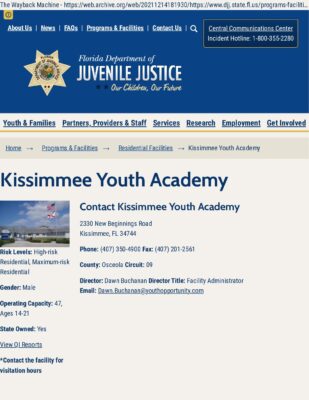 Djj.state.fl.us Programs-Facilities Residential-Facilities Kissimmee-Youth-Academy (Wayback 2021-12-14) Website capture
-
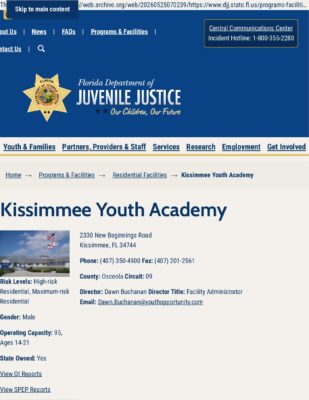 Djj.state.fl.us Programs-Facilities Residential-Facilities Kissimmee-Youth-Academy (Wayback 2026-05-25) Website capture
-
 Djj.state.fl.us Programs-Facilities Residential-Facilities Residential-Facility-Detail (Wayback 2015-09-07) Website capture
-
 Djj.state.fl.us Programs-Facilities Residential-Facilities Residential-Facility-Detail (Wayback 2018-12-04) Website capture
-
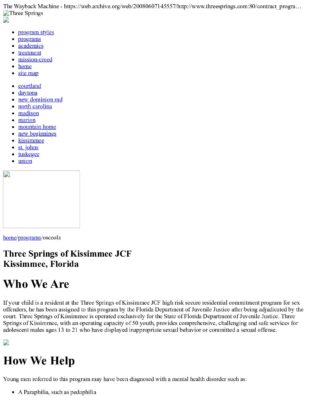 Threesprings.com Contract_Programs Programs Kissimmee.html (Wayback 2008-06-07) Website capture
Survivor testimony
What people who lived or worked here say happened. Survivors' own words are published with their permission; forum accounts are what was posted publicly and are reported as claims, not findings.
Reported on survivor forums
- Fornits: Anthony Robbins (2003-2006, 51 posts)
- Fornits: Survivor and posters discuss abuse and trauma at Peninsula Village (2005-2009) (2005-2009, 2061 posts). This thread discusses Peninsula Village, a behavior modification facility in Tennessee, with posters debating the abusive nature of the program and analyzing books written by former residents. A survivor details extensive physical and psychological abuse experienced between 1996 and 1998, while o...
- Fornits: Typical Day at Sagewalk (2005-2006, 507 posts)
- Fornits: Carlbrook (2005-2013, 2740 posts)
- Fornits: Former Staffers (2005, 19 posts)
- Fornits: Karen In Dallas (2005-2007, 624 posts)
- Fornits: Good program experiences! (2005-2007, 149 posts)
- Fornits: Concern for a "student" (2005-2014, 164 posts)
- Fornits: Behind the scenes (2005, 8 posts)
- Fornits: Arizona Boys Ranch (2005, 129 posts)
- Fornits: BREAKING NEWS ... Low Wages High Turnover for Workers at Pr (2005-2006, 35 posts)
- Fornits: Information Please for my daughter ..I am trying to get her (2006, 115 posts)
- Fornits: Back to the Woods.. (2006, 13 posts)
- Fornits: Count Down to Criminal Trial Date: Sept 18-29th Cheryl Sudwe (2006, 111 posts)
- Fornits: Amazing.... (2006, 20 posts)
- Fornits: I hereby Challenge Cheryl to show herself.... (2006, 19 posts)
- Fornits: Maia Szalavitz (2006, 132 posts)
- Fornits: Level System (2006, 66 posts)
- Fornits: Update from "former" program mom (2006, 201 posts)
- Fornits: Why Struggling Teens is a total waste of our time. (2006, 87 posts)
- Fornits: So what should I do (2006, 131 posts)
- Fornits: In this thread, let's list better things you can do with you (2006, 55 posts)
- Fornits: KATHY MOYA (FICA) (2006, 31 posts)
- Fornits: This forum needs to change their views of Teen Escort Agents (2006, 87 posts)
- Fornits: The Politics of Advocacy. (2006, 22 posts)
- Fornits: I have a question for Buzzkill's son. (2006, 56 posts)
- Fornits: Help Me Please!! (2006, 45 posts)
- Fornits: I went to the amusement park today. (2006-2007, 105 posts)
- Fornits: When did adoelscence become a pathology (2006, 36 posts)
- Fornits: Angellika Arndt , 7 R.I.P. (2006, 46 posts)
- Fornits: The Who (2006-2010, 4290 posts)
- Fornits: Who wins the prize as the most Cult like program? (2006-2008, 53 posts)
- Fornits: Food Choices (2006, 27 posts)
- Fornits: Marathon Workshops (2006, 56 posts)
- Fornits: The current "My teen wont forgive me" thread on ST (2006, 212 posts)
- Fornits: Looking for Ex-Staff Testimony (2007, 29 posts)
- Fornits: Interesting tidbit from the mouth of the ca-ca fatcat, Izzy. (2007, 967 posts)
- Fornits: Rocklyn Academy(Canada) (2007-2009, 68 posts)
- Fornits: Three Springs New Beginnings (2007, 4 posts)
- Fornits: So what is this all about (2008, 124 posts)
- Fornits: 3 Springs Research Project-Active (2008, 25 posts)
- Fornits: xxxxxxxxxxxxxxxxxxxx (2008-2009, 15 posts)
- Fornits: Prison or TBS? (2009, 32 posts)
- Fornits: Fornits is a breeding ground for harassment. (2009, 6 posts)
- Fornits: Are there good ones? (2010, 63 posts)
- Fornits: The Parents Side of the Story (2010, 83 posts)
- Fornits: CAFETY's facility list of over 1,200 programs (2012, 16 posts)
Materials and links
External links
A program's own website is linked as an archived snapshot, so the page reads as it did when it was captured.
- djj.state.fl.us
- Archived website (Wayback Machine)
- sequeltsi.com (archived copy)
- sequeltsi.com (archived copy)
- sequeltsi.com (archived copy)
- sequeltsi.com (archived copy)
- sequeltsi.com (archived copy)
- sequeltsi.com (archived copy)
Licensing and inspection reports
Survivor posts and discussion
Staff and owners
- Nikia Bland - Director of Admissions - Three Springs | LinkedIn
- Sandy Morrison - Program Director - Three Springs | LinkedIn