
Facility profile Oregon
Catherine Freer Wilderness Program
Also known as Catherine Freer of Nevada
Catherine Freer Wilderness Program was a wilderness therapy in Albany, Oregon. It operated from 1988 to 2012.
About Catherine Freer Wilderness Program
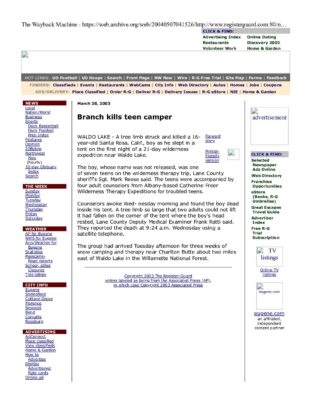
Catherine Freer Wilderness Therapy Expeditions was a wilderness therapy program for teenagers, run from Albany, Oregon, from 1988 until it closed abruptly in 2012.source Its founder, psychologist Robert Cooley, sent teens on backpacking treks in Oregon and, through a second program, in Nevada.source 1, source 2, source 3 Three children died on its treks within ten months.source 1, source 2, source 3 Erica Harvey, 15, died of heatstroke in Nevada in May 2002.source 1, source 2 Her mother told Congress that another child died on a Nevada trek that October.source Cory Baines, 16, was killed in his sleep by a falling tree limb in Oregon in March 2003.source 1, source 2 In 2007 federal investigators made Erica's death one of ten case studies for Congress.source
Cooley named the program after Catherine Freer, a friend and elite mountain climber who died with her climbing partner in 1987.source Oregon licensed it as both a mental health and an alcohol and drug treatment program.source It was a founding member of the trade groups NATSAP and the Outdoor Behavioral Healthcare Industry Council.source Its enrollment packet described hikes of up to 12 miles a day under a 45- to 50-pound pack.source Contact with medical staff was "limited to emergency situations" and "at the discretion of qualified staff rather than participants."source Families could send no more than two letters per family member in the first three weeks, and visits were "not possible."source ABC's Primetime featured the program in May 2002 and reported that each trek began with a strip search.source In 2004 the company added Santiam Crossing, a therapeutic boarding school in Scio.source Paul Smith was the program director and Rob Koning its last executive director.source 1, source 2
Erica Harvey, of Phoenix, died on May 27, 2002, her first full day in the Nevada program, near the Arc Dome Wilderness.source 1, source 2, source 3 By about 6 p.m., eyewitnesses said, she was talking gibberish, then fell off the trail into a ravine and had no pulse.source Staff first thought she was faking, and it was 45 minutes before anyone called for a helicopter.source They gave search-and-rescue the wrong coordinates, and the trip's EMT was on his first trek.source Five hours after she went down, her temperature was still 101.7 degrees; the cause of death was heatstroke and dehydration.source 1, source 2 The program's press release said staff gave CPR and that "a definitive reason for the collapse is not known at this time."source A spokeswoman later said Erica had hiked only a couple of miles and had 1.5 liters of water.source A police report recommended a charge of "felony child abuse leading to death," but none was filed.source Her parents, Michael and Cynthia Harvey, sued the program and settled for an undisclosed amount.source
Cynthia Clark Harvey told Congress in 2007 that a second child died in October 2002, she believed, in the same Nevada wilderness area.source A GAO investigator confirmed it.source On March 25, 2003, seven teens and four counselors began a 21-day snow-camping trek near Waldo Lake in Oregon's Willamette National Forest.source That night a tree limb fell on the tent of Cory Baines, 16, of Santa Rosa, California.source 1, source 2 Counselors found him dead the next morning.source
On October 10, 2007, Cynthia Clark Harvey testified before Rep. George Miller's House committee on abuse and deaths in programs for troubled teens.source 1, source 2 She said, "Freer's trusted team mistook a dire medical emergency for teenage belligerence."source A Government Accountability Office investigator told the committee the Nevada program had closed but the Oregon one was still open.source Jan Moss, NATSAP's executive director, told the committee NATSAP had reviewed the death and found "no wrongdoing," so Catherine Freer remained a member.source Catherine Freer said it supported Miller and held "the highest level of state licensing and national accreditation that is available to us today."source Miller's bill passed the House twice but stalled in the Senate.source Former students have published accounts of the program since 2014, and one described it to the U.S. Senate Finance Committee in 2024 (see Survivor testimony).source 1, source 2
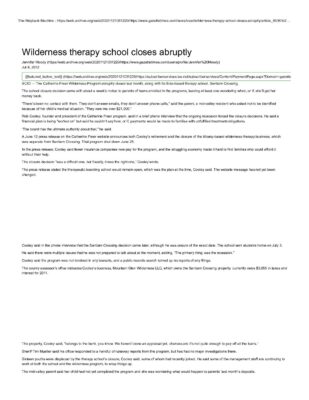
On June 12, 2012, Cooley announced his retirement and the closing of the wilderness program, which shut on June 25.source 1, source 2 His press release blamed insurers that had stopped paying, and the lingering recession.source 1, source 2 "The decision to close the company when I retired was a difficult one, but fiscally it was the right one," he wrote.source The release said Santiam Crossing would stay open, but the school sent its 16 students home on July 3 after about a week's notice.source 1, source 2 "They owe me over $21,000," one parent told the Corvallis Gazette-Times.source By July 2012 both programs were closed, and Cooley could not say how, or if, families with unfinished treatment would be repaid.source
Also drawn on: strugglingteens.com, "Catherine Freer Student Collapses and Dies".
Survivor testimony
What people who lived or worked here say happened. Survivors' own words are published with their permission or quoted from where they published them, with only the spelling and punctuation fixed; forum accounts are what was posted publicly and are reported as claims, not findings.
We had been advised by Freer not to tell Erica we were placing her until our arrival for the family meeting that would begin the trek. Of all the many profound and tormenting regrets we have about our terrible decision, agreeing to deceive Erica is one of the worst. When we told her why we were there, she was shocked, angry and scared. We will be haunted as long as we live by Erica's cry of "Please, Daddy, don't make me go."
The worst part of it all was the initial kidnapping on December 13 2003. Then I did two treks in the Cascade mountains where I almost froze to death. Out there at the end everyone spent the last four days completely alone.
When I got there, they strip searched me and took my stuff. … We were hiking to some place in the dark in the Oregon mountains in January. I stopped and told them this was bullshit. They said I was free to walk away assuming I would be scared to. I unhooked the sled and started to walk away. They tackled me and made me put the sled back on and keep marching. I remember being really cold all the time.
I went through this program 13 years ago and I would never in a million years send my kids here. A peer of mine who also was in the program fractured her ankle the 3 rd day on the trip and the camp counselors yelled at her to keep moving. They rigged her ankle up an forced her to complete the uphill hiking for the next 18 days. I would say we were near death on 2 different occasions because our instructors got lost and we ended up at the bottom of a treacherous ravine, having to climb almost straight uphill about 200 feet with heavy packs on our backs. … This program is not safe.
I was sent here in 04, a week before Summer Break. Ended getting held over because I focused too much on wanting to go home during my solo. This place was terrible! There was no actual therapy, just hunger and hiking. … Catherine Freer was by far the worst and the program I got the least out of. Fear is a great short-term motivator, but does not work when trying to get the changes to last.
Thank god this placed closed, money scheme to the fullest. Their business model is getting thousands of dollars from parents to take their kids on a 3 week starved/forced hike. Then afterwards they tell every parent their kids need more help and tell you to send them to boarding schools, in which they will get a kick back for the refferal. I wasn't eating and throwing up for 5 days from the stress and they still kept me marching on.
Reported on survivor forums
Timeline
From the records: who ran it and the deals that moved it, its names, and the deaths, incidents, inspection findings, lawsuits and news stories on file. Point at an event, or tap "More about this", for the details.
1988
Opened in Albany, Oregon
2002
Death
On May 27, 2002 a 15-year-old girl died on her first full day at the Nevada program after collapsing while hiking; the cause was heatstroke and dehydration...
Death May 27, 2002
On May 27, 2002 a 15-year-old girl died on her first full day at the Nevada program after collapsing while hiking; the cause was heatstroke and dehydration, and her parents filed a lawsuit that was settled for an undisclosed amount.
Also on record (2002): A 15-year-old died of dehydration and heat-stroke in 2002 at the Catherine Freer Wilderness Program.
Also on record (October 20, 2002): A 15-year-old girl died in October 2002 at the program, reportedly from a previously undetected heart condition.
Lawsuit
The parents of a girl who died in 2002 sued the program; the case was settled for an undisclosed amount.
Lawsuit
Incident
ABC Primetime featured Catherine Freer on May 23, 2002; four days later a participant died in the program.
Incident May 2002
2003
Death
On March 26, 2003 a 16-year-old participant was killed in his sleep when a tree branch fell on him.
Death March 26, 2003
2005
Injury
In 2005 an 18-year-old participant suffered a severe head injury after slipping and hitting his head on a log during a hike in the Willamette National Forest and later recovered.
Injury
2012
Closed
News coverage
-
Obsidian Trails settles wrongful death lawsuit
The mother of a 15-year-old boy who died in 2000 while enrolled at Obsidian Trails Outdoor Program has reached a settlement in her wrongful death lawsuit. Court documents from the case cited physical restraint and blunt force trauma as causes of death, prompting renewed discussions regarding state oversight and licensing for wilderness therapy programs.
-
Seen 'n Heard, 5/2001
This industry news compilation from May 2001 reports on staff appointments, curriculum development, book awards, and legislative updates across various emotional growth schools and wilderness programs. Notable updates include progress on Oregon state regulations for outdoor treatment programs and personnel changes at several residential facilities.
-
Seen 'n Heard, 1/2000 - Short news clips about Special Schools & Programs
The January 2000 issue of Seen 'n Heard provides brief updates on several specialty education programs, including a risk‑assessment comparison of wilderness therapy, an upcoming Small Boarding Schools Association conference, corrections to earlier listings, and plans for new group‑home and facility expansions. The items are presented as factual notices without editorial commentary.

2 articles that mention it in passing
-
New Efforts to Crack Down on Residential Programs for Troubled Teens
Federal lawmakers introduced the Stop Child Abuse in Residential Programs for Teens Act of 2011 to regulate residential facilities and prohibit abusive practices, physical deprivation, and unauthorized restraints. The legislation follows Government Accountability Office findings documenting widespread allegations of abuse and multiple deaths at such programs. Industry groups and political opponents have expressed opposition to federal regulatory oversight, favoring state-level authority instead.
-
Seen and Heard - October 2001
This industry newsletter compilation details various administrative updates, staff appointments, program expansions, and leadership changes across multiple therapeutic boarding schools, wilderness programs, and youth residential facilities for October 2001. Notices include new program accreditations, facility curriculum updates, and personnel transitions within the troubled teen industry.
Staff
Administration
-
Rob Cooley
Former Founder and Executive Director (2006-2012)source
Elsewhere in the industry
- a Clinician Intern at the Children's Crisis Treatment Center in Philadelphia from 2004 until 2005
- Outdoor Behavioral Healthcare Industry Council
-
Paul Smith
Former Program Director (2010)source
Elsewhere in the industry
- Arbinger Institute Managing director
- Anasazi Foundation Board Secretary
- Copper Hills Youth Center Therapist
-
Rob Koning
Former Executive Director (2012)source
Elsewhere in the industry
- New Vision Wilderness Therapy Former Executive Director (2012)
-
Kirk Shimeall
Former Program Director, Wilderness Directorsource
Notable staff
-
Julia Andrick
Former Marketing Communications Director, Media Contact (2006-2009)source
Elsewhere in the industry
- Santiam Crossing Marketing Communications Director, Admissions Director, 2007-2012
- Boulder Creek Academy Director of Outreach and Marketing
- Trails Carolina Admissions and Outreach Director
- Northwest Academy Director of Admissions, 2018
-
Kevin Riley
Former Clinical Director, Coordinating Therapist (2007-2009)source
Elsewhere in the industry
- Santiam Crossing Clinical Director, 2008
-
Will Twombly
Former Staffsource
Elsewhere in the industry
- Three Rivers Montana Therapist, 2006
- True North Wilderness Program Parent Therapist, 2012
-
Adam Goddard
Former Coordinating Therapistsource
Elsewhere in the industry
- Pinnacle Point Hospital Staff
- Capstone Treatment Center Former Staff
-
Adrienne Tauses
Former Wilderness Therapistsource
Elsewhere in the industry
- P.A.C.E. center for girls Staff
-
Brian J. Bulemore
Former Supervising Therapist (2001)source
Elsewhere in the industry
- NorthStar Center Clinical Director, 2006-2020
-
Chris Kaiser
Former Staffsource
Elsewhere in the industry
- Pacific Quest Co-Founder and Co-Owner, 2004-2021
- SUWS Idaho Field guide
- a field guide for several unnamed programs in Idaho
-
Danielle Andrews
Former Lead Field Guidesource
Elsewhere in the industry
- Brighton Center’s Homeward Bound Shelter Staff
- Four Circles Recovery Center Therapist, Counselor, 2020
- Magnolia Mill School Therapist, Executive Director
- Solstice West Staff, 2015
-
Jeff Brand
Former Wilderness Guidesource
Elsewhere in the industry
- Outpost Program Staff
-
Mike Ervin
Former Referral Agentsource
Elsewhere in the industry
- Aspen Education Group Eastern Regional Director of Admissions (Outdoor Division), 2008
- Lone Star Expeditions Executive Director
- Cherry Gulch Owner, Admissions Director (2007)
- SUWS of the Carolinas admissions director
-
Sarah Mack
Former Marketing Directorsource
Elsewhere in the industry
- Explorations Montana Director of Development
- Skelton, Thomason and Associates Partner, Parent Coach and Director of Business Development
- Oregon Transition Homes Founder
- Parent Coach Professionals Associate
-
Sebastiaan Zuidweg
Former Wilderness Therapist, Lead Therapistsource
Elsewhere in the industry
- Open Sky Wilderness Therapy Clinical Director
-
Kaysie Dannemiller
Former Wilderness Guidesource
Elsewhere in the industry
- Rite of Passage, Inc Guide, 2010
- Ascent Inc. Therapist, 2021
- Ascent Wilderness Program Therapist
- Mount Bachelor Academy Phase III Staff
- Phoenix Outdoor Staff
-
Kimberly Van Lanen
Former Field Therapistsource
Elsewhere in the industry
- Carlbrook School Advisor
- Blackwater Outdoor Experiences Field Therapist
- Pressley Ridge School Counselor
37 more staff with no other connections on record
-
Amy Cirincione
Former Clinical Director, Field Therapist / Coordinating Therapist (2009)source
-
Katherine Eastlake
Former Clinical Director (2011)source
-
Adam Drummer
Former Field Guidesource
-
Allan Capp
Former Field Guidesource
-
Allison Sullivan
Former Wilderness Therapistsource
-
Averyl Growden
Former Wilderness Therapistsource
-
Becky Austin
Former Supervising Therapist (1996)source
-
Ben Poynter
Former Wilderness Guidesource
-
Brian Reardon
Former Wilderness Guidesource
-
Brook Jackson
Former Wilderness Guidesource
-
Chris Hoskins
Former Field Guidesource
-
Chris Rahm
Former Coordinating Therapistsource
-
David Neiss
Former Wilderness Therapistsource
-
Gene Vey
Former Supervising Therapist (2001)source
-
Jeff Peyton
Former Coordinating Therapistsource
-
Jon O'Connor
Former Adventure Activities Trainersource
-
Josh Garner
Former Wilderness Guidesource
-
Kraig Mead
Former Wilderness Therapistsource
-
Liz Feldman
Former Asst. Wilderness Managersource
-
Lonnie Drouhard
Former HR Directorsource
-
Maria Deshazer
Former Wilderness Therapistsource
-
Mark Allee
Former Wilderness Guidesource
-
Mark Andrews
Former Wilderness Guidesource
-
Marlies Luepges
Former Wilderness Guidesource
-
Melissa Proctor
Former Wilderness Therapistsource
-
Michelle Bachand
Former Wilderness Therapistsource
-
Molly DePasqual
Former Wilderness Guidesource
-
Natala Larson
Former Admissions Directorsource
-
Quinn Hoffman
Former Field Guidesource
-
Rachelle Perez
Former Wilderness Guidesource
-
Ryan Demarest
Former Field Guidesource
-
Sabrina Hadeed
Former Wilderness Therapistsource
-
Sonja Micocci
Former Wilderness Therapistsource
-
Tanya Sue Kramer
Former Program Managersource
-
Todd Embree
Former Wilderness Therapistsource
-
Travis Moles
Former Field Guidesource
-
Wren Anderson
Former Wilderness Therapistsource
Rules and practices
Practices
- Restraint
- Seclusion or isolation
- Strip searches
- Confrontation groups
- Limits on contact with family
Connections on the network map
The companies, people and programs our research map ties to this program. Open it on the network map.
Ownership
Documents
Woodbury Reports Mentions (2)


-
 Branch Kills Teen Camper (Register-Guard, 2003-03-28, Wayback Copy)
-
 Wilderness Therapy School Closes Abruptly (Gazette-Times, Wayback Copy)
-
 Catherine Freer's Wilderness Therapy Expedition, Enrollment Information Packet (Heal Copy, Wayback 2017-04-07) Enrollment document
-
 Teen Dies On Wilderness Trek Run By Oregon-Based Camp (The Oregonian, 2002-06-21, Wayback Copy)
From the Unsilenced archive
37 documents about Catherine Freer Wilderness Program that Unsilenced collected and Kids Over Profits does not hold a copy of. They open on Unsilenced's Google Drive. Their whole folder: Catherine Freer Wilderness.
Documents
- 1-2006.pdf
- 10-2006.pdf
- Additional Links for Catherine Freer Wilderness.xlsx
- All Girls Flyer 2012.pdf
- All_Girls_Flyer_2011.pdf
- application.PDF
- application_packet (1).pdf
- application_packet (2).pdf
- application_packet.pdf
- Catherine Freer Closure Press Release.png
- Catherine Freer Death Press Release.png
- Catherine Freer Enrollment Information Packet(1).pdf
- Catherine Freer Enrollment Information Packet.pdf
- CFREERanInspirationalFriend.pdf
- Freer Release.pdf
- Girls_Summer_Expedition_06.pdf
- Girls_Summer_Expedition_07.pdf
- InformationRelease.pdf
- Nevada Secretary of State Information(1).pdf
- Nevada Secretary of State Information.pdf
- newsreleasefinal2.doc
- Oregon Secretary of State Information.pdf
- Oregon Secretary of State Information 2(1).pdf
- Oregon Secretary of State Information 2.pdf
- Oregon Secretary of State Information.pdf
- OTH_Application.pdf
- parent_packet (1).pdf
- parent_packet (2).pdf
- parent_packet (3).PDF
- parent_packet.pdf
- parent_packet_2004_8-12.pdf
- PS from Catherine Freer, Bridges Boys Academy, Provo Canyon School.pdf
- Struggling Teens Marketing January 2008.pdf
- Sutton EMT Audio-audio.wav
- Technology _ Accounting Partners - Proficio.pdf
- TheOriginalHardWoman.pdf
- TheWaytheWindBlows.pdf
From SCIAD NET
8 documents about Catherine Freer Wilderness Program that Kids Over Profits does not hold a copy of. SCIAD NET keeps them on Google Drive, where they open.
- Parent Information Packet 2004
- Catherine Freer News - Winter 2005
- Catherine Freer News - Fall 2006
- FREER CELEBRATING 25 YEARS OF SERVING TROUBLED TEENS; RETIREMENT OF FOUNDER ROB COOLEY; AND ANNOUNCING THE COMPANY’S CLOSURE
- Catherine Freer: An Inspiration and Friend
- Enrollment Information Packet (1)
- Enrollment Information Packet (2)
- Oregon Transition Homes Application and Packet Information
Wiki entries
We have questions about Catherine Freer Wilderness Program
If you were there, worked there or sent your child there, you can help fill in what our records are missing. Each question takes a moment; skip anything you do not know.
Materials and links
External links
A program's own website is linked as an archived snapshot, so the page reads as it did when it was captured.
Staff listing or directory
Advertising and marketing listings
Reference and research
Other links
- Catherine Freer Information (archived copy)
- Catherine Freer Parent Packet
- Catherine Freer Wilderness Program Website Homepage
- Catherine Freer Application Information Packet
- Catherine Freer: An Inspiration and Friend - By Robert Cooley
- Secret Prisons for Teens- Catherine Freer
- article (archived copy)